A member of Serbia’s media regulator says its governing council never approved a statement accusing two television channels of breaching election-silence rules, raising questions about regulatory authority and transparency ahead of Sunday’s parliamentary vote.
Serbia’s Regulatory Authority for Electronic Media (REM) is facing an internal dispute over an official-looking statement concerning alleged election-silence violations by television channels N1 and Nova S.
The controversy emerged on Friday, October 23, just two days before Serbia’s parliamentary election on October 25.
REM announced that its monitoring staff had identified broadcasts potentially violating restrictions on political campaigning during the legally mandated election-silence period.
However, REM Council member Rodoljub Šabić publicly challenged the statement’s authority, saying that the regulator’s governing council had neither considered nor approved the matter.
The dispute raises a question extending beyond the two broadcasters: who is authorised to act in the regulator’s name during the final hours of an election campaign?
What did REM allege?
According to the statement reported by Serbian media, REM’s professional monitoring service identified several television segments broadcast on October 23.
For Nova S, the regulator cited material aired between 07:53 and 07:55 and between 08:02 and 08:18 during its morning programme Probudi se.
For N1, the cited segments aired between 08:03 and 08:04 and between 08:21 and 08:22.
REM said the broadcasters’ editors had been informed of the disputed content and reminded of their obligations under election-silence regulations.
The published account did not provide a detailed legal explanation of why each segment amounted to prohibited electoral campaigning.
According to N1’s reporting, one disputed segment concerned threats directed at journalists Milan Radonjić and Vuk Cvijić following an investigative report involving allegations about former President Aleksandar Vučić and associates of an accused drug trafficker.
Those allegations have not been independently established by Votendi. Whether reporting on that subject breached election-silence rules is a separate legal question.
REM Council member challenges the document
Rodoljub Šabić, one of the council’s independent members, disputed the validity of the statement.
He said the council had never considered the document and that four independent council members were not informed about it.
Šabić also said a planned council meeting had failed to take place because four members refused to participate in a session proposed by REM President Stevica Smederevac without public attendance.
Without their participation, he said, the council lacked a quorum.
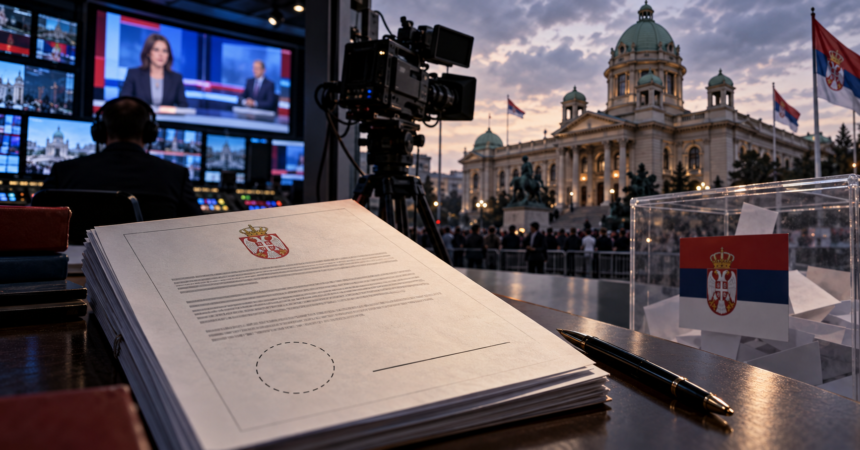
In comments reported by the newspaper Danas, Šabić questioned how a document he described as lacking a signature and official seal could have been issued in the regulator’s name.
He also called for clarification of whether REM staff had the authority to take measures against broadcasters without a council decision.
Šabić suggested the circumstances could warrant examination by criminal investigators.
That suggestion is an allegation concerning the regulator’s procedures, not a finding that any criminal offence occurred.
Why the distinction between staff warnings and council decisions matters
The central issue is not simply whether the broadcasters complied with election law.
There are two separate questions.
First, did N1 and Nova S broadcast material legally prohibited during the election-silence period?
Second, was the communication issued in REM’s name properly authorised, and did it amount to an administrative warning, a formal council decision or another form of regulatory action?
Those questions require different evidence.
Determining a broadcasting violation would require examination of the relevant recordings, legal provisions and applicable procedures.
Determining the statement’s authority would require identifying its author, the approval process and any official decision authorising its release.
An internal disagreement over the document does not, by itself, establish that the broadcasters complied with the law. Equally, an allegation of non-compliance does not automatically establish that a legally enforceable sanction was imposed.
A wider dispute over media oversight
The controversy comes amid broader questions about media regulation during Serbia’s election campaign.
Earlier in October, reporting on the OSCE Office for Democratic Institutions and Human Rights (ODIHR) interim election-observation findings highlighted concerns about political and economic pressure on media organisations, editorial independence and unequal campaign coverage.
A separate analysis by the Serbian publication Radar questioned REM’s broadcaster-monitoring selection and highlighted differences between the regulator’s quantitative monitoring approach and ODIHR’s broader assessment of electoral fairness.
Šabić has also criticised earlier REM Council decisions involving the television channel Informer. Those criticisms remain his account of disputed regulatory proceedings.
The institutional disagreement matters because election monitoring depends not only on consistent rules but also on procedures that broadcasters and the public can examine and challenge.
Election silence began on October 23
Serbia’s election-silence period began at midnight on Friday, October 23, and is scheduled to end when polling stations close at 20:00 local time on Sunday, October 25.
During that period, restrictions cover the promotion of candidates and electoral programmes, appeals to vote for or against electoral lists, and publication of election-result estimates before polls close.
The restrictions do not automatically answer whether every item of political journalism is prohibited. The character and context of the specific broadcast remain important.
Eighteen electoral lists are contesting 250 seats in Serbia’s National Assembly.
What remains unanswered?
The controversy leaves several factual questions requiring clarification from REM:
- Who prepared and authorised the October 23 statement?
- Was the document intended as a staff notification or as a formal decision of the regulator?
- Was any sanction imposed, or were editors merely notified of alleged breaches?
- Which legal provisions and specific broadcast content formed the basis of the allegations?
- Will REM publish the relevant authorisation and any supporting council records?
These questions are important regardless of the political positions of the broadcasters or the electoral parties they cover.
As Serbia prepares to vote, transparent enforcement of broadcasting regulations remains part of the broader framework for public confidence in the electoral process.
Votendi will follow developments through its Serbia Parliamentary Election 2026 hub.
Sources
- Danas — Šabić disputes REM Council involvement
- N1 — REM member challenges the disputed statement
- FoNet — Questions over the REM document
- N1 — Serbia’s election-silence period
- Nova.rs — ODIHR interim report on media conditions
Reporting and analysis prepared October 24, 2026. The allegations and disputed institutional procedures described above should not be interpreted as established legal violations.