
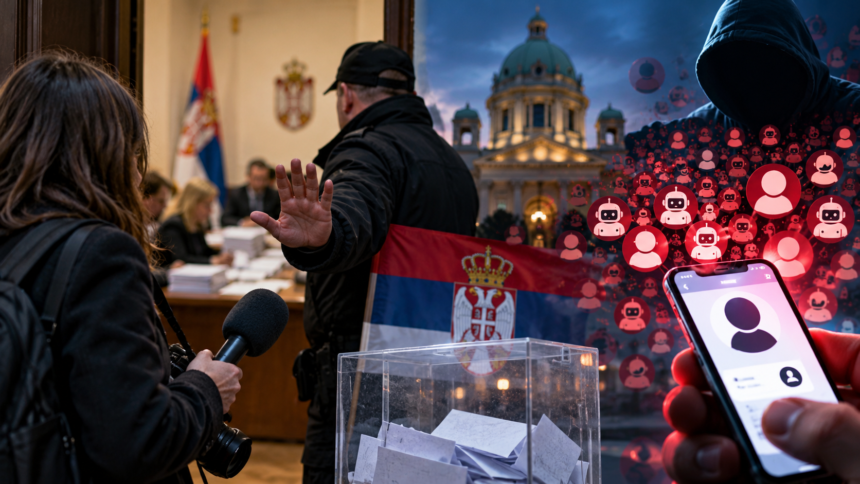
One day before Serbia’s parliamentary election, journalists’ organizations are demanding action over restrictions on access to local election commissions, while independent news outlet Nova.rs reports an influx of approximately 15,000 suspicious Instagram followers in just 30 minutes. The incidents raise new questions about media access, digital interference and election transparency.
BELGRADE, October 24, 2026 — Serbia’s final day before its early parliamentary election has been marked by two developments affecting independent journalism: reported restrictions on reporters covering local election commissions and a suspected coordinated bot attack targeting Nova.rs on Instagram.
As voters prepare to cast their ballots on Sunday, October 25, both incidents highlight how important access to reliable information becomes during the final stages of an electoral process.
Journalists report being denied access to election commissions
Journalists’ organizations represented in Serbia’s Permanent Working Group for the Safety of Journalists have called on the Republic Electoral Commission (RIK) to intervene following reports that journalists were prevented from covering local election commission activities in Pančevo and Vranje.
According to a statement carried by the Journalists’ Association of Serbia, journalists from Panpress and Pančevo Si Ti encountered difficulties accessing the Pančevo City Election Commission after seeking permission to attend.
Nenad Živković of Pančevo Si Ti was reportedly told by security personnel to leave the city administration building. Separately, Mihajlo Stojković of InfoVranjske was reportedly escorted out of the building housing the election commission in Vranje, where the explanation concerned accreditation from the national electoral authority.
Journalists’ organizations say local election commission work should be open to media scrutiny under applicable rules and have sought clarification from the national election commission. These accounts are allegations reported by the organizations; they do not in themselves establish that voting or counting has been compromised.
Nova.rs reports 15,000 suspicious followers in 30 minutes
A separate development emerged Saturday evening when independent news portal Nova.rs reported a new suspected bot attack against its official Instagram account.
According to the newsroom, around 15,000 new followers appeared within approximately half an hour, an increase it characterized as abnormal and potentially involving automated or inauthentic accounts.
Nova.rs said it had reported the activity to Meta, Instagram’s parent company, and warned that sudden spikes in suspicious activity can create problems for accounts targeted by third parties.
Such activity may interfere with a newsroom’s ability to reach readers through social networks, particularly if an account becomes subject to automated anti-spam restrictions. But it is not yet independently established who organized this reported influx, whether it had a political motive or whether the latest episode caused an account suspension.
Why the timing matters
The two reported episodes involve distinct but related aspects of journalistic access. One concerns the ability to observe electoral administration in person; the other concerns the digital channels through which news outlets distribute information.
Both become more important as voters seek reports on election procedures, turnout, possible irregularities and official results. Restrictions or disruptions can make independent verification harder even without proving any direct interference with the electoral outcome.
Reports of suspicious follower surges have affected a number of Serbian news and civil-society accounts in recent months, including earlier incidents discussed by the Association of Independent Electronic Media (ANEM). Similar incidents, however, should not be assumed to have a common organizer without evidence.
International observers will assess the election environment
The OSCE Office for Democratic Institutions and Human Rights (ODIHR) is observing the October 25 parliamentary election. Its mission is examining election administration, the campaign environment, media coverage and online activity, alongside other elements of the electoral process.
ODIHR and its international partners are scheduled to present preliminary findings on Monday, October 26. The observation mission has not, on the basis of these two reports alone, determined that the incidents amount to a systematic election violation.
What happens next?
Important questions remain: Will RIK clarify journalists’ access to local commissions? Will local reporters be able to attend subsequent proceedings? Can Meta identify and address suspicious activity against the Nova.rs account without affecting the newsroom’s own publishing access?
For voters, the larger issue is whether information about the election can be collected and distributed freely, transparently and in time to allow scrutiny of official claims.
Votendi will follow polling-day developments and official results as they become available. For related context, read our report on questions surrounding a media regulator warning involving N1 and Nova.