
Spain’s general election campaign began on Friday, 13 November, with two prominent surveys pointing to very different standings between the country’s main parties. A 40dB poll published for El País and Cadena SER puts the conservative People’s Party (PP) 2.1 percentage points ahead of the Socialist Party (PSOE). A large pre-election study from the public polling institute CIS, released the previous day, instead gives PSOE a 7.8-point advantage.
The difference between the two surveys’ estimated PP–PSOE margins is 9.9 percentage points. Both are snapshots produced under different conditions, not election results. Voters will elect a new Congress of Deputies on 29 November 2026.
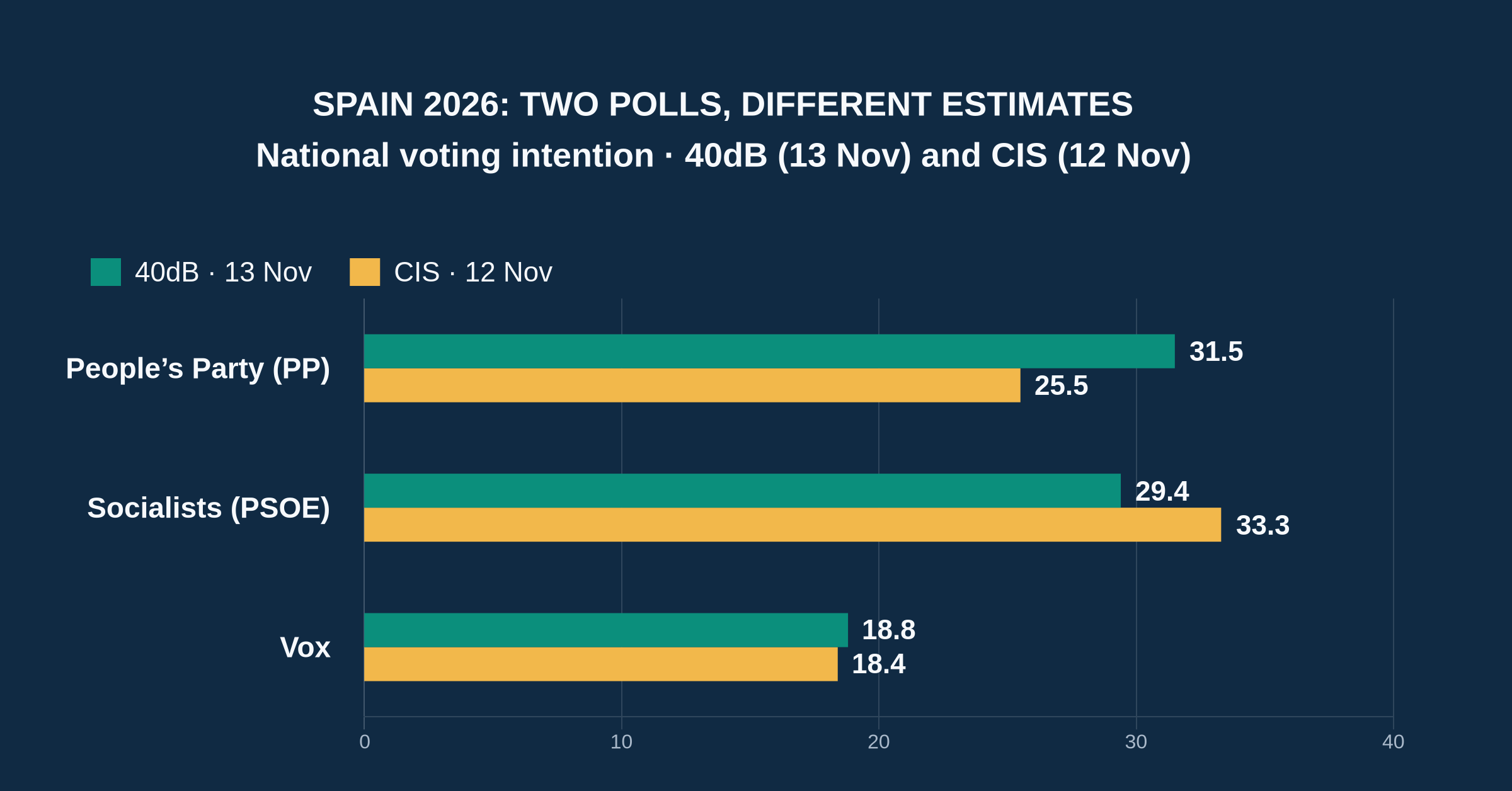
40dB versus CIS: the headline figures
| Party | 40dB · 13 Nov | CIS · 12 Nov |
|---|---|---|
| PP | 31.5% | 25.5% |
| PSOE | 29.4% | 33.3% |
| Vox | 18.8% | 18.4% |
40dB: 1,000 online interviews, 10–12 November. CIS study 3584: 45,074 telephone interviews, 7–30 October. Figures are pollsters’ own vote estimates; the samples were not interviewed over the same period.
The biggest difference concerns the two largest parties. 40dB estimates support for the PP six percentage points higher than CIS, while its PSOE figure is 3.9 points lower. Vox’s national estimate, by contrast, is similar in the two studies: 18.8% and 18.4%.
The 40dB survey was reported by Cadena SER on 13 November. The CIS findings, from pre-election study 3584, were reported by RTVE on 12 November.
Different numbers, different parliamentary projections
National vote share is not the same as a parliamentary seat count. Spain elects 350 deputies in geographically defined constituencies, and 176 seats constitute an absolute majority. The allocation depends on where votes are cast, not merely the national totals.
In the 40dB projection reported by Cadena SER, the PP–Vox bloc, including the PP’s alliance with UPN in Navarre, reaches approximately 192 seats, above the 176-seat threshold.
The CIS projection instead places the PP at 98–106 seats and Vox at 57–65. Adding the published endpoints gives 155–171 seats for the two parties, below the majority threshold. Those endpoints are a simple comparison of reported intervals, not a joint probability forecast. CIS estimates PSOE at 134–143 seats.
These are two organisations’ models, not two possible certified outcomes. They should not be treated as election-night results or as probabilities of either coalition taking office.
Why are the surveys so far apart?
Fieldwork dates matter. CIS interviewed voters between 7 and 30 October, whereas the new 40dB snapshot is based on interviews collected from 10 to 12 November. They therefore capture sentiment during different phases of the pre-election period. The more recent survey is not automatically more accurate, but it is measuring a different moment.
Survey mode and sample design differ. CIS used a large telephone survey of 45,074 respondents; 40dB conducted 1,000 online interviews. A larger sample can reduce sampling uncertainty, but it does not, on its own, remove differences caused by recruitment, non-response, weighting, turnout assumptions or the model used to turn answers into a vote estimate.
Published figures are estimates, not raw answers. Pollsters can apply different adjustments for undecided respondents, previous voting behaviour and expected participation. Their treatment of regional candidacies and electoral alliances may also affect seat calculations. Without a common reanalysis of comparable microdata, it would be unjustified to attribute the 9.9-point gap to any one methodological choice—or to declare one poll definitively correct.
The contrast is especially important because Vox is measured at almost the same level by both organisations. The disagreement is concentrated in how support for the PP and PSOE is estimated, rather than in a uniform difference across all parties.
What to watch between now and 29 November
The first daily 40dB tracking release opens a series intended to follow campaign movements. The most informative comparison will be how results change within the same polling series, using fieldwork dates and methodological details, rather than treating every new figure from a different pollster as a direct swing.
There is also a legal limit to the publication of new polls. Under Spain’s electoral law (LOREG, Article 69.7), publication and dissemination of election polls are prohibited during the five days preceding voting: 24–28 November for this election. The official campaign began on 13 November and ends on 27 November, according to Royal Decree 806/2026.
Votendi’s Spain 2026 polling tracker lists individual surveys and fieldwork dates alongside its aggregate series. The underlying polls—including 40dB and CIS—can be inspected separately rather than compressing their differences into one headline number. Our polling average is a descriptive aggregation based on the surveys included in its calculation, not an independent forecast of the final result.
Sources: Cadena SER / 40dB (13 November); RTVE / CIS study 3584 (12 November); BOE election decree; LOREG.