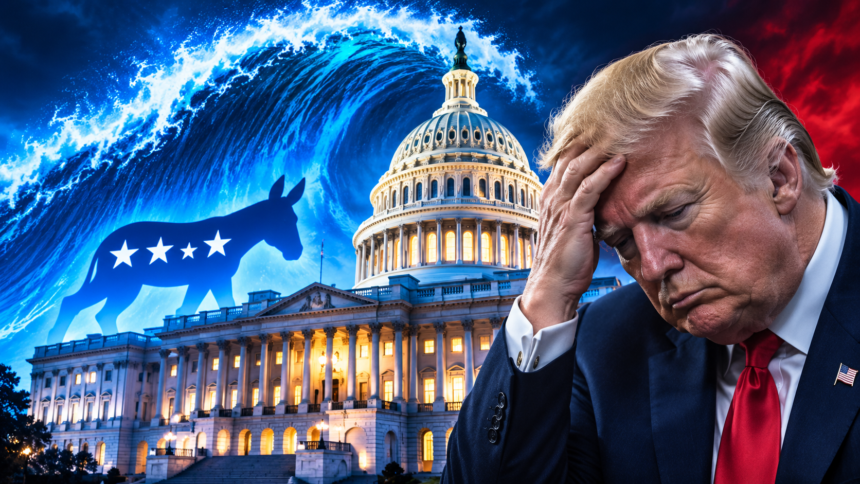
Donald Trump is facing the most serious electoral setback of his second presidency after Democrats secured projections for control of both chambers of Congress. As Republican Senate seats fell across the country, the president attacked Fox News, insulted one of its commentators and insisted his party would have won overwhelmingly if he had personally been on the ballot.
- “If I Had Been on the Ballot, We Would Have Won in a Landslide!”
- Trump Turns His Anger on Fox News
- Personal Attack on Jessica Tarlov
- Democrats Break Through in Republican Territory
- Democrats Secure Senate Majority as House Also Flips
- Trump’s Next Weapon: “Mr. Veto”
- A Contradictory Message: Trump Also Offers to Work With Democrats
- The Political Reckoning Facing Trump
- A Democratic Congress Could Investigate the White House
- An Electoral Catastrophe With Consequences Beyond 2026
November 4, 2026 | Votendi Political Analysis
Donald Trump’s Republican Party has suffered an electoral catastrophe in the 2026 midterms, losing its grip on Congress after a wave of Democratic victories in states previously considered Republican strongholds.
Instead of a routine midterm setback, the election has produced a sweeping reversal of congressional power.
Decision Desk HQ has projected Democratic control of both the Senate and the House of Representatives, dealing a major blow to Trump’s ability to govern during the final two years of his presidency.
And the president’s response has been revealing.
As the results began turning against Republicans, Trump unleashed a series of attacks on Fox News, dismissed the network’s polling, personally insulted a television commentator and suggested the outcome would have been dramatically different if his own name had appeared on the ballot.
His reactions reflected a striking contrast between the scale of Republican losses and his insistence that his own political standing remained strong.
“If I Had Been on the Ballot, We Would Have Won in a Landslide!”
As the scale of the Republican losses became clearer, Trump offered his own explanation for the outcome.
On Truth Social, the president declared:
“I wasn’t on the Ballot and if I was, we would have won IN A LANDSLIDE!”
The statement represented a remarkable attempt to separate Trump’s personal political standing from the performance of Republican candidates.
For weeks, the president had campaigned for his party and encouraged voters to support Republicans as an endorsement of his administration.
Yet when the results began pointing toward major Republican losses, Trump emphasized that he had not personally been a candidate.
The contradiction is politically significant.
Trump had made himself a central figure in the midterm campaign, appearing at rallies and endorsing candidates in competitive races.
His political involvement was particularly visible in states such as Texas, where Trump-backed Republican Ken Paxton lost the Senate race to Democrat James Talarico.
The president’s claim that his own presence on the ballot would have produced a landslide is hypothetical and cannot be verified from the election results.
What can be established is that Republican candidates suffered substantial losses despite Trump’s campaigning.
Trump Turns His Anger on Fox News
Even before the full scale of the Democratic victories became apparent, Trump was directing his frustration toward a familiar target: Fox News.
The president repeatedly attacked the conservative-leaning television network on Truth Social as election coverage unfolded.
He accused Fox of unfair polling, giving excessive airtime to Democrats and treating his administration negatively.
In one post, Trump described Fox News polling as deeply biased and characterized its questions as attacks on him.
He also claimed the network’s ratings had fallen by 27%, attributing the alleged decline to its coverage of Democrats.
The president provided no independently verifiable evidence establishing that particular ratings decline or its cause.
Trump’s comments highlighted a growing tension between the White House and a television network long associated with conservative political audiences.
Rather than focusing exclusively on the developing election results, the president publicly challenged the credibility of the coverage itself.
Personal Attack on Jessica Tarlov
Trump’s criticism became particularly personal when he targeted Fox News commentator Jessica Tarlov.
While watching the network’s election coverage, the president called Tarlov “DUMB AS A ROCK” and complained about hearing her on television.
He said he would change channels until she was no longer on the air.
Tarlov, a Democratic commentator on Fox’s The Five, had discussed economic conditions, including high gasoline prices.
She subsequently responded publicly, suggesting that the president was reacting negatively to uncomfortable economic information.
The exchange illustrated a recurring feature of Trump’s relationship with the media: personal attacks on commentators whose assessments he disputes.
In this case, the confrontation unfolded while Republicans were experiencing substantial electoral losses.
Democrats Break Through in Republican Territory
The election results themselves provide the strongest explanation for the political upheaval.
Democrats captured Republican-held Senate seats in North Carolina, South Carolina, Texas, Kansas, Ohio and Iowa, according to Decision Desk HQ’s election-night projections.
The victories represent a significant geographical expansion of Democratic success.
In Texas, James Talarico defeated Republican Ken Paxton, delivering a Democratic Senate victory in a state Republicans have dominated for decades.
In South Carolina, Annie Andrews secured another notable Democratic breakthrough.
In North Carolina, former Governor Roy Cooper defeated Republican Michael Whatley.
Kansas also produced a Democratic victory, with Adam Hamilton defeating Republican Roger Marshall.
Additional Democratic gains followed in Ohio, where Sherrod Brown defeated Jon Husted, and Iowa, where Josh Turek won the open Senate seat.
The results were particularly damaging for Republicans because they were not confined to a handful of traditionally competitive states.
They extended into territory where the party had expected to remain competitive or retain its advantage.
Democrats Secure Senate Majority as House Also Flips
DDHQ projected Democratic control of the House at 03:09 Central European Time on November 4.
The organization subsequently projected Democratic control of the Senate at 05:19 CET.
In the latest checked Senate count, Democrats had reached 51 projected seats, compared with 40 for Republicans, with nine races still outstanding.
In the House, the latest checked DDHQ figures showed 211 seats called for Democrats and 119 for Republicans, while the remaining districts continued to be counted.
The distinction matters: the House’s final composition was still unresolved, even though DDHQ had projected the party that would control it.
The broader political conclusion, however, is clear within DDHQ’s projections.
Democrats are set to control both chambers of Congress, ending unified Republican congressional control during Trump’s second term.
The scale of the Republican losses gives the result significance beyond the usual midterm changes in party representation.
Trump’s Next Weapon: “Mr. Veto”
Even before the polls closed, Trump had begun outlining how he would confront a Democratic-controlled Congress.
In an interview with CBS News, the president emphasized his constitutional authority to reject legislation passed by Congress.
“I have the ultimate power — it’s called ‘veto,’” Trump said.
He also indicated that he was prepared to make extensive use of executive authority to continue advancing his agenda.
The remarks suggest that the White House could respond to Democratic congressional control through confrontation over legislation, federal spending and executive powers.
A presidential veto can block a bill unless two-thirds of both congressional chambers vote to override it.
With Democrats projected to hold ordinary majorities rather than two-thirds majorities, Trump would retain considerable power to prevent legislation from becoming law.
However, the strategy carries political risks.
A prolonged confrontation between the president and a Democratic Congress could produce legislative gridlock, contentious budget negotiations and potential government shutdowns.
A Contradictory Message: Trump Also Offers to Work With Democrats
Despite his attacks on Fox News and his warnings about presidential vetoes, Trump also adopted a more conciliatory tone in other conversations.
Speaking to The New York Times, he said he was willing to accept the election results and work with Democrats.
He subsequently indicated to Politico that he was interested in negotiating with Democratic leaders rather than spending the remainder of his presidency simply rejecting legislation.
The contrasting messages reveal two possible approaches to divided government.
One involves confrontation, vetoes and aggressive use of executive authority.
The other involves negotiations with congressional Democrats over legislation both sides might be prepared to support.
Which approach dominates would have substantial consequences for Washington over the next two years.
The Political Reckoning Facing Trump
Beyond the immediate loss of congressional power, the midterm results raise important questions about Trump’s influence over the Republican Party.
The president remains the party’s central political figure, but the defeats of Republican candidates he supported may intensify debate over campaign strategy, candidate selection and the administration’s public standing.
Economic concerns played a major role in the election.
Exit polling highlighted widespread dissatisfaction with living costs and the country’s direction, while voters also identified government accountability and corruption as important issues.
Trump’s administration has faced criticism over inflation, tariffs, immigration policy and the consequences of overseas conflict.
The extent to which individual policies influenced particular races will require closer analysis of voting patterns and election data.
Nevertheless, the election has created an immediate political challenge for the president and his allies.
A Democratic Congress Could Investigate the White House
One of the biggest consequences of the Republican losses is the potential expansion of congressional oversight.
Democratic control of the House and Senate would give opposition lawmakers committee leadership, investigative authority and significant influence over the federal legislative agenda.
Congressional committees could examine executive branch conduct, demand documents, summon witnesses and investigate government contracts and administrative decisions within their legal authority.
Democrats could also block or delay presidential nominees in the Senate.
The possibility of impeachment proceedings may return to the political debate, although removing a president would still require a two-thirds majority in the Senate.
These powers would fundamentally change the relationship between Congress and the White House.
Trump would retain the presidency, his veto and significant executive authority.
But he would face a legislature far less willing to support his agenda automatically.
An Electoral Catastrophe With Consequences Beyond 2026
For Trump, the political damage extends beyond the congressional seat count.
The 2026 midterms were widely viewed as a national judgment on the first two years of his second administration.
He campaigned extensively, endorsed candidates and encouraged voters to support Republicans.
The resulting losses therefore invite scrutiny of both the administration’s policies and the Republican Party’s electoral strategy.
Trump’s response has combined criticism of the media, claims about his personal popularity, warnings of presidential vetoes and indications that he may negotiate with the new congressional majority.
For Democrats, the results create an opportunity to exercise substantial influence over federal policy and oversight.
For Republicans, they raise difficult questions ahead of the 2028 presidential election.
And for the United States, they mark the beginning of a new period of divided government.
The most consequential fact of election night is not Trump’s attack on Fox News or his claim that he would have won personally. It is that voters have delivered Republican losses substantial enough for DDHQ to project Democratic control of both chambers of Congress.
Trump will remain in the White House.
But the Congress that emerges from the 2026 elections is set to be controlled by his political opponents.
That change will define the final two years of his presidency.
Editor’s note: Election results reflect the latest available Decision Desk HQ projections as of November 4, 2026. Final seat totals remain subject to outstanding counts and official certification. Trump’s social media criticism of Fox News began before all major election races were called.
Follow the latest election developments: Votendi — 2026 US Midterm Election Live Results
Sources: Axios — Trump’s response to the midterms, CBS News — Trump on his veto powers, Forbes — Trump’s attacks on Fox News, DDHQ Senate Results, DDHQ House Results.