


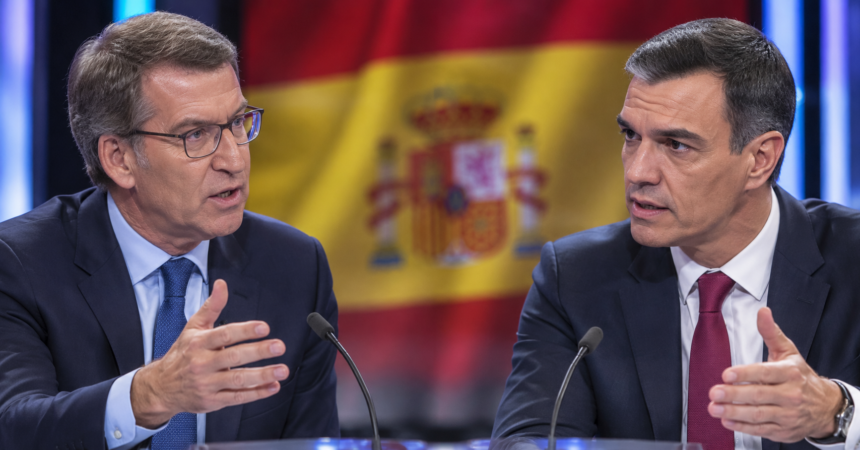
Spain’s first head-to-head election debate produced a clear difference in how viewers assessed the two main candidates — but not clear evidence of a shift in voting intentions. A flash survey published on Friday, 20 November, found that 45.2% of people who watched at least some of Thursday’s televised confrontation rated Alberto Núñez Feijóo, leader of the opposition People’s Party (PP), the stronger performer. Prime Minister Pedro Sánchez of the Socialist Party (PSOE) was chosen by 31.9%.
That is a 13.3-percentage-point gap in perceptions of the debate, not a 13.3-point lead in election support. Spain votes on Sunday, 29 November, and the question now is whether any post-debate movement appears in surveys conducted after the broadcast.
What the flash survey actually measured
Ateneo del Dato’s flash poll for elDiario.es put Feijóo at 45.2% and Sánchez at 31.9% among people who saw the debate in full or in part. A further 13.7% said neither was better and 6.2% considered them equally good.
| Who performed better? | Share of debate viewers |
|---|---|
| Alberto Núñez Feijóo (PP) | 45.2% |
| Pedro Sánchez (PSOE) | 31.9% |
| Neither | 13.7% |
| Both equally | 6.2% |
Source: Ateneo del Dato / elDiario.es, published 20 November 2026. Percentages reflect evaluations by debate viewers, not party vote shares. The remaining respondents did not fall into these reported categories.
The survey interviewed 1,146 Spanish adults online on 19–20 November, after the debate. Of those, 958 had watched it in full, in part or in clips. Ateneo del Dato reported a margin of error of approximately ±4.1 points for the viewer subgroup, using its stated weighting assumptions. As with other post-debate polling, the audience surveyed is not identical to the entire electorate.
Most respondents say the debate did not change their choice
The same survey found that 56% said the debate reinforced the vote they had already decided on, while 32% said it made no difference. Another 9% said they were reconsidering their choice and around 1% reported an intention to change it. These are respondents’ immediate assessments, not measured changes in actual votes.
The survey also shows why a headline verdict cannot be read as a universal consensus: 84.7% of PP voters preferred Feijóo’s performance, while 62.2% of PSOE voters preferred Sánchez. Among PSOE voters, 18.6% rated Feijóo higher. The proportions describe opinions within these surveyed groups, not changes of party allegiance.
What the election polls said before the debate
In a 40dB. daily tracking report for EL PAÍS and Cadena SER released on 20 November, the PP stood at 32.2%, the PSOE at 30.2% and Vox at 17.6% of estimated valid votes. The PP–PSOE gap was two percentage points.
Crucially, 40dB.’s interviews ran from 15 to 19 November and closed before Thursday night’s debate. Its figures must therefore be treated as a pre-debate baseline rather than evidence of the debate’s impact. Daily tracking waves overlap in their fieldwork and should not be counted as fully independent surveys.
The pollster’s published seat projection put the PP, the PP–UPN joint arrangement and Vox together at 192 of the Congress’s 350 seats, compared with the 176-seat threshold for an absolute majority. That is 40dB.’s modelled seat allocation, not an election result and not a Votendi forecast. National vote shares and seat projections answer different questions.
The debate was watched by millions — but winning viewers is not winning votes
The confrontation reached an average television audience of approximately 10.15 million people, according to figures reported by EFE.
An RTVE analysis of the debate found that housing, corruption and immigration dominated the exchanges. RTVE counted about 29 minutes of Feijóo’s 38 minutes of speaking time as criticism, while Sánchez allocated around 11 of his 37 minutes to defending his government’s record.
Those figures describe the encounter’s content and each candidate’s approach. They do not establish which proposals voters supported or how they will vote.
Votendi’s take: watch the next comparable poll
Three distinct measures are now circulating in Spain’s campaign: who viewers rated the better debater, which party respondents intend to vote for, and how a pollster converts that vote estimate into seats. They should not be merged into a single score.
The flash poll provides evidence of an immediate perception advantage for Feijóo among surveyed viewers. It does not demonstrate a corresponding increase in PP support.
The 20 November 40dB. tracking figures cannot settle that question because fieldwork was completed before the debate. The next comparable voting-intention survey with genuinely post-debate interviews will be the more useful test, with attention to sample dates and overlapping tracking panels.
Votendi will continue to distinguish individual polls from its aggregation and from published pollster seat projections. Follow the Spain 2026 election tracker for dated polls, sources and methodological details.
Sources and methodology
Debate evaluation: Ateneo del Dato / elDiario.es, 19–20 November fieldwork, 1,146 online interviews, 958 debate viewers.
Pre-debate national voting intentions: 40dB. tracking, day 8, 15–19 November, n=2,000.
Additional context: RTVE’s debate analysis and EFE’s television audience report.