
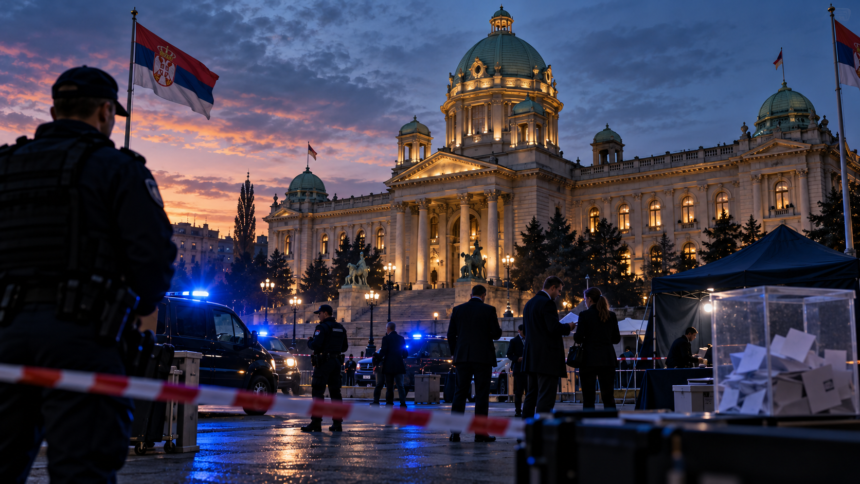
Serbian authorities arrested five people in Novi Sad on Wednesday, 21 October, over allegations that they were preparing violence on the day of the country’s parliamentary election. Separate police operations and complaints by student-linked activists have sharpened questions about public safety and political freedoms in the final four days before the vote.
According to a statement from Belgrade’s Higher Public Prosecutor’s Office, reported by Serbian media on Wednesday, police detained five suspects in Novi Sad in an investigation into an alleged plan for unrest and attacks on political opponents and officers on Sunday, 25 October 2026. The allegations have not been tested in court, and being arrested does not establish guilt. Blic reported the prosecutors’ statement and the five arrests.
What prosecutors say happened in Novi Sad
Authorities allege that the group intended to organise acts of violence around election day, including disturbances in Belgrade. State news agency Tanjug reported claims that a suspect was recruiting people and acquiring weapons or other materials, while early accounts referred to around 80 prospective participants. The figure of 80 is an allegation about possible recruitment, not the number of people confirmed arrested. Investigators’ descriptions of a potential plot are claims to be examined through the legal process, not independently verified findings.
The operation has been described as involving police, prosecutors and a special anti-terrorism unit. The available reporting does not independently establish whether those arrested were acting for any parliamentary electoral list, nor whether a proposed attack was operationally imminent. Tanjug’s account includes more detailed allegations, which remain attributed to its sources.
Separate searches and an arrest in Vrnjačka Banja
In a separate operation, Serbian broadcaster RTS, as reported by N1, said a man identified by initials M. A. was detained in Vrnjačka Banja following a search of property and vehicles, on suspicion of advocating a violent change to the constitutional order and planning to participate in disturbances on election day.
Local student-election representatives disputed the implications of that operation. Katarina Obradović, described by Serbian news site Nova.rs as a local coordinator of the Students’ List, said that campaign material was found and electronic devices were taken during the search. That is an account from a political participant, not an independently established inventory of seized evidence.
Nova.rs also reported a search concerning Srđan Ilić, associated with the civic group Beograd ostaje (Belgrade Remains). The group rejected media claims that he was organising violence and characterised the coverage as intimidating. Statements about Ilić and the Vrnjačka Banja operation concern separate individuals and proceedings; they should not be conflated with the five Novi Sad suspects or treated as proof of a common plan. See Nova.rs’s report and attributed responses.
Students had warned of arrests before Wednesday
The timing adds another dimension. On 18 October, three days before Wednesday’s operations, representatives of the student movement publicly claimed that their meetings were being monitored and warned of possible arrests ahead of a closing campaign rally. They rejected any suggestion that their organising involved illegal activity. N1 published the statement at the time. Read the students’ earlier statement as reported by N1.
That chronology is newsworthy, but a warning made before the arrests does not establish why police acted. Equally, the seriousness of an allegation of planned violence does not remove the need for evidence, due process or scrutiny of how security operations affect campaigning.
Why election monitors will be watching
The arrests arrive at a sensitive point in a fiercely contested campaign. International organisations have separately raised concerns about electoral conditions, polarisation and the ability of competing political groups to campaign on equal terms. The Parliamentary Assembly of the Council of Europe (PACE) is sending 20 parliamentary observers from 23–26 October, while OSCE/ODIHR has been conducting longer-term monitoring of the process.
The observers’ role is not to decide individual criminal cases. But the treatment of candidates, campaign volunteers, protesters, journalists and voters forms part of the wider environment in which the election takes place. After the vote, it will matter whether allegations of intimidation or violence are supported by documents, witness accounts, court filings or independent findings rather than political assertions alone. Votendi has already detailed the international observation arrangements and the Council of Europe’s earlier assessment of campaign conditions.
What is confirmed — and what is not
| Established by reporting | Not yet independently established |
|---|---|
| Five suspects were detained in a Novi Sad election-day violence investigation, according to prosecutors. | Whether the alleged plot would have been carried out, or the guilt of the suspects. |
| Separate searches and detentions were reported in other locations. | Whether those operations are all legally connected to the Novi Sad case. |
| Student representatives warned on 18 October that they expected police action. | Whether any operation was politically motivated or targeted lawful campaign activity. |
At publication time, the key outstanding questions include the precise evidence supporting each allegation, the procedural status of each detained person, whether defence counsel has responded, and whether prosecutors can substantiate alleged links between suspects and any political organisation. Those answers may change as proceedings develop.
Election context: Serbia votes on 25 October 2026. Votendi’s Serbia election hub tracks the contest, while our latest NSPM poll analysis explains the competing national vote-intention numbers. Polling and election-safety reporting should be treated as distinct forms of evidence.
Sources and editorial note
Reporting checked on 21 October 2026: Blic, quoting the Higher Public Prosecutor’s Office; Tanjug; N1 on the separate operation; Nova.rs on activists’ statements; and N1 on the 18 October student warning. This article attributes criminal allegations to investigators, opposing interpretations to their speakers and does not imply a finding of guilt or motive.