



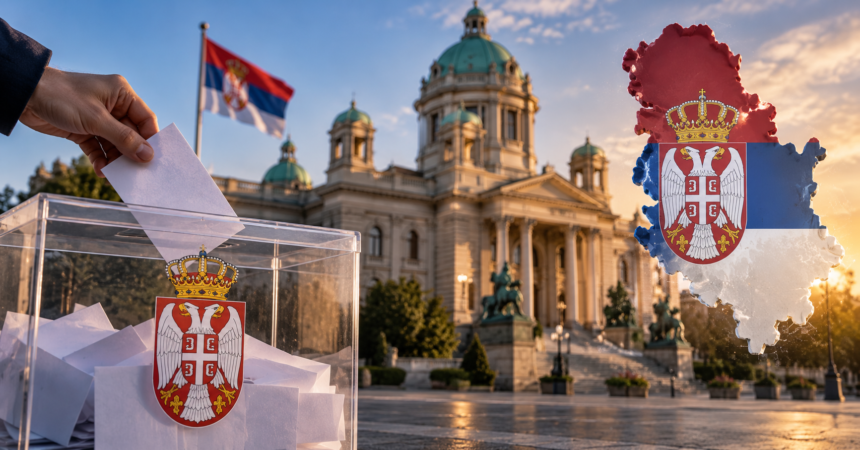
Serbia will hold a parliamentary election on 25 October 2026. Voters will elect all 250 members of the National Assembly. Votendi is covering Serbia as a curated election hub: official lists, individual national polls, key dates and election-system context, without publishing a proprietary polling average or forecast.
How the election works
Serbia elects 250 MPs in a single nationwide constituency. Voters cast one vote for an electoral list, and seats are allocated proportionally using the D’Hondt, or highest-quotient, method.
Ordinary lists need at least 3% of votes cast to participate in seat allocation. Recognized national-minority lists may participate below the standard threshold. Under the current rules, when such a minority list is below 3%, its quotients used for seat allocation are increased by 35%.
Main electoral lists
The Republic Electoral Commission (RIK) has proclaimed a broad field of lists. Among those appearing prominently in current polling and official election documents are Aleksandar Vučić – Ujedinjena Srbija, Studentska lista – Studenti pobeđuju, Ivica Dačić – Faktor stabilnosti!, Evropska Srbija – Marinika Tepić – Zdravko Ponoš and Autentična desnica – dr Miloš Jovanović, alongside several recognized national-minority lists.
Votendi treats official-list status separately from polling. A list’s inclusion here does not imply support, ranking or an election forecast.
What do the latest polls show?
The latest verified national poll in Votendi’s Serbia dataset is Faktor Plus, fielded from 16 to 20 September on a sample of 986 respondents. It reported Aleksandar Vučić – Ujedinjena Srbija at 48.6%, Studentska lista at 37.1%, the SPS-led list at 4.9%, Evropska Srbija at 3.6% and Autentična desnica at 2.8%.
Earlier surveys differed materially. An NSPM telephone poll conducted 2–12 July reported Studentska lista at 39.6% and the SNS/Vučić option at 37.5%. A CRTA / Stanford Democracy Action Lab face-to-face survey conducted 10–24 June reported 44.9% for the Student List and 35.7% for SNS among decided voters.
These surveys are not directly interchangeable: fieldwork dates, methodology and the list configurations tested changed during the campaign. For that reason Votendi displays individual poll snapshots and selected trends for Serbia rather than calculating a proprietary polling average.
What is not a poll?
BIRODI’s late-August 48.5% / 38.6% figures were published as an analytical election scenario based on historical results, polling inputs and a turnout assumption. Votendi does not include that model in the Serbia poll table. Likewise, an IRI figure reporting the share of respondents who would consider voting for a student list is not treated as a direct vote-intention result.
Official source
The primary official source for the election is the Republic Electoral Commission (RIK). RIK publishes proclaimed electoral lists, election instructions and official results.
See the Votendi Serbia 2026 election hub for the latest polls and election updates.