
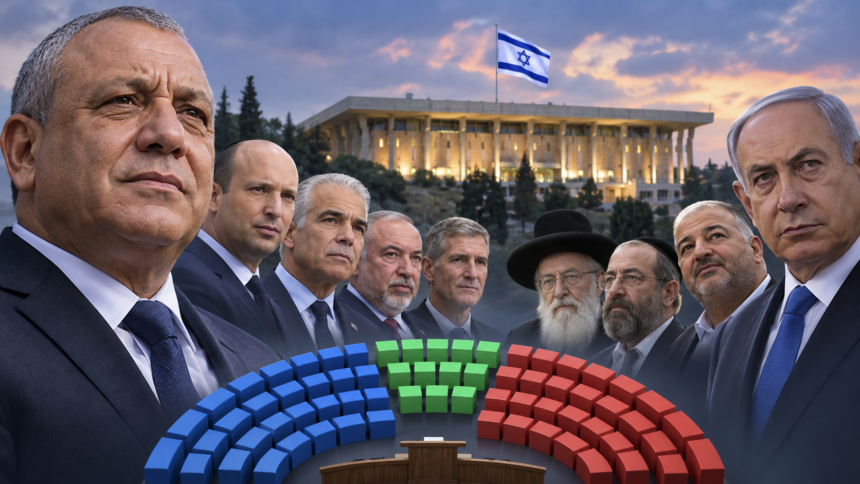
President Isaac Herzog has chosen Gadi Eisenkot to attempt to form Israel’s next government. Yet the former military chief faces a parliamentary puzzle: 67 lawmakers recommended him, while his existing political bloc controls only 48 seats. The difference could determine whether Israel gets a new prime minister or enters another period of political deadlock.
- The numbers: 67 recommendations, only 48 coalition seats
- Route one: an agreement with the ultra-Orthodox parties
- Route two: Arab-party support without coalition membership
- Route three: a national unity government with Likud
- The Netanyahu factor: 53 seats, but only 46 recommendations
- The November 10 test: who controls the new Knesset?
- What to watch during the negotiations
- Votendi analysis: the real meaning of 67–48
- Sources and methodology
JERUSALEM | November 7, 2026 — Israeli President Isaac Herzog announced on Saturday that he would formally task Gadi Eisenkot, leader of the centrist Yashar party, with forming a government at a ceremony on Sunday, November 8, at 5 p.m. local time.
The decision follows the October 27 Knesset election, in which Prime Minister Benjamin Netanyahu’s governing alliance lost its parliamentary majority without an opposing bloc securing one of its own.
Eisenkot will initially have 28 days to assemble a government, with a possible extension of up to 14 days.
But the decisive question is not who received the presidential mandate. It is whether the parties that recommended Eisenkot are willing to support the same government.
The numbers: 67 recommendations, only 48 coalition seats
Israel’s 120-seat Knesset is divided into three broad parliamentary groupings following the election.
| Parliamentary grouping | Seats |
|---|---|
| Eisenkot-led Jewish-majority opposition bloc | 48 |
| Netanyahu-aligned parties | 53 |
| Arab-led parties | 19 |
| Total | 120 |
Eisenkot’s four-party bloc consists of Yashar with 21 seats, Together with 12, the Democrats with eight and Yisrael Beiteinu with seven.
Netanyahu’s alliance includes Likud with 27 seats, United Torah Judaism (UTJ) with seven, Otzma Yehudit with seven, Shas with six and Religious Zionism–Zehut with six.
The remaining 19 seats belong to the Joint List, with 11, and Ra’am, with eight.
During presidential consultations, all four parties in Eisenkot’s bloc recommended him. Both Arab-led parties did the same, bringing his total to 67 recommendations.
Netanyahu received 46 recommendations. Crucially, the seven lawmakers from United Torah Judaism declined to recommend either candidate.
That distinction is central to the emerging coalition negotiations.
The 67 recommendations demonstrate support for giving Eisenkot the first opportunity to govern. They do not constitute an agreement on cabinet membership, policy or parliamentary confidence.
For the completed election count and party-level seat distribution, see Votendi’s Israel 2026 election results tracker.
Route one: an agreement with the ultra-Orthodox parties
A coalition bringing together Eisenkot’s 48 lawmakers, UTJ’s seven and Shas’s six would hold exactly 61 seats.
The arithmetic is straightforward. The politics are not.
United Torah Judaism’s decision to withhold its recommendation from Netanyahu has made negotiations with the opposition possible. Its leader, Yaakov Asher, has publicly welcomed a change in Avigdor Liberman’s position toward cooperation with ultra-Orthodox parties.
Liberman, whose Yisrael Beiteinu party holds seven seats, has long advocated mandatory military service for ultra-Orthodox men. On November 6, however, he confirmed that he was willing to consider political cooperation and compromise on the issue.
This does not mean the disagreement has disappeared.
Eisenkot continues to demand military or national service, while Democrats leader Yair Golan has indicated that cooperation with ultra-Orthodox parties would require commitments on conscription, employment and education.
For the religious parties, exemptions from military service remain a defining concern.
Shas presents another obstacle. The six-seat party recommended Netanyahu during the presidential consultations and continues to describe itself as part of the right-wing bloc.
Israeli television reported on November 7 that religious figures associated with Shas might avoid obstructing an agreement approved by UTJ’s rabbinical leadership. Shas publicly rejected suggestions that it was preparing to join an Eisenkot-led government.
Those reports should therefore not be interpreted as a confirmed coalition agreement.
The arithmetic also leaves little room for defections or abstentions among coalition partners. A 61-seat government would depend on every member maintaining the agreement on crucial votes.
And UTJ alone would bring Eisenkot’s bloc to just 55 seats — still six short of an absolute majority.
Route two: Arab-party support without coalition membership
The second configuration produces a larger parliamentary total.
Eisenkot’s 48 seats plus the Joint List’s 11 and Ra’am’s eight would amount to 67.
The challenge lies in the distinction between supporting the replacement of Netanyahu and participating in an Eisenkot government.
The Joint List has indicated willingness to support an alternative government from outside the formal coalition. Ra’am has also recommended Eisenkot.
However, several leaders of the Jewish-majority opposition bloc reject forming a government dependent on Arab-led parties.
Eisenkot has established four principles for prospective political partners, including recognition of Israel as a Jewish, democratic, liberal and egalitarian state, acceptance of the principles of the Declaration of Independence, a commitment to military or national service and recognition of Hamas as a terrorist organisation whose military and governing capabilities must be dismantled.
Such conditions could become a substantial obstacle to a formal arrangement with Arab-led factions.
A minority government supported externally by some or all of their lawmakers remains a distinct constitutional possibility.
Importantly, a new Israeli government does not necessarily need 61 coalition members to win its initial confidence vote. According to the Israel Democracy Institute, the investiture vote requires a simple majority of those voting. Abstentions can therefore be decisive.
But securing a confidence vote and sustaining a government through budgets, security decisions and contentious legislation are different challenges.
A government dependent on external parliamentary support would need arrangements extending beyond the initial vote.
Route three: a national unity government with Likud
Netanyahu has called for a broad national unity government as an alternative to an administration relying on Arab-led parties.
His proposal, however, includes his existing religious and nationalist allies.
That condition conflicts with Eisenkot’s stated approach.
Yashar has suggested that Likud could participate in a government led by Eisenkot if it abandoned its alliance with parties the opposition describes as extremist and accepted Yashar’s governing principles.
Eisenkot has also ruled out serving in a government with Netanyahu.
The disagreement goes beyond personal leadership.
The two politicians have conflicting positions on ultra-Orthodox military-service exemptions and the demand for an official investigation into the failures surrounding the October 7, 2023 attacks.
A unity arrangement would have to address the premiership, the composition of the cabinet, national-service legislation and accountability for past security failures.
It would also need to clarify which parties would be included and which would remain outside the government.
The Netanyahu factor: 53 seats, but only 46 recommendations
Netanyahu remains Israel’s caretaker prime minister while the coalition negotiations proceed.
Likud is also the largest individual party in the new Knesset, with 27 seats compared with Yashar’s 21.
Nevertheless, Netanyahu’s traditional bloc has only 53 seats, eight short of an outright parliamentary majority.
And with UTJ refusing to recommend him, he entered the presidential decision with endorsements representing just 46 lawmakers.
If Eisenkot fails to form a government, the constitutional process allows the president to consider assigning the mandate to another member of parliament.
That need not automatically be Netanyahu, although the Likud leader remains a central participant in the negotiations.
Failure by the first candidate is not equivalent to a parliamentary majority emerging for the second.
The November 10 test: who controls the new Knesset?
The new Knesset is due to convene on November 10.
One early parliamentary question concerns the election of its speaker.
Opposition and Arab-led parties have discussed coordinating to replace Likud’s incumbent speaker, Amir Ohana.
The result could provide an early indication of whether the 67 lawmakers who recommended Eisenkot can also cooperate in actual parliamentary votes.
However, supporting the same candidate for speaker would not establish agreement on a government or its programme.
The two decisions involve different political commitments.
What to watch during the negotiations
Four developments will be particularly important.
The first is whether United Torah Judaism submits or accepts a concrete coalition framework, rather than merely indicating openness to negotiations.
The second is whether Shas changes its formal position. Its six mandates complete the 61-seat calculation alongside Eisenkot’s bloc and UTJ.
The third is whether Liberman, Golan and the ultra-Orthodox parties can agree on binding terms for military or national service.
The fourth is whether Eisenkot can obtain external parliamentary support from Arab-led parties without losing the support of members of his own bloc.
A further possibility is that individual lawmakers change their parliamentary alignment, but such a scenario should not be counted as an agreement before any commitments are publicly confirmed.
Votendi analysis: the real meaning of 67–48
The post-election result has produced two different measures of political support.
The first is the presidential recommendation count, in which Eisenkot secured 67 endorsements against Netanyahu’s 46.
The second is the distribution of parties that have demonstrated willingness to govern together. On that measure, Eisenkot begins with 48 seats.
Bridging the difference requires agreements on policies that have divided Israeli politics for years: religion and state, military service, Arab political participation, security and the relationship between Likud and its traditional partners.
The presidency has resolved who gets the first opportunity to negotiate.
It has not resolved who can assemble a government capable of commanding the Knesset’s confidence.
Israel’s next phase will therefore be determined less by the election-night totals themselves than by the coalition agreements — or parliamentary support arrangements — that emerge from them.
For continuing coverage, follow Votendi’s Israel election hub and 2026 Knesset results.
Sources and methodology
This analysis uses the completed Central Elections Committee seat allocation, President Herzog’s official statement on party consultations, November 7 reporting by Associated Press and The Times of Israel, and the Israel Democracy Institute’s explanation of government formation.
Coalition configurations are arithmetic illustrations, not negotiated agreements or probability forecasts. Figures refer to the 120 seats allocated after the October 27, 2026 election. Information is current to November 7, 2026.