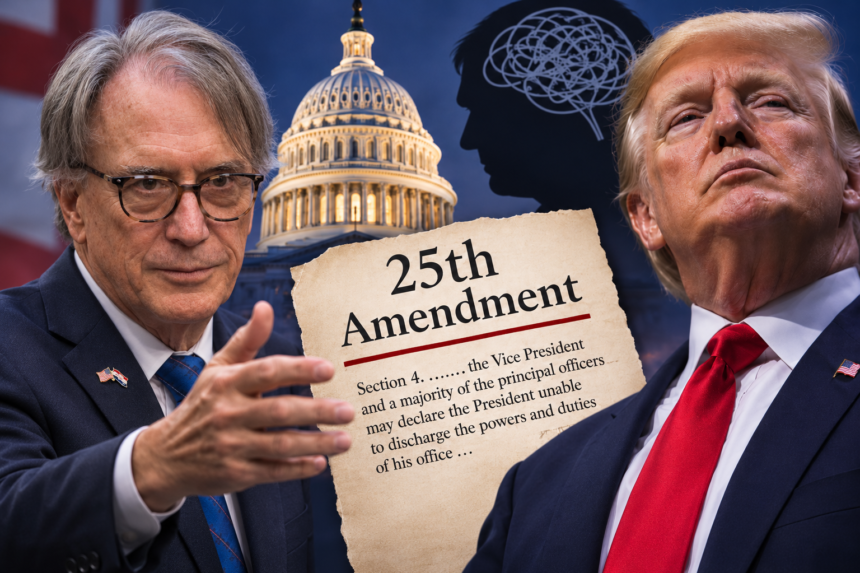
Former US ambassador to Croatia Peter Galbraith has sharply criticized Donald Trump following the November 3 midterm elections, questioning the president’s ability to perform his duties and portraying the Republican losses as a rebuke of his leadership. His remarks have renewed a wider constitutional question: could the 25th Amendment be used to transfer presidential power?
The distinction matters. Galbraith did not explicitly call for the 25th Amendment to be invoked in the interview reviewed by Votendi. His assessment was political commentary, not a medical finding or a formal determination of presidential incapacity. The Constitution sets out a specific process that cannot be triggered by an electoral defeat or by congressional criticism alone.
What Peter Galbraith actually said
Speaking to Croatian broadcaster N1 on November 4, the former ambassador described the election outcome as an unusually severe rejection of Trump. He linked Republican losses to the war in Iran, high fuel prices, economic concerns and controversies surrounding the administration.
Galbraith also made a pointed allegation about the president’s cognitive condition, using language that characterized Trump as undergoing decline. That is Galbraith’s opinion, not an established medical diagnosis. He cited the president’s public statements and conduct to argue that voters had serious concerns about his leadership. Index also reported his comments.
In the same interview, Galbraith said the new Congress would still face institutional limits on its ability to change administration policy. His comments on Trump’s fitness should not be confused with an announcement that the vice president, cabinet or Congress has initiated constitutional proceedings.
What the 25th Amendment really allows
The 25th Amendment, ratified in 1967, deals with presidential succession and inability. Section 3 allows a president to temporarily transfer powers voluntarily. The involuntary process is found in Section 4.
Under Section 4, the vice president and a majority of the principal officers of the executive departments can send a written declaration to congressional leaders stating that the president is unable to discharge the powers and duties of the office. The vice president then becomes acting president.
The amendment also permits the vice president to act with a majority of another body established by Congress through law, instead of the cabinet. But Congress cannot simply vote by itself to activate Section 4 without the vice president. The Congressional Constitution Annotated explains that the vice president’s participation is central to the mechanism.
What happens if Trump disputes the declaration?
The president can respond by declaring in writing that no inability exists. The vice president and the relevant majority then have four days to reaffirm their position. If they do, Congress must resolve the dispute within the constitutional timetable. To maintain the vice president as acting president, two-thirds of both the House of Representatives and the Senate must determine that the president is unable to serve.
If that two-thirds threshold is not met in both chambers, the president resumes the powers and duties of the office. The process has never been used to displace a sitting US president under Section 4. Reuters explained the same constitutional requirements when earlier calls to use the amendment arose during the Iran war.
Does the new Democratic Congress change anything?
The November midterms have shifted the legislative balance, but the new members do not take office until January 3, 2027. Even when they do, control of Congress does not replace the amendment’s initiating requirements. Democrats could examine executive conduct, hold hearings or propose legislation within their constitutional powers, but they cannot unilaterally declare Trump unable to serve through a standard majority vote.
Even a law establishing a different body to participate in a Section 4 determination would not remove the vice president from the procedure. And if a president contested the declaration, two-thirds majorities in both chambers would still be required to sustain the transfer of authority.
Why this is different from impeachment
The 25th Amendment and impeachment address different constitutional questions. The amendment concerns whether the president can perform the office’s duties; impeachment concerns alleged misconduct for which the House may bring charges and the Senate may convict.
Under impeachment, the House needs a simple majority to approve charges, followed by a two-thirds vote of senators present to convict and remove a president. Under a contested Section 4 process, the vice president and cabinet or other authorized body must initiate the declaration, and two-thirds of both congressional chambers are required to maintain the acting presidency.
Disagreement with a president’s policies, harsh public rhetoric or an election defeat does not by itself establish constitutional inability. As physician and presidential-health commentator Lawrence K. Altman has argued, the amendment should not be treated as a substitute for ordinary political accountability.
What has the White House said?
The White House has previously rejected accusations about Trump’s fitness and defended his health and ability to carry out his responsibilities. During an earlier round of 25th Amendment calls, a spokesperson told the Daily Beast in October that the president was active, accessible and in excellent health. That response predates Galbraith’s November 4 interview and should not be presented as a direct response to it.
The constitutional bottom line
Galbraith’s remarks add a prominent former diplomat’s criticism to the post-midterm debate over Trump’s leadership. They do not establish that the president is incapacitated, and they do not constitute a formal attempt to use the 25th Amendment.
For the amendment’s involuntary procedure to begin, Vice President JD Vance would have to participate, alongside the required cabinet majority or another legally designated body. If Trump contested the resulting declaration, the decision would require two-thirds support in both houses of Congress. The election result alone cannot set that process in motion.
Votendi previously published a broader explanation of the 25th Amendment and claims of presidential incapacity. Follow our US midterm results coverage for the continuing congressional transition.
Source note — November 5, 2026: Galbraith’s remarks are attributed to his November 4 N1 interview. Constitutional requirements are drawn from the US Constitution and the congressional Constitution Annotated. Reuters and PolitiFact provided additional procedural context. Galbraith’s statements are political assessments, not medical evidence. Existing Trump image reused from Votendi’s media library.