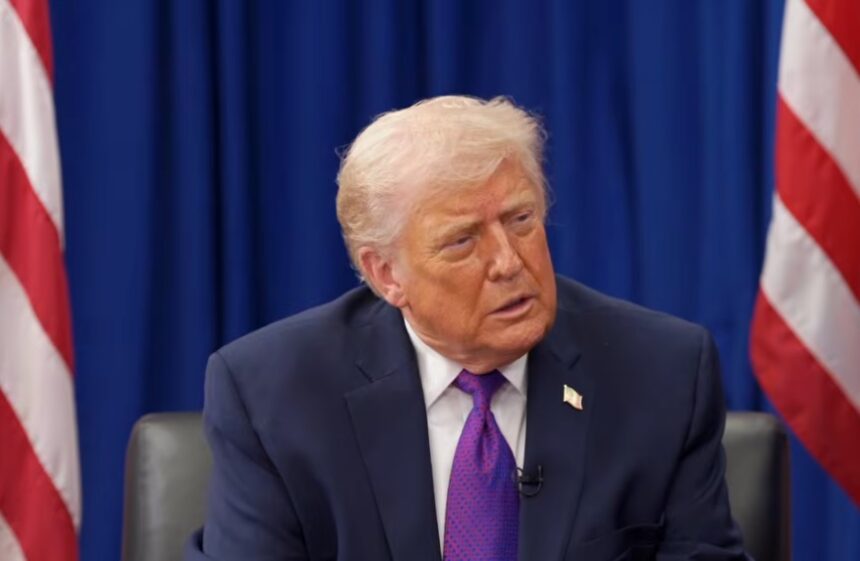
Questions about Donald Trump’s cognitive fitness have renewed scrutiny of a rarely used constitutional provision. But removing a sitting US president on grounds of incapacity is far more complicated than a congressional vote — and political criticism is not a medical diagnosis.
WASHINGTON, November 4, 2026 — As the United States absorbs the consequences of its midterm elections, renewed attention is turning to the constitutional limits of presidential power and the circumstances under which President Donald Trump could be relieved of his duties.
One provision has repeatedly surfaced in debates about Trump’s conduct and health: the 25th Amendment to the US Constitution.
The amendment provides a mechanism for transferring presidential authority when a president is unable to perform the responsibilities of the office. However, it does not allow Congress to remove a president simply because lawmakers question his judgment, disagree with his policies or believe he is medically unfit.
What does the 25th Amendment actually say?
Ratified in 1967, following the assassination of President John F. Kennedy, the 25th Amendment established clearer procedures for presidential succession and incapacity.
Its fourth section addresses situations in which a president cannot or will not voluntarily acknowledge an inability to perform the duties of office.
Under this provision, the vice president and a majority of the Cabinet — or a majority of another body established by Congress — can formally declare the president unable to carry out those duties.
The vice president would then immediately assume presidential powers as acting president.
But that would not necessarily settle the matter.
If the president contests the declaration, a further constitutional procedure begins. Should the vice president and the relevant majority reaffirm their assessment within four days, Congress must decide whether the transfer of authority should continue.
Keeping the vice president in charge against the president’s objection requires a two-thirds majority in both the House of Representatives and the Senate.
The procedure is deliberately demanding.
Section 4 has never been invoked in American history.
Doctors raised concerns, but the White House rejected them
Questions about Trump’s cognitive health have circulated throughout his second presidential term.
In 2026, a group of 30 psychiatrists and other medical professionals publicly challenged his fitness to serve, citing what they considered concerning patterns in his public behavior.
Their statement, reported by the medical journal The BMJ in May, called for the president’s removal from office and referred explicitly to the 25th Amendment.
The statement was also submitted for inclusion in the Congressional Record by two Democratic senators.
However, assessments based on publicly observable behavior are not equivalent to a comprehensive clinical examination of the president.
The White House has presented a sharply different assessment.
Following Trump’s May 2026 medical examination, presidential physician Sean Barbabella reported that the president was in excellent health and capable of performing his duties.
According to the Associated Press, Trump scored 30 out of 30 on the Montreal Cognitive Assessment, a screening test used to identify possible cognitive impairment.
A perfect result on that screening test does not establish every aspect of neurological or psychological functioning. Equally, unusual public remarks, video clips or political disagreements cannot independently establish a diagnosis of dementia.
Those distinctions matter when discussing the capacity of an elected president to remain in office.
Can a Democratic Congress remove Trump under the amendment?
Not on its own.
The results of the November 3 midterm elections have changed the balance of political power in Washington. But congressional majorities do not automatically acquire the authority to declare a president incapacitated.
Section 4 requires the participation of the vice president, currently JD Vance, alongside the constitutionally specified majority.
Congress becomes decisive only if the president challenges an incapacity declaration and the vice president and relevant majority maintain it.
Even then, the constitutional threshold is exceptionally high: two-thirds support in each chamber.
That is a fundamentally different requirement from a simple majority.
The distinction is especially relevant as Democrats prepare to exercise greater congressional oversight of the Trump administration following the midterm elections.
They can pursue hearings, demand information and challenge administration decisions through constitutional mechanisms. But those powers do not replace the specific procedure established by the 25th Amendment.
What is the difference between the 25th Amendment and impeachment?
The two mechanisms serve different purposes.
Impeachment is a constitutional process addressing alleged misconduct by a president or another federal official.
The House of Representatives can approve articles of impeachment by a simple majority, while conviction and removal require a two-thirds vote in the Senate.
The 25th Amendment, by contrast, concerns an inability to discharge presidential responsibilities.
Its purpose is to ensure continuity of government when a president cannot perform the office’s functions, rather than to punish political decisions or alleged misconduct.
A transfer of powers under Section 4 also makes the vice president acting president rather than automatically installing a permanent successor.
The president may subsequently seek to reclaim those powers through the procedure established by the amendment.
Why the question matters after the midterms
A weakened president and an incapacitated president are not the same thing.
The midterm results may change Trump’s ability to advance legislation, negotiate budgets, secure confirmations and resist congressional investigations.
But electoral setbacks do not alter the medical or constitutional standards for determining presidential incapacity.
Any serious attempt to invoke Section 4 would require action inside the executive branch and potentially overwhelming agreement across Congress.
That makes the provision an extraordinary constitutional safeguard rather than an ordinary instrument of partisan politics.
The latest debate also raises a broader question about transparency and presidential health.
How should the public evaluate competing claims about a president’s medical fitness when official reports, independent professional opinions and politically motivated commentary offer different interpretations?
For voters and institutions alike, distinguishing verified medical information from political accusation remains essential.
The central constitutional fact is clear: the 25th Amendment creates a path for transferring presidential power in cases of incapacity, but neither controversial behavior nor an opposition victory in Congress is sufficient to activate it.
As Washington enters a new period of divided political power, the debate over Trump’s fitness may continue. The constitutional rules governing presidential incapacity, however, remain unchanged.
Sources: US National Archives — 25th Amendment, Reuters — 25th Amendment explainer, Associated Press — Trump’s medical examination, The BMJ — Medical professionals’ statement.