



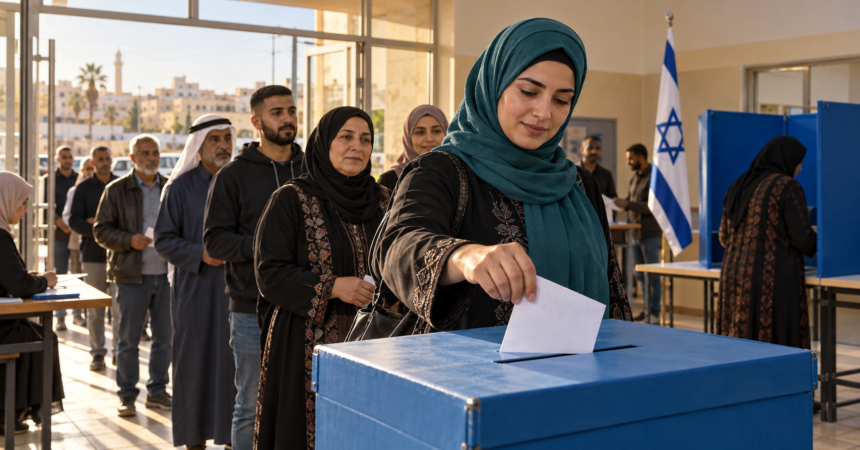
Bedouin voter turnout had already exceeded its final 2022 level by 4 p.m. on Tuesday, according to Israel Elects, highlighting a potentially significant shift in participation as Israel votes for its next Knesset.
The election-monitoring account reported turnout of 54.7% among Bedouin voters, compared with approximately 51% at the close of voting in 2022. That puts the reported afternoon figure around 3.7 percentage points above the previous election’s final level, with several hours of voting still remaining. The figures are attributed to Israel Elects; Votendi has not independently verified its definition of the Bedouin electorate or the underlying calculation. x.com
Why the turnout surge matters for Ra’am
The historical chart accompanying the post shows why the increase could matter for Mansour Abbas’s Ra’am party.
According to that graphic, Ra’am won 72.4% of valid votes among the Bedouin electorate shown in 2022, well ahead of Hadash–Ta’al on 11.6% and Balad on 8.5%.
Those are historical results, rather than a breakdown of votes cast in today’s election. Nevertheless, they illustrate Ra’am’s strong position in this voting group and explain why higher participation could benefit the party.
The potential advantage depends on whether newly participating voters make similar choices. Turnout alone cannot establish which parties are gaining votes or how many additional Knesset seats they might secure.
Reports from Rahat point to strong mobilisation
Reporting from southern Israel provides further evidence of increased participation.
The Times of Israel described unusually busy polling stations in Rahat, a major Bedouin city and Ra’am stronghold. Residents interviewed by the newspaper cited housing demolitions, gun violence and dissatisfaction with National Security Minister Itamar Ben Gvir’s policies as reasons for voting. These accounts offer local context, rather than a representative survey of voters’ motivations. timesofisrael.com
A wider rise in Israeli turnout
The reported Bedouin increase comes alongside strong participation nationally.
According to Central Elections Committee figures reported by The Times of Israel, 55.7% of eligible voters nationwide had voted by 4 p.m., compared with 47.5% at the same stage in 2022. The newspaper described this as the highest turnout recorded for that hour. The Times of Israel
The distinction matters: higher participation in one community must be assessed alongside changes elsewhere. A rise in Bedouin turnout could increase Ra’am’s vote total without necessarily producing an equivalent rise in its national vote share.
What to watch when results arrive
The next question is whether the reported mobilisation translates into stronger support for Ra’am once ballots are counted.
Votendi will be watching the party’s national vote share, its performance in Bedouin localities and the eventual distribution of Knesset seats. Even a stronger result would leave a separate political question: whether other parties are willing to cooperate with Ra’am in forming or supporting a government.
For now, the turnout figures point to increased participation. They do not establish the election’s outcome.