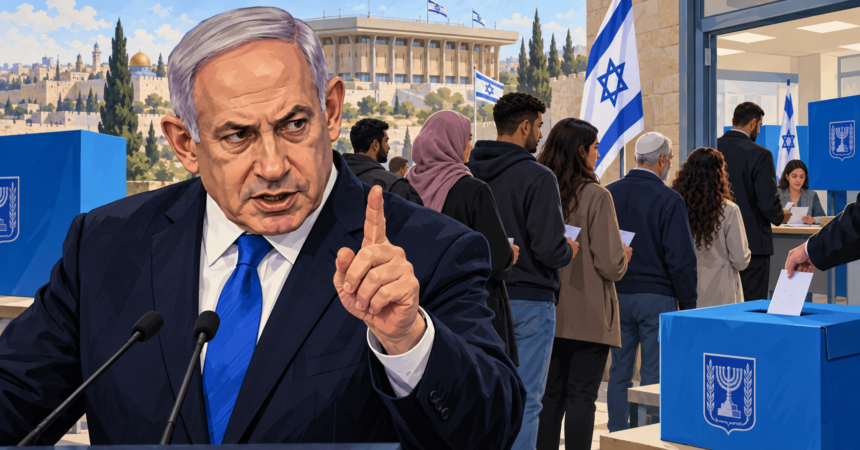
Israeli Prime Minister Benjamin Netanyahu has accused people he describes as Ra’am operatives of attempting to “steal the election” as turnout in Arab communities becomes a central issue in Israel’s October 27 parliamentary vote. Police have confirmed three arrests in an alleged voter-bribery investigation, but the suspicions do not establish widespread election fraud. Meanwhile, early participation figures from Bedouin communities show significant differences from town to town.
Netanyahu’s election-day allegation
In a video addressed to Likud supporters on Tuesday, Netanyahu warned that Arab voters in southern Israel were turning out in large numbers and said that people associated with Ra’am, an Arab-majority party led by Mansour Abbas, were trying to steal the election from his party.
Netanyahu cited the arrest of three men as he urged Likud voters to go to the polls. The Times of Israel reported his remarks at 1:12 p.m. Israel time. The claim that Arab turnout was higher than Jewish turnout in the Negev was not accompanied in that statement by a verifiable breakdown.
What police have confirmed — and what they have not
Israeli police said three men from Bedouin communities in the south were arrested overnight on suspicion of involvement in a scheme to pay people to vote for Ra’am. Police said searches uncovered envelopes containing tens of thousands of shekels in cash. The suspects were due to appear before a judge for a remand hearing, according to the police account reported by The Times of Israel.
Arrests on suspicion of voter bribery are not evidence that an election has been stolen. The public police report describes alleged efforts to induce votes for Ra’am; it does not by itself establish that party leaders organised the suspected activity or that the integrity of the nationwide count was compromised. The allegations remain subject to investigation and legal process.
Rahat reports 36.9% turnout, but Arab communities are not voting at one pace
A midday local turnout update from the Negev put participation in Rahat at 36.9%, compared with 28.8% in Tel Sheva and 27.4% in Beersheba. Nationwide turnout stood at 31.5% by noon, according to the Central Elections Committee. The local breakdown was reported by Beersheba and Negev News in an update published at 1:48 p.m. local time.
These are participation figures at a particular point in the day, not final turnout or party vote shares. They illustrate why the behaviour of Arab and Bedouin voters cannot be reduced to a single national number. They also do not demonstrate which party is receiving the ballots cast.
Arab-majority parties could play an important role in the eventual parliamentary arithmetic, but that depends on the vote shares each list receives, the 3.25% electoral threshold, and how the 120 Knesset seats are allocated. A governing majority requires 61 seats.
Rival parties have also lodged complaints
Election-day concerns have not been confined to Likud. Gadi Eisenkot’s Yashar party said it had submitted a complaint to the Central Elections Committee alleging that ballot slips had been removed, damaged or turned over at various polling stations. Other parties also reported local irregularities, according to The Times of Israel.
The complaints merit examination but should not be confused with verified proof of coordinated nationwide interference. Associated Press reported that election officials had found no evidence of systematic sabotage as voting continued and described the problems reported to that point as limited.
Why the turnout debate matters before polls close
Israel’s election uses nationwide proportional representation, so turnout affects both the number of votes cast and the effective vote total required to pass the parliamentary threshold. But claims about who benefits from a surge in participation must be tested against actual ballots, not partisan videos or isolated local observations.
Most polling stations are scheduled to close at 10 p.m. Israel time on October 27. Exit polls may then offer an initial picture; official votes and seat allocations will follow as counting progresses.
Follow Votendi’s Israel election live results, seat counts and coalition blocs and see our earlier report on the record early turnout for additional context.
Reporting snapshot: October 27, 2026, early afternoon Israel time. All investigations and allegations are described as such; early turnout figures are not election results.