Did Serbia avoid a violent confrontation on election night? A report in Britain’s The Times alleges that Aleksandar Vučić considered resisting a decisive parliamentary election defeat before abandoning that course. The allegations are serious, but they are not established facts, and Vučić’s spokeswoman has offered a different explanation for the security deployment in Belgrade.
Published 28 October 2026. This report distinguishes allegations made to The Times, official vote totals and independently reported developments. No attempted coup has been independently established by Votendi.
What The Times reported
In a report published on 28 October, The Times said politicians and a former senior police official believed Vučić was prepared to use force or challenge the result of Serbia’s 25 October parliamentary election, before unexpectedly conceding defeat.
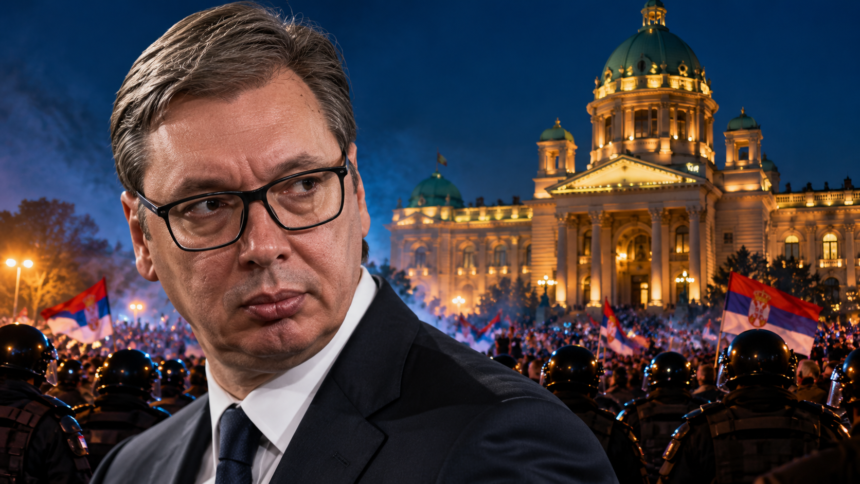
Spasoje Vulević, a former Serbian counterterrorism police chief, told the newspaper that 4,000 police officers and 3,000 men he characterised as pro-government enforcers had been deployed in central Belgrade. He interpreted that presence as evidence that Vučić might refuse to accept the election outcome. Those reported personnel figures and the alleged purpose of the deployment have not been independently verified by Votendi.
Sandro Gozi, a member of the European Parliament, said his political group had received disturbing diplomatic information on election day suggesting a risk of violent resistance. Radomir Saičić, a candidate associated with the victorious Student List, also alleged that a plan existed to contest a narrow result by force. These are claims and assessments attributed to the speakers, not proof that orders were issued or an operation was initiated.
Did calls from European officials change the decision?
Several people quoted by The Times believed telephone warnings may have persuaded Vučić not to contest the result. Vulević suggested the calls came from European governments at a senior level. Gozi said he could not confirm whether such calls occurred, and also pointed to the scale of the Student List’s victory as a possible factor.
Speculation about a call from Viktor Orbán has also circulated, but there is no verified evidence that Orbán intervened to stop a coup. Neither the identity of any alleged callers nor the content or impact of their purported conversations has been independently established.
What happened on election night?
The Times described black-clad groups gathering near the camp used by Vučić supporters in Belgrade’s central Pionirski Park and the deployment of gendarmerie personnel, as roads were reportedly closed. According to its account, Vučić conceded at approximately 9:30 p.m. local time, around 90 minutes after the polls closed.
The broader result is independently documented: Serbia’s Republic Electoral Commission said on 26 October that, based on 8,187 polling stations, the Student List had received 52.71% of votes and a provisional 140 of 250 parliamentary seats. The Vučić-backed United Serbia list received 39.17% and 104 seats. The figures were preliminary and subject to the remaining electoral process.
Associated Press reporting also confirms that Vučić conceded soon after the polls closed and that tensions continued after the election, including confrontations around sites associated with his supporters. Those developments establish a volatile atmosphere; they do not independently demonstrate an attempted coup.
How Vučić’s side responded
Vučić’s spokeswoman disputed the suggestion that police had been deployed to support a power grab. Speaking to The Times, she said the security presence was a response to threats of violence from protesters. The explanation conflicts with the interpretation offered by Vulević and other sources quoted by the paper.
The distinction is central to assessing the story. A large police deployment, warnings of potential clashes and allegations from political opponents do not by themselves establish a coordinated plan to overturn an election. Independent evidence about command decisions, instructions and communications would be needed to resolve the competing accounts.
Why this matters for Serbia’s transition
The Student List’s provisional parliamentary majority gives it a strong numerical position, but a change of government still requires the completion of legal procedures and the formation of a new administration. As the Associated Press noted on 28 October, the vote must be certified, the new parliament constituted and a government formed. Tensions and disputes surrounding the transition therefore remain significant.
Votendi’s assessment: The Times investigation raises questions that merit scrutiny, particularly regarding the security operation and alleged diplomatic communications. But the publicly confirmed facts are the election result, Vučić’s concession and the continuing transition process. The existence of a plan to seize or retain power by force remains an allegation rather than a verified finding.
For continuously updated results and background, see Votendi’s Serbia parliamentary election live-results page and 2026 Serbia election hub.
Sources: The Times (28 October); 021/Nedeljnik summary of The Times reporting (28 October); Republic Electoral Commission figures, published by the Serbian government (26 October); Associated Press (28 October).