
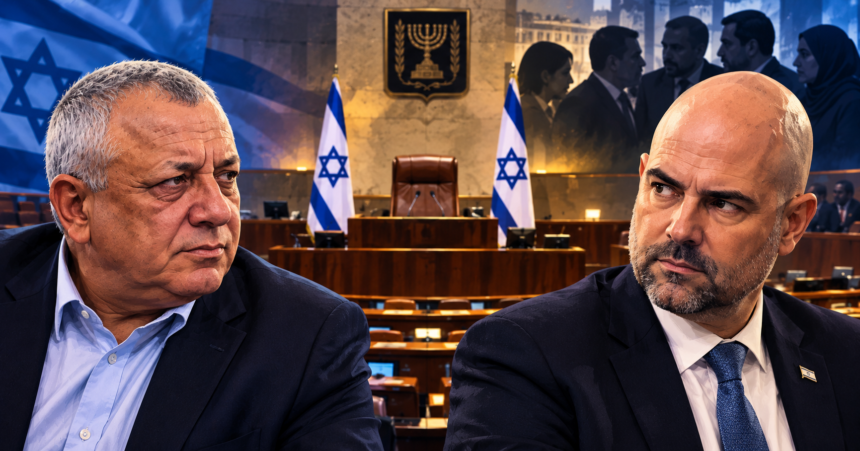
Gadi Eisenkot’s opposition bloc is considering replacing Knesset Speaker Amir Ohana with Arab-party support, according to a Channel 12 report relayed by The Times of Israel on October 28.
The report says no replacement candidate has been agreed. Oded Forer and Elazar Stern are among the names under discussion. This remains a reported plan, rather than a completed parliamentary agreement.
Arab parties signal willingness to help replace Netanyahu
Separately, Joint List leader Yousef Jabareen told Channel 13 that parties seeking to replace Benjamin Netanyahu’s government would need to engage with his faction. In remarks to Ynet, he also signalled readiness to help remove the Netanyahu-led government.
His comments indicate willingness to discuss a political alternative; they do not establish that the opposition parties have accepted common terms for governing.
The arithmetic: 54–49–17
Votendi’s verified vote snapshot from October 28 at 12:32 Israel time contains 4,401,898 valid votes from 10,156 reporting polling stations. Votendi’s provisional allocation gives Netanyahu-aligned parties 54 seats, the main opposition 49 and Arab-led parties 17.
Together, the latter two groups have 66 seats in that calculation, above the 61-seat majority mark. These are provisional calculations from partial official votes, not a final official seat allocation or an agreed coalition.
Why the speaker question matters
Votendi analysis: A shared candidate for speaker could test whether parties opposed to Netanyahu can coordinate a parliamentary majority. Agreement on that office would still leave the separate questions of who leads a government, which parties join it and what programme they accept.
The next concrete signals to watch are an agreed speaker candidate, explicit commitments from the participating parties and an announced parliamentary timetable. Until then, the report points to a possible route for cooperation rather than a settled transfer of power.
Follow Israel’s live results and Votendi’s provisional seat calculation · Read the coalition-options analysis.
Sources and verification
- The Times of Israel, citing Channel 12: reported speaker initiative. The individual update displays 14:13 Israel time on October 28, 2026.
- The Times of Israel: Jabareen’s remarks to Channel 13 and Ynet, update displayed at 12:02 Israel time.
- Central Elections Committee: national vote results; snapshot and provisional allocation as displayed on Votendi.
Reporting checked October 28, 2026. Vote counting continues. The speaker initiative is attributed reporting; the implications section is Votendi analysis.