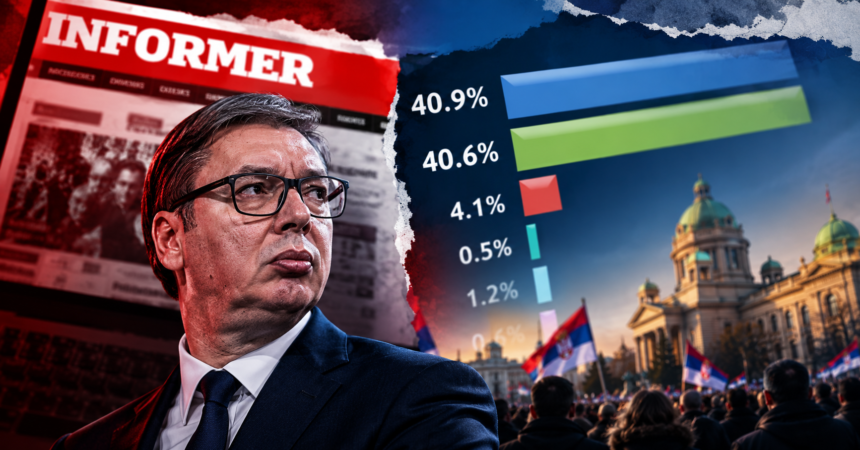
A graphic circulating in Serbia on Wednesday, 21 October, attributes a virtually tied parliamentary election poll to Ipsos. Online users claim Informer — an outlet repeatedly documented as a vehicle for pro-Vučić propaganda and campaigns against government critics — published and then deleted it. Neither the poll’s authenticity nor the alleged deletion has been independently verified.
Just four days before Serbia’s 25 October parliamentary election, a purported polling graphic has drawn attention for the extremely narrow difference it shows between two major electoral lists: Aleksandar Vučić’s Ujedinjena Srbija at 40.9% and the student-backed Studenti pobeđuju at 40.6%.
The image carries a headline reading “Vanredni parlamentarni izbori 2026” (“Snap Parliamentary Election 2026”) and the label “Izvor: IPSOS” (“Source: IPSOS”). But a label on an image is not proof of its source. Votendi has not identified a public Ipsos release or independently verifiable survey document confirming these numbers.
What the circulating graphic claims
The percentages below are transcribed from the unverified graphic. They are not authenticated Ipsos results.
| List named in the image | Claimed support |
|---|---|
| Ujedinjena Srbija | 40.9% |
| Studenti pobeđuju | 40.6% |
| Faktor stabilnosti | 4.1% |
| Evropska Srbija | 1.7% |
| Autentična desnica | 1.6% |
| Alternativa za Srbiju | 1.4% |
| SVM | 1.2% |
The image also lists several smaller parties and minority lists at below 1% each. The apparent 0.3-percentage-point gap between the two largest options cannot establish a statistically meaningful advantage without the survey’s sample size, fieldwork dates, question wording, population definition and treatment of undecided voters.
Where the claim about Informer came from
A post on Reddit’s r/serbia community on 21 October shared the graphic alongside an allegation that it had been posted and removed within minutes. The discussion provides evidence that the claim is circulating, not proof that Informer actually published or deleted the image.
Votendi could not verify an original Informer article or an archived version featuring these figures. No established reason for any alleged removal can therefore be reported. The circulating image does not display a survey date, sample size, methodology, commissioner or polling registration information.
Informer: a documented record of propaganda and smear campaigns
To describe Informer simply as a “pro-government tabloid” understates its documented record. Independent media researchers and fact-checkers have repeatedly identified the outlet as a vehicle for pro-Vučić propaganda, disinformation and campaigns aimed at discrediting political opponents, protesting students and other government critics. The State Media Monitor classifies it as “captured private” media aligned with Aleksandar Vučić’s government and the Serbian Progressive Party (SNS). It is published through Insajder Tim, majority-owned by Informer editor-in-chief Dragan J. Vučićević.
In an extensive 2026 investigation published by Raskrikavanje through the SEE Check network, researchers identified 399 false, unfounded or manipulative items on Informer’s front pages during 2025 alone. The investigation documented its repeated portrayal of student protesters as terrorists, violent extremists and would-be coup plotters, as well as a false suggestion that opposition leader Miloš Jovanović had called for Vučić to be killed. Vučić appeared on 185 of the tabloid’s front pages, predominantly in favourable coverage or as a portrayed victim.
The Reuters Institute’s Digital News Report 2026 cites Serbian Press Council monitoring that recorded 1,456 breaches of the journalism code by Informer in the second half of 2025. In the same report’s audience research, only 19% of respondents familiar with Informer rated its news as trustworthy, the lowest score among brands measured. These are documented indicators of systematic editorial problems, not merely accusations from the political opposition.
Serbia’s election watchdog CRTA said in November 2024 that it filed criminal complaints concerning alleged intimidation of prosecutors and judges involving Informer figures. In June 2025, CRTA filed another complaint against editor-in-chief Vučićević over claims that the organisation intended to provoke violence and steal local elections. Those are allegations made in criminal complaints, not findings of criminal guilt.
The Media Ownership Monitor independently documents the outlet’s ownership. At the wider national level, Freedom House’s 2026 Serbia report describes political pressure on independent journalism and a media environment marked by significant government influence.
These findings show why it is misleading to treat Informer as just another newspaper with a partisan editorial preference: its role in amplifying pro-Vučić narratives and targeting critics is supported by documented monitoring and specific cases. None of that, however, establishes that the disputed Ipsos graphic was authentic or that Informer published and deleted it. Both claims require separate evidence.
An Informer commentary published the same morning
In a separate Informer article dated 21 October at 10:35, SNS presidency member Nebojša Bakarec criticised opposition-associated polling reports. In his commentary, he asserted that surveys by Ipsos and Faktor Plus had shown support for the ruling party around 46–48% during 2025–26, and pointed to a September Faktor Plus poll giving the Vučić-backed list 48.6% and the student-backed list 37.1%.
These were Bakarec’s political claims, not a formal statement by Ipsos. His article did not authenticate or address the disputed graphic, and its publication time alone cannot prove anything about a purported subsequent post or deletion.
How the claim compares with documented polling
A publicly documented NSPM poll published on 20 October reported 44.5% for the student-backed list and 42.7% for the Vučić-aligned list. That telephone survey interviewed 1,050 respondents between 25 September and 5 October, according to its published methodology.
Faktor Plus’s September survey reported 48.6% for the government-aligned list and 37.1% for the student-backed list. The two independently documented surveys therefore already present substantially different snapshots, gathered at different times and potentially using different assumptions.
Votendi’s Serbia election hub compares published polling organisations individually rather than presenting a proprietary average or forecast. The purported Ipsos figures have not been entered into Votendi’s polling database.
What would establish whether the graphic is real?
A verifiable original release or direct confirmation from Ipsos would be needed to authenticate the figures. Ideally, the source would identify fieldwork dates, methodology, sample, exact list labels, denominator, sponsor and publication authorisation. An independently archived Informer page or verifiable original post would be needed to substantiate the separate deletion allegation.
For now, this is a story about an unverified image and an unverified claim about a media outlet — not a confirmed late-campaign Ipsos poll. Votendi will update this report if independently verifiable documentation becomes available.