



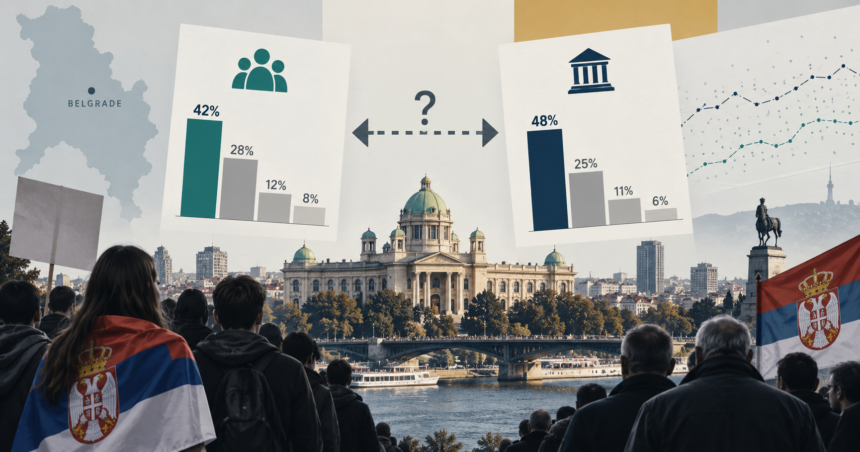
Serbia’s parliamentary election is approaching with one unusually clear feature in the polling data: there is still no consensus about who is actually ahead.
Depending on the pollster, the race ranges from a sizeable lead for the student-backed list to a double-digit advantage for the Vučić-led government configuration. The difference between those two pictures is more than 20 percentage points when measured by the lead margin.
That makes Serbia one of the harder elections to summarize with a single headline number.
Votendi therefore does not publish a proprietary polling average for Serbia. Instead, the election hub compares individual national surveys and shows the range of results reported by different pollsters.
Four pollsters, four different pictures
Using the latest eligible poll from each polling organisation currently tracked by Votendi produces a striking spread.
The newest published NSPM figures put Studentska lista at 44.4% and Aleksandar Vučić – Ujedinjena Srbija at 41.7%, giving the student list a 2.7-point lead.
Faktor Plus, however, reports almost the opposite picture. Its 16–20 September survey, based on 986 respondents, places Ujedinjena Srbija at 48.6% and Studentska lista at 37.1% — an 11.5-point government-side lead.
CRTA / Stanford Democracy Action Lab, in a face-to-face survey conducted in June, found Student List at 44.9% and SNS at 35.7% among decided voters. That corresponds to a 9.2-point student-list advantage.
Nacija’s July survey, meanwhile, showed a much tighter contest: Ujedinjena Srbija at 44.1% and Vladan Đokić – Studenti pobeđuju at 41.6%, a government-side lead of 2.5 points among decided respondents.
Put together, the latest pollster snapshots do not produce one obvious leader. They produce a range.
For the student-list family, reported support runs from 37.1% to 44.9%.
For the SNS / Vučić / Ujedinjena Srbija family, it runs from 35.7% to 48.6%.
The margin swings by more than 20 points
The scale of the disagreement is clearer when the poll margins are compared.
CRTA gives the student list a lead of roughly 9 points. Faktor Plus gives the government-side list a lead of roughly 12 points.
That is a swing of more than 20 percentage points in the reported margin between two pollsters.
This does not mean one of the polls must necessarily be “wrong.” The surveys differ in timing, method, vote base and — importantly in Serbia’s case — the exact electoral lists presented to respondents.
The newest poll is therefore not automatically the most representative one.
List configurations are part of the problem
Another complication is that Serbian polls do not always test identical political configurations.
Government-supporting options have appeared under labels including SNS / Aleksandar Vučić, Aleksandar Vučić – Ujedinjena Srbija, and broader coalition formulations.
The student-backed side has similarly appeared as Studentska lista, Student List, and Vladan Đokić – Studenti pobeđuju.
Votendi groups these into two broad political poles in its overview to make the surveys easier to compare, but keeps the original list names on individual poll records.
The grouping is therefore a presentation tool — not an assumption that all surveys tested exactly the same ballot choice.
What can we actually say about the current state of the race?
The strongest conclusion from the available data is not that either side has established a stable national lead.
It is that both major political poles remain competitive across credible published surveys, while the estimated balance between them remains highly pollster-dependent.
NSPM and CRTA provide evidence for a student-list lead.
Faktor Plus provides evidence for a substantial government-side lead.
Nacija and the July NSPM survey point to a considerably narrower contest.
That level of disagreement makes the arrival of new surveys especially important. A sequence of polls from several organisations moving in the same direction would be more informative than any single new topline.
The battle around the 3% threshold also matters
Below the two leading poles, several parties and coalitions are operating close to Serbia’s ordinary 3% parliamentary threshold.
The latest Faktor Plus poll has SPS at 4.9% and Evropska Srbija at 3.6%, while Autentična desnica is reported at 2.8%.
Other surveys have placed several smaller opposition and right-wing lists on either side of the threshold.
Because the exact party configurations differ between polls, Votendi does not combine these figures across surveys. The Serbia tracker instead shows threshold figures one poll at a time.
This matters because relatively small changes around 3% can affect which votes participate in seat allocation and, eventually, the parliamentary balance.
Uncertainty is currently the story
With the election approaching, Serbia does not yet have the kind of polling environment where a conventional average would necessarily clarify the race.
It could instead create false precision.
The current evidence supports a more cautious reading: the contest is competitive, the pollster effect is unusually large, and the exact structure of the lists matters almost as much as the headline percentages themselves.
The next important signal will be whether polling organisations begin to converge as election day approaches — or whether Serbia enters the final phase of the campaign with fundamentally conflicting measurements of public opinion.
Votendi will continue adding national polls individually, preserving their original list configurations, fieldwork dates, samples and methodology wherever those details are available.
Follow the Serbia 2026 election hub for the latest polls, reported ranges, official electoral lists and election-system information.