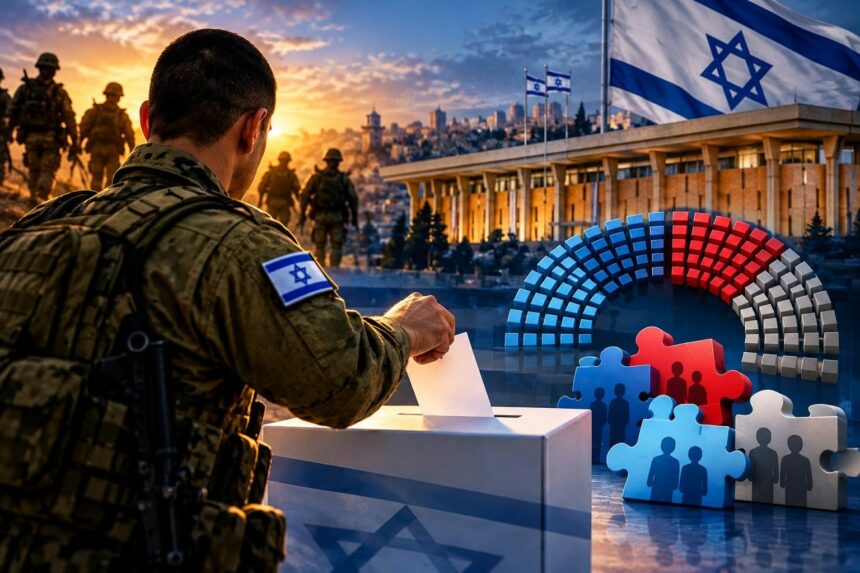
Hundreds of thousands of ballots cast by soldiers, reservists and other special-category voters are being counted in Israel. Historical voting patterns suggest that Arab and ultra-Orthodox parties face challenges, while several right-wing and centrist parties could benefit. But the decisive question is whether the remaining votes can deliver the single seat Gadi Eisenkot needs to bypass Avigdor Liberman.
- How Israel’s military traditionally votes
- Who could benefit in 2026?
- Eisenkot’s Yashar and Bennett’s B’Yachad
- Religious Zionism and Otzma Yehudit
- Avigdor Liberman’s Yisrael Beytenu
- Arab and ultra-Orthodox parties
- The Reservists Party: The biggest potential disruption
- The coalition mathematics: Why a single seat matters
- Scenario 1: No change to the current allocation
- Scenario 2: Eisenkot gains one seat from Netanyahu’s bloc
- Scenario 3: Arab parties lose one seat to Eisenkot’s allies
- Scenario 4: Arab parties lose a seat to Netanyahu’s bloc
- Scenario 5: Liberman loses one seat to another opposition party
- Scenario 6: Liberman gains a seat from Netanyahu
- Scenario 7: Arab parties gain a seat from Netanyahu
- Scenario 8: The Reservists Party crosses the threshold
- Why the Arab parties’ internal seat distribution matters
- Liberman remains the central coalition obstacle
- What to watch as the count continues
- The bottom line
Israel’s election is entering its final counting phase, with the balance of power between Prime Minister Benjamin Netanyahu and opposition leader Gadi Eisenkot still unresolved.
According to the latest partial results published Thursday morning, October 29, with 91.1% of votes counted, the parliamentary picture remains:
| Political grouping | Projected seats |
|---|---|
| Netanyahu-led bloc | 53 |
| Eisenkot-led bloc, including Liberman | 48 |
| Arab parties | 19 |
| Total | 120 |
The Central Elections Committee began counting special ballots at approximately 1 a.m. Thursday. Its latest estimate indicated between 430,000 and 480,000 double-envelope ballots, although that number remained preliminary.
These include votes cast by soldiers, reservists, diplomats, prisoners, hospital patients and other eligible voters unable to vote at their regular polling stations.
The final allocation could shift several seats, but no new bloc majority has been established. זמן ישראל
How Israel’s military traditionally votes
The conventional assumption that military ballots automatically favor Netanyahu is misleading.
Israel’s armed forces include voters from across the political spectrum, and historical special-ballot results show significant support for both right-wing and centrist parties.
An analysis published by Israeli business newspaper Globes, using the 2022 election results, provides a useful comparison.
| Party or alliance in 2022 | Special ballots | Nationwide vote | Difference |
|---|---|---|---|
| Religious Zionism–Otzma Yehudit | 15.45% | 10.84% | +4.61 pp |
| National Unity | 10.65% | 9.08% | +1.57 pp |
| Yisrael Beytenu | 5.70% | 4.48% | +1.22 pp |
| Likud | 23.52% | 23.41% | +0.11 pp |
| Shas | 6.84% | 8.25% | −1.41 pp |
| United Torah Judaism | 3.74% | 5.88% | −2.14 pp |
| Ra’am | 1.75% | 4.07% | −2.32 pp |
| Hadash–Ta’al | 1.71% | 3.75% | −2.04 pp |
Source: Globes, October 28, 2026. גלובס
Three conclusions emerge from these historical figures.
First, the strongest overperformance came from the religious-nationalist right, rather than Likud itself.
Second, centrist parties with prominent military leadership also performed well. National Unity, which included Eisenkot in 2022, received a higher share of special ballots than its nationwide average.
Third, Arab and ultra-Orthodox parties received considerably smaller shares.
These patterns help explain the potential direction of seat changes, although the parties and voter composition have changed since 2022. They cannot be treated as a direct forecast for 2026.
Who could benefit in 2026?
Eisenkot’s Yashar and Bennett’s B’Yachad
Eisenkot, a former military chief of staff, has political connections with the security establishment and a campaign built partly around leadership and national service.
Bennett’s B’Yachad also competes for voters across the center-right and secular-nationalist electorate.
Israeli Democracy Institute researcher Assaf Shapira told Channel 12 that parties such as Yashar and B’Yachad could benefit from voting patterns resembling those that previously strengthened National Unity.
A stronger showing for these parties, however, would not necessarily increase the opposition bloc’s total seats. Gains could come from another opposition party. mako
Religious Zionism and Otzma Yehudit
The religious-nationalist right has historically performed particularly well among special-ballot voters.
In 2022, the combined Religious Zionism–Otzma Yehudit list exceeded its nationwide vote share by 4.61 percentage points in special ballots.
Both parties now compete separately, making the historical comparison imperfect.
Nevertheless, the 2022 figures explain why their performance is one of the most closely watched elements of the remaining count.
Avigdor Liberman’s Yisrael Beytenu
Liberman is another politician whose party has previously benefited from special ballots.
In 2022, Yisrael Beytenu increased its representation from five to six seats during the final counting process, while United Torah Judaism fell from eight to seven.
That precedent matters because Liberman’s seven projected seats are currently central to the coalition deadlock. ynet
A gain for Yisrael Beytenu could strengthen Liberman’s bargaining position without making it any easier for Eisenkot to build a government that excludes him.
Arab and ultra-Orthodox parties
Historically, Arab parties and United Torah Judaism have performed less strongly among special-ballot voters.
This largely reflects the demographic composition of the special-ballot electorate, rather than a change in how existing supporters vote.
The military electorate includes fewer Arab and ultra-Orthodox voters relative to their shares of the overall population.
Consequently, the combined Arab representation of 19 seats could change as the remaining ballots are incorporated into the national count.
The same applies to ultra-Orthodox parties, particularly United Torah Judaism.
However, a lower percentage of special-ballot votes does not automatically mean a party loses a seat. The final allocation depends on the national vote totals and Israel’s Bader–Ofer seat-distribution system. m.knesset.gov.il
The Reservists Party: The biggest potential disruption
The most consequential threshold scenario involves the Reservists–Economic Party, headed by Yoaz Hendel and Yaron Zelekha.
At the latest available detailed count, the party had approximately 135,000 votes, representing 2.63% of valid ballots counted.
Israel’s electoral threshold is 3.25%.
The party therefore needs a considerably stronger share of remaining votes than it received nationally.
An earlier analysis by Ynet estimated that approximately 12% of outstanding ballots would be needed for the party to cross the threshold. That calculation was based on an earlier counting snapshot and must be updated as new votes are processed.
There is some historical polling evidence of support among reservists and younger voters, but these surveys cannot establish how the remaining 2026 ballots were actually cast. Bakalpi – Elections 2026
Why would crossing the threshold matter?
Because the party would enter parliament with approximately four seats, forcing a redistribution of all 120 mandates.
Ynet outlined one conditional recalculation in which the Reservists Party’s entry would produce:
| Group | Seats in that scenario |
|---|---|
| Netanyahu bloc | 52 |
| Eisenkot bloc, including Liberman | 46 |
| Arab parties | 18 |
| Reservists–Economic Party | 4 |
| Total | 120 |
This is a hypothetical allocation reported by Ynet, not a confirmed result or Votendi forecast. ynetglobal
Politically, Hendel’s party would constitute an additional negotiating factor rather than automatically belonging to either bloc.
The coalition mathematics: Why a single seat matters
The current election arithmetic contains one particularly important detail.
Eisenkot’s projected 48 seats already include Liberman’s seven representatives.
Without them, the remaining parties in the Eisenkot-led bloc have 41 seats.
Adding all 19 Arab representatives produces:
41 + 19 = 60 seats.
That is exactly one short of a parliamentary majority.
Therefore, a small redistribution of seats could change the mathematical possibilities.
The following scenarios illustrate the main ways the final count could affect that balance. They are conditional examples, not predictions.
Scenario 1: No change to the current allocation
Netanyahu retains 53 seats, Eisenkot’s bloc 48, and Arab parties 19.
Excluding Liberman’s seven seats, an Eisenkot-led alliance supported by every Arab representative would have 60 seats.
Result: No majority without Liberman.
Scenario 2: Eisenkot gains one seat from Netanyahu’s bloc
The new distribution would be:
- Netanyahu: 52
- Eisenkot bloc: 49
- Arab parties: 19
If that additional seat goes to Yashar, B’Yachad or the Democrats, rather than Liberman, the calculation becomes:
42 + 19 = 61 seats.
This would create a mathematical parliamentary majority without Liberman.
However, reaching 61 seats would not automatically produce a government. Eisenkot and Bennett have expressed reservations or opposition to relying on Arab parties, and the relevant parties would still have to negotiate an agreement.
Scenario 3: Arab parties lose one seat to Eisenkot’s allies
Suppose the Arab parties fall from 19 to 18, while the non-Liberman opposition parties gain one seat.
The distribution becomes:
Netanyahu 53, Eisenkot bloc 49, Arab parties 18.
Excluding Liberman:
42 + 18 = 60 seats.
The opposition’s parliamentary strength relative to Netanyahu would remain unchanged.
This is why a gain for Eisenkot does not necessarily solve the coalition problem.
Scenario 4: Arab parties lose a seat to Netanyahu’s bloc
The distribution would become:
Netanyahu 54, Eisenkot bloc 48, Arab parties 18.
Excluding Liberman, the potential anti-Netanyahu alignment would have:
41 + 18 = 59 seats.
This would increase the number of additional lawmakers needed for an alternative government.
Scenario 5: Liberman loses one seat to another opposition party
This is a particularly interesting possibility.
The overall three-way distribution would remain unchanged:
Netanyahu 53, Eisenkot bloc 48, Arab parties 19.
But Liberman would fall from seven to six seats, while Yashar, B’Yachad or the Democrats would gain one.
The arithmetic excluding Liberman would then be:
42 + 19 = 61 seats.
In other words, Eisenkot could theoretically reach 61 without taking a mandate from Netanyahu.
A redistribution within his own bloc could be sufficient.
That makes Liberman’s individual seat total almost as important as the overall balance between the two major blocs.
Scenario 6: Liberman gains a seat from Netanyahu
Suppose Netanyahu falls to 52 and Eisenkot’s bloc rises to 49, but the additional seat goes specifically to Yisrael Beytenu.
Liberman would then hold eight seats.
Excluding him, the arithmetic would remain:
41 + 19 = 60 seats.
The opposition would have gained a mandate from Netanyahu without eliminating its dependence on Liberman.
Scenario 7: Arab parties gain a seat from Netanyahu
Another mathematical possibility would be:
Netanyahu 52, Eisenkot bloc 48, Arab parties 20.
Without Liberman, the anti-Netanyahu parties would again total:
41 + 20 = 61 seats.
This scenario moves in the opposite direction from the historical special-ballot voting pattern, but it illustrates how the origin and destination of a single mandate determine the majority calculation.
Scenario 8: The Reservists Party crosses the threshold
The arrival of a new four-seat party would require a broader recalculation.
Under Ynet’s reported conditional allocation of 52 seats for Netanyahu, 46 for Eisenkot’s bloc, 18 for Arab parties and four for the Reservists, neither established bloc would independently command a majority.
The Reservists could become a negotiating partner in a broader coalition.
But their leaders’ stated opposition to governments dependent on Arab parties, as well as to Netanyahu’s existing ultra-Orthodox coalition arrangements, would create additional obstacles.
Why the Arab parties’ internal seat distribution matters
The Joint List and Mansour Abbas’s Ra’am have different political histories and approaches to cooperation with Jewish-led parties.
An internal redistribution from the Joint List to Ra’am would not change the combined Arab total.
For example, a shift from 12–7 to 11–8 would leave them with 19 seats.
But it could affect the composition of a possible parliamentary support arrangement.
The two lists also signed a surplus-vote agreement before the election, which can affect how their remaining votes are translated into seats.
These agreements determine seat allocation, however, not whether parties are obliged to cooperate politically. ynet
Liberman remains the central coalition obstacle
Even if the remaining votes create a mathematical majority for an alternative government, political commitments remain a major constraint.
According to a Channel 12 report carried by The Times of Israel, Liberman has resisted renewed contacts with opposition leaders and continued to reject both a Netanyahu-led government and a minority government dependent on Arab parties.
The report suggested he would prefer a national unity arrangement involving Netanyahu and Eisenkot. This remains a reported position, not an agreed coalition deal. The Times of Israel
Meanwhile, other opposition leaders have also expressed objections to cooperation with one or both Arab-led parties.
Consequently, the relevant distinction is between a numerical majority and a politically achievable coalition.
A group of 61 legislators can theoretically possess a parliamentary majority while remaining unable to agree on the formation and composition of a government.
What to watch as the count continues
Three developments deserve particularly close attention.
The first is the combined Arab-party total. A move from 19 to 18 would affect the coalition arithmetic, especially if the lost seat went to Netanyahu’s bloc.
The second is the allocation among Yashar, B’Yachad and Yisrael Beytenu. A gain for Eisenkot’s or Bennett’s party could have very different implications from an equivalent gain for Liberman.
The third is whether the Reservists–Economic Party can reach the 3.25% electoral threshold, triggering a much wider redistribution of parliamentary seats.
There is also an important technical consideration: special ballots are not assigned a separate group of Knesset seats. Their votes are added to the national totals, after which the entire 120-seat allocation is recalculated.
Even relatively modest differences in party support can therefore change the final distribution. m.knesset.gov.il
The bottom line
Israel’s remaining special ballots are not simply a contest between Netanyahu and Eisenkot.
The 2022 results show that different groups within both political camps can benefit, while Arab and ultra-Orthodox parties have historically received weaker support from this electorate.
For the coalition negotiations, the decisive variables are more specific.
A seat moving from Netanyahu to Eisenkot’s non-Liberman allies could produce a 61-seat anti-Netanyahu majority. A seat moving from Arab parties to those same allies would not. A seat moving from Liberman to another opposition party could also create a mathematical majority without him.
And if the Reservists Party crosses the electoral threshold, the entire calculation changes again.
The special-ballot count may settle the final numbers, but Israel’s political deadlock will ultimately depend on which parties are prepared to turn those numbers into a governing arrangement.
The figures remain provisional. This analysis describes conditional parliamentary arithmetic and historical voting patterns, not a prediction of the final result.
Follow Votendi’s Israel 2026 election hub for election coverage and results.