



With two weeks to go, no single polling bloc has an uncontested route to 61 Knesset seats. The crucial questions now concern ultra-Orthodox partners, Arab-party support, and the choices parties make after election night.
- The polling map: 61 is the number that matters
- Path 1 — A Netanyahu-led right-religious coalition
- Path 2 — An Eisenkot-centred coalition of Zionist opposition parties
- Path 3 — A minority or externally supported government involving Arab parties
- Path 4 — Shas and UTJ become independent power brokers
- Path 5 — Cross-camp unity, prolonged negotiations or no immediate majority
- What to watch on election night
- Source references
Israel votes on 27 October 2026 for a new 120-seat Knesset. But the political question will not end with the party that wins the most seats. A government must be able to command a workable parliamentary majority, conventionally measured against the 61-seat threshold. That makes coalition compatibility at least as important as the leading party's result.
The latest Channel 12 survey, published on 12 October, placed Gadi Eisenkot's Yashar on 23 seats and Benjamin Netanyahu's Likud on 20. Yet party rankings alone do not settle the coalition question. Several lists occupy positions that do not translate neatly into a guaranteed governing alliance, while differences between polls remain substantial.
The polling map: 61 is the number that matters
An independent Israel Votes 2026 eight-poll average, using polls available through 12 October, groups the parties as follows:
| Polling group | Average seats | Gap to 61 |
|---|---|---|
| Netanyahu-aligned bloc | 54.1 | 6.9 below |
| Anti-Netanyahu Zionist parties | 49.0 | 12.0 below |
| Parties between those blocs | 4.1 | Not a government by itself |
| Joint List and Ra'am | 12.8 | Not automatically aligned |
Source: Israel Votes 2026, eight-poll composite through 12 October. These are average bloc estimates, not election results, Votendi forecasts, or promises of coalition participation. Figures contain decimals because they are averages of different surveys. Methodology.
The spread between individual surveys is an additional warning against over-reading the composite. The 12 October Channel 14 survey reported a 61-seat Netanyahu bloc, while the broader average was below that mark. This is why the analysis below treats coalition combinations as conditional scenarios, not predictions of which government will take office.
Path 1 — A Netanyahu-led right-religious coalition
The familiar right-religious formula groups Likud with nationalist and religious-right parties and the ultra-Orthodox factions Shas and United Torah Judaism (UTJ). It is a recognisable political grouping, with shared governing experience, but its ultimate viability depends on the election-night distribution of seats and on the partners' willingness to renew the alliance.
At the eight-poll-average level, the Netanyahu-aligned grouping stands at 54.1 seats, below an absolute majority. A stronger election result for its constituent parties could change that arithmetic, as the Channel 14 reading illustrates. Conversely, a small party falling below the electoral threshold could change both the bloc total and the distribution of seats elsewhere. Neither possibility should be treated as settled before votes are counted.
The key political variable is no longer just Likud's position. It is whether Shas and UTJ regard another Netanyahu government as acceptable on the terms offered, especially over military-service legislation.
Path 2 — An Eisenkot-centred coalition of Zionist opposition parties
An alternative arrangement could be assembled from parties currently positioned against Netanyahu, including Eisenkot's Yashar, Naftali Bennett's B'Yachad, The Democrats, Yisrael Beiteinu, and other compatible Zionist opposition lists. Their shared opposition to another Netanyahu premiership does not amount to agreement on every substantive policy.
The coalition problem is arithmetic before it is ideological. In the latest independent composite, the anti-Netanyahu Zionist group averages 49.0 seats. Even adding every seat from the separate 4.1-seat category of parties between the blocs would not, in that simplified calculation, reach 61. Any actual governing agreement would need a different seat distribution or cooperation beyond those categories.
Nor is there a ready-made common programme. Bennett and Eisenkot, for example, have articulated differences over the terms of ultra-Orthodox military service, as described in The Jerusalem Post's August analysis. A coalition agreement would have to resolve those issues, not merely allocate cabinet positions.
Path 3 — A minority or externally supported government involving Arab parties
The electoral importance of Ra'am and the Joint List is not captured by a simple label such as “opposition”. Together, those lists average 12.8 seats in the cited composite. Depending on the eventual seat distribution and formal coalition commitments, their parliamentary votes or abstentions could matter to a government-formation attempt.
Several distinct arrangements must be kept separate: joining a cabinet, supporting a government from outside, and abstaining on a confidence vote are not interchangeable. Each requires its own political negotiations and legal-parliamentary context. Some Zionist opposition parties have reservations about dependence on Arab-party support, and the Arab parties do not constitute a guaranteed single negotiating bloc.
The illustrative sum of the independent average for Zionist opposition parties and Arab parties is above 61, but that is not a forecast or a coalition agreement. It mixes aggregate survey categories and assumes cooperation that has not been established. It is useful only for showing why the parliamentary position of those parties may be important after the vote.
Path 4 — Shas and UTJ become independent power brokers
This is the most important new wrinkle in the immediate coalition debate. On 13 October, The Jerusalem Post reported, citing assessments from sources familiar with the parties, that Shas and UTJ might refrain from recommending either Netanyahu or Eisenkot to President Isaac Herzog after the election.
That possibility should not be confused with a decision to join an Eisenkot government. Withholding a recommendation, negotiating outside a coalition, and changing governing partners are separate actions. The parties' bargaining positions could also change as the results and proposed conscription terms become clear.
Only two days earlier, Shas and UTJ signed a surplus-vote sharing deal and pledged cooperation in the next Knesset. That demonstrates the need to distinguish cooperation between ultra-Orthodox parties from an unconditional commitment to Netanyahu. Military conscription and the status of religious study are central to those negotiations. Eisenkot has said that Israel needs a workable plan for wider military service, illustrating a central policy difficulty for any cross-camp arrangement (The Jerusalem Post, 28 May).
Importantly, the independent composite already includes Shas and UTJ within the Netanyahu-aligned category. Their seats cannot simply be added to both sides. If their alignment changes, the bloc calculation itself must change.
Path 5 — Cross-camp unity, prolonged negotiations or no immediate majority
A fragmented Knesset could also prompt talks about a broader government that crosses today's political divide, a minority cabinet with limited parliamentary support, or an extended period of failed coalition negotiations. These are possible parliamentary outcomes, not interchangeable descriptions of a single prospective alliance.
A cross-camp cabinet would require unusually significant compromises over leadership and policy. A minority administration would need reliable arrangements for confidence and budget votes. If none of the available combinations is viable, the formation process could remain unresolved even after the election delivers a clear party-by-party result.
What to watch on election night
The first figure will be the number of seats held by each potential governing combination, not just the winning party's lead. Equally important will be which smaller lists cross the electoral threshold, whether Shas and UTJ endorse a candidate for prime minister, and whether any party offers outside support or refuses to participate in a given coalition. Early election-night seat estimates should be treated as provisional until the count and coalition talks clarify the picture.
The central conclusion is about constraints, not a projected winner. A headline plurality cannot govern on its own. Under the current polling map, a workable majority depends on alliances that must be negotiated and cannot be read directly from national polling tables.
Follow the Votendi Israel Knesset Election 2026 hub for polls, party context and election updates.
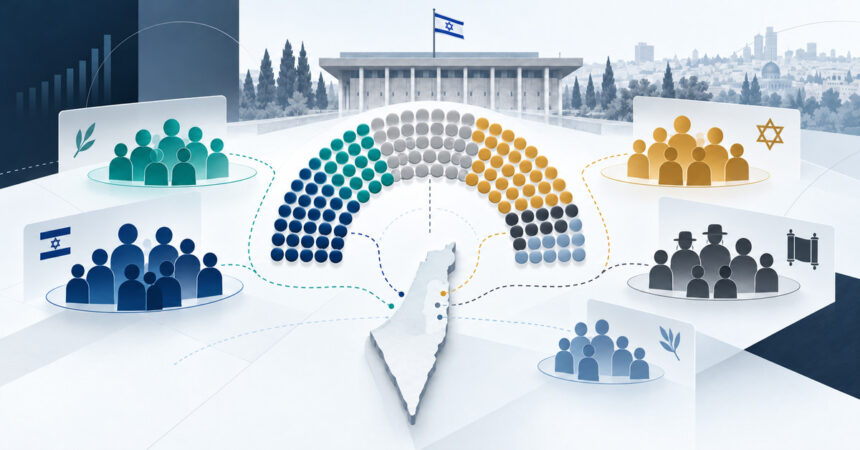
Methodology note: This article is a scenario analysis prepared on 13 October 2026. Bloc figures come from the independently published Israel Votes 2026 composite through 12 October; they are not a Votendi polling average, forecast or probability estimate. The illustration is conceptual, not a seat projection.
Source references
Israel Votes 2026 — current eight-poll bloc average, through 12 October: https://www.israelielection.org/
Israel Votes 2026 — methodology and poll comparisons: https://www.israelielection.org/polls
Channel 12 / N12 — seat poll, 12 October: https://www.mako.co.il/news-israel-elections/2026/Article-cc91389788031a1026.htm
The Jerusalem Post — Shas and UTJ may withhold recommendations, 13 October: https://www.jpost.com/israel-election-2026/article-911533
The Jerusalem Post — Shas–UTJ vote-sharing pact, 11 October: https://www.jpost.com/israel-election-2026/article-911320
The Jerusalem Post — Bennett and Eisenkot's coalition differences, 30 August: https://www.jpost.com/israel-election-2026/article-906999
The Jerusalem Post — Eisenkot on conscription, 28 May: https://www.jpost.com/israel-news/politics-and-diplomacy/article-897694
Ynet — candidate lists for the 2026 Knesset election, 9 September: https://www.ynet.co.il/news/elections2026/article/zhxwpouks
Votendi — Israel Knesset Election 2026 hub: https://votendi.com/elections/israel-knesset-election-2026/