Israel is heading into the final four days before its October 27 Knesset election amid a major security escalation in the occupied West Bank. Two Israeli soldiers were killed and three others wounded in a shooting attack near Hebron on Friday, October 23. Israeli forces killed both Palestinian gunmen, and Prime Minister Benjamin Netanyahu responded by ordering closures and preparing a far-reaching military operation.
The developments have brought security, the government’s response and the treatment of civilians in the West Bank into sharper focus at the end of an election campaign already marked by disagreement over national security. The incident is significant in its own right; it does not establish how Israelis will vote on Tuesday, and there is no new post-attack polling demonstrating a change in public opinion.
What happened near Hebron on October 23?
According to the Israel Defense Forces, two Palestinian gunmen opened fire at a military checkpoint near Yehuda Junction, on the outskirts of Hebron in the southern West Bank. The ensuing gunfight lasted more than 20 minutes before Israeli soldiers shot and killed both attackers. The Israeli army said it believed the gunmen had initially intended to attack civilians travelling on Route 35, but that assessment remains part of a preliminary investigation rather than an independently established account of their plans.
The military identified the soldiers killed as Staff Sgt. Ron Yonatan Roytman, 23, and Sgt. Yuval Shai Svilem, 20, both serving with the Home Front Command’s 775th Search and Rescue Battalion. Three other soldiers were injured. Initial reports described five people as wounded, including two critically; the subsequent military announcement confirmed that the two critically injured soldiers had died.
The military said ammunition recovered from the gunmen’s vehicle was consistent with preparations for a potentially larger attack. Israeli security officials were investigating whether the attackers operated independently or had outside direction or support. The Times of Israel’s account of the IDF’s preliminary findings and Reuters’ reporting from Hebron describe the immediate aftermath.
Hamas praised the shooting in a statement. Reporting on whether it formally claimed responsibility differed as the day developed: an earlier Times of Israel update said the group had not claimed the attack, while The Washington Post’s later report said Hamas had taken responsibility. Any operational link beyond the attackers themselves requires careful attribution as the investigation continues.
Closures, searches and threats of a wider operation
Netanyahu ordered Israeli forces to seal off Hebron and prepare for a possible broader lockdown across the West Bank. Israeli military commanders announced a counterterrorism operation and restrictions on movement in and around Hebron and Halhul. These are reported security decisions and operational preparations, not evidence that every part of the West Bank was already under a complete lockdown.
After visiting the site, Netanyahu said he wanted a much wider operation aimed at dismantling militant infrastructure. He discussed removing residents from part of Hebron and conducting house-to-house searches, likening the approach to earlier Israeli operations in Jenin and Tulkarm.
A Reuters reporter at the scene saw bulldozers begin demolishing Palestinian homes after Netanyahu’s statements. Local residents said the targeted properties were unrelated to the gunmen. Reuters reported that the military had not immediately responded to its request for comment on those claims. The potential displacement of residents, the scope of demolition orders and legal scrutiny of such operations therefore remain important parts of the story, separate from the investigation of the shooting.
Reuters noted that Human Rights Watch had characterized mass expulsions during earlier operations as potential war crimes, an assessment Israel rejects. Friday’s announced plans should not be confused with a judicial finding about this specific operation.
Netanyahu and Eisenkot respond as campaigning nears its end
Netanyahu presented the attack as an indication of the threats facing Israel and said security forces would intensify operations. His coalition allies, including National Security Minister Itamar Ben Gvir and Finance Minister Bezalel Smotrich, called for a stronger military response and for action against the Palestinian Authority. Their proposals are political statements, not measures shown to have been fully implemented.
Opposition politician Gadi Eisenkot, himself a former IDF chief of staff, offered condolences and expressed support for the soldiers. In his campaign, Eisenkot has criticized Netanyahu’s security record while supporting forceful measures against Hamas. The contest therefore should not be reduced to a simple choice between a security-focused government and an opposition opposed to military action.
Netanyahu’s and Eisenkot’s policy differences also extend to coalition partners, governance and their responses to the violence involving settlers in the West Bank. For campaign positions and today’s reactions, see Reuters’ October 23 profile of Eisenkot and The Washington Post’s election-period coverage of the Hebron attack.
The wider West Bank security picture
The shooting follows an escalation of violence involving Palestinian armed groups, Israeli security forces and Israeli settlers in the occupied West Bank. Palestinian attacks on Israeli soldiers and civilians have continued, while rights groups and journalists have reported attacks on Palestinians and their property, particularly during the olive-harvest season.
Reuters reported that recent settler attacks had killed Palestinians and injured other residents and visitors, including journalists and foreign officials. The Israeli government maintains that settlement expansion and security operations serve Israeli interests; United Nations bodies and most governments regard the settlements as illegal under international law, a position Israel disputes.
Those separate strands matter to a credible election analysis. Assessing security requires reporting attacks against Israelis as well as the impact of Israeli operations, settler violence and movement restrictions on Palestinians—not treating any one event as the whole picture.
What can—and cannot—be concluded before October 27?
The attack occurred while the electoral outlook remained highly contested. In a Votendi comparison published on October 23, the Maariv/Lazar survey projected 48 seats for Netanyahu’s bloc, while Channel 14/NEXT DATA projected 62. A majority in the 120-seat Knesset requires 61 seats.
That polling disagreement existed before the full political impact, if any, of Friday’s security events could be measured. An attack, a speech or a military order should not be treated as an election result or as proof that voters have changed their preferences. The surveys’ dates, samples and methods also differ, so they cannot be combined casually into a new outcome prediction.
The practical questions for the coming days are whether the security operation expands, what happens to movement restrictions and residents in the Hebron area, whether investigators establish the attack’s organizational links, and how competing political figures address the crisis. The consequences for coalition negotiations can only be assessed using election results and the parties’ actual positions.
For polling, party lists, election rules and ongoing reporting, visit Votendi’s Israel Knesset Election 2026 hub.
Sources and reporting note
- Reuters, October 23, 2026 — attack, military response, Netanyahu’s visit, demolitions, local accounts and wider West Bank context.
- The Times of Israel / IDF announcement, October 23 — soldiers’ identities and updated casualty information.
- The Times of Israel, October 23 — preliminary IDF account of the shooting and operational orders.
- The Washington Post, October 23 — statements by political leaders, reported Hamas response and election context.
- Reuters, October 23 — Eisenkot’s political background and policy positions.
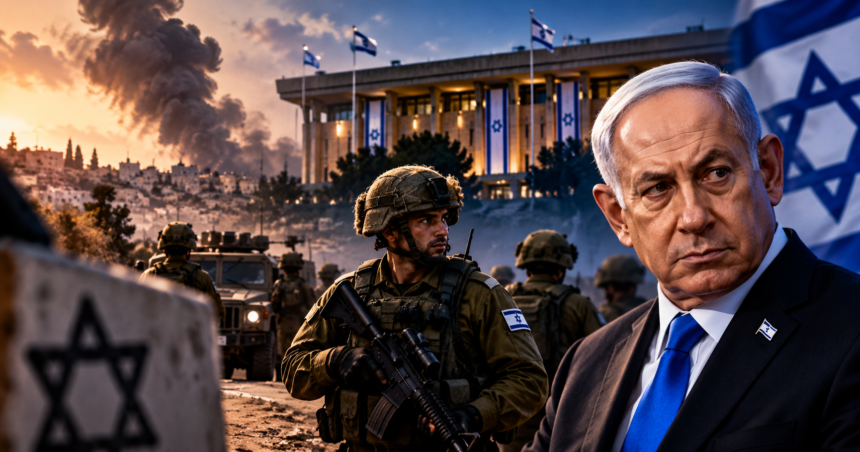
Reporting cut-off: October 23, 2026. Military assessments, allegations by local residents and political declarations are attributed to their sources. This article does not claim to measure the electoral effect of the attack, and it does not constitute a Votendi forecast. Featured image: archival photograph of the Knesset in Jerusalem (2022), Clema12 / Wikimedia Commons, CC BY-SA 4.0; it does not depict the October 23 attack.