
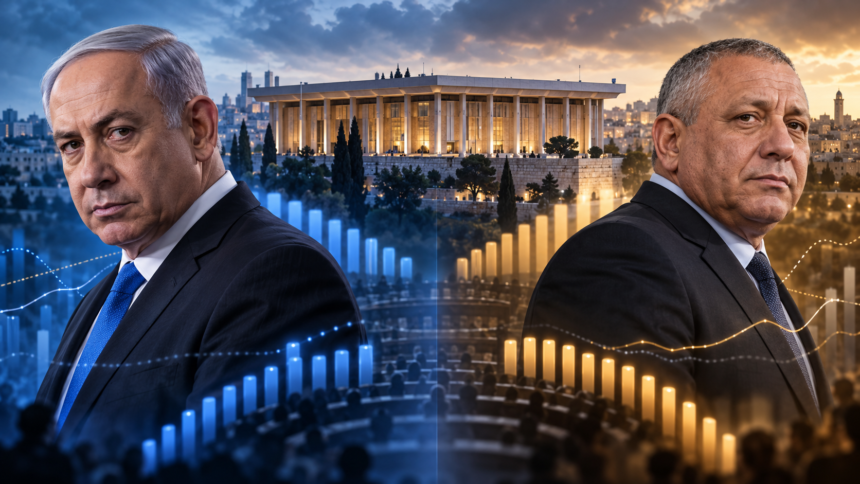
Four days before Israel votes, the final round of Knesset polling offers two strikingly different pictures of the parliamentary balance. Maariv’s Lazar Research survey gives Benjamin Netanyahu’s bloc 48 seats; Channel 14’s NEXT DATA survey gives it 62. Both were released at the end of the same campaign week. The discrepancy is not a difference of one or two marginal seats: it changes whether that bloc is above or below the 61-seat majority line.
Israel’s election is scheduled for Tuesday, October 27, 2026. With 120 seats in the Knesset, the immediate analytical question is not merely which party tops a survey. It is whether the eventual distribution of seats can sustain a government—and which parties are willing to cooperate.
The same election, a 14-seat gap
The final Maariv/Lazar survey, reported on October 23, puts Gadi Eisenkot’s Yashar on 21 seats, Netanyahu’s Likud on 19 and Naftali Bennett’s B’Yachad on 15. Under the published bloc grouping, the Netanyahu-aligned parties total 48 seats, the principal Zionist opposition parties 54, Arab lists 14 and the Reservists–Economic Party four. Neither principal bloc reaches 61 on its own.
The Channel 14/NEXT DATA survey published on October 22 instead has Likud on 30, Yashar on 20 and B’Yachad on 11. It reports 62 seats for Netanyahu’s bloc, 44 for the opposition grouping and 14 for the Arab parties.
| Projected seats | Maariv / Lazar | Channel 14 / NEXT DATA |
|---|---|---|
| Likud (Netanyahu) | 19 | 30 |
| Yashar (Eisenkot) | 21 | 20 |
| B’Yachad (Bennett) | 15 | 11 |
| Netanyahu bloc | 48 | 62 |
| Zionist opposition bloc | 54 | 44 |
| Arab parties | 14 | 14 |
| Reservists–Economic / unaligned | 4 | 0 |
Source-reported projections from different surveys; totals reflect each outlet’s bloc classifications. They are neither official results nor a Votendi polling average or forecast. Data published October 22–23.
The most visible divergence is Likud itself: 19 versus 30 seats. Eleven of the 14 seats separating the Netanyahu-bloc totals correspond to the difference in Likud projections, although seats cannot be treated as independently transferable across parties. Variation in survey methods, turnout assumptions, weighting and smaller-party thresholds also matters. Without comparable underlying microdata, the precise cause cannot be established.
Why the 3.25% threshold still matters
Israel’s 3.25% electoral threshold creates a discontinuity: a list narrowly below it receives no seats, and votes for nonqualifying lists do not count towards seat allocation. That can change several other parties’ mandates even when their underlying vote shares move only slightly.
In the Maariv poll, Ofer Winter’s Amcha Yisrael receives 3.0%, below the threshold, while the Reservists–Economic Party led by Yoaz Hendel and Yaron Zelekha receives 3.5% and a projected four seats. In the Channel 14 poll, both are below the threshold. The difference helps produce distinct parliamentary maps, but it does not by itself explain the much larger disagreement over Likud’s support.
This is also why a bloc label should not be mistaken for a signed coalition agreement. Maariv’s 54 opposition seats plus the four seats assigned to the Reservists–Economic Party would total 58, still short of 61—and there is no automatic commitment from the smaller list. Arab parties’ projected 14 seats may become relevant to parliamentary arrangements, but their possible participation or outside support is a separate political question, not something established by adding columns.
A unity government is popular in one poll—but the question matters
Maariv also asked what voters would prefer if the election produced no clear outcome. 60% of respondents supported forming a unity government rather than returning immediately to the polls: 33% preferred a prime minister from the change bloc, 19% Netanyahu, and 8% said the leader’s identity was not important so long as unity was achieved. Another 23% preferred a new election. These figures describe responses to that hypothetical question, not an agreement among political parties.
However, a separate Israel Democracy Institute survey published October 22 found a different pattern when respondents were offered a set of alternatives in a stalemate. Among Jewish respondents, 35% preferred another election, 28% a unity government with rotation and 23% a minority government. Among Arab respondents, 46% preferred another election, 9% unity and 25% a minority government.
These two sets of percentages should not be presented as a direct trend or contradiction. The questions, answer choices and reported populations differ. The comparison instead highlights how cautiously the phrase “public support for unity” should be interpreted before actual coalition proposals, partners and leadership arrangements are specified.
Voter certainty is not the same as turnout
Maariv’s survey additionally reports that 81% of respondents said they were certain to vote. That is a measure of stated intention, not a verified turnout forecast. Actual turnout, including turnout among different communities and supporters of small parties, is one of several unknowns that could change the final distribution.
The latest findings follow earlier Channel 12 and Channel 13 polling that also put Yashar ahead of Likud, but not necessarily within reach of a self-sufficient governing majority. The differences between polling outlets have persisted into the campaign’s closing stage.
What to watch on October 27
Four questions are more useful than declaring an election winner from any one survey: how many seats each list actually receives; which small parties cross 3.25%; whether an aligned group reaches 61; and what governing commitments, if any, the elected parties are prepared to make.
The distinction between leading the party table and assembling a parliamentary majority remains essential. A seat projection is a snapshot of respondents’ preferences translated through an electoral formula, while coalition formation depends on political negotiations after voting.
Follow individual surveys, parties and the election rules in Votendi’s Israel Knesset Election 2026 hub. Votendi treats Israel as a curated election hub and does not present these figures as a proprietary polling average.
Sources and methodology
- Maariv / Lazar Research results via Walla, October 23, 2026. Seat and bloc figures from a survey reported with 1,048 respondents; reporting notes 3.5% for Hendel–Zelekha and 3.0% for Winter.
- Channel 14 / NEXT DATA, October 22, 2026. Survey reporting 7,936 adult participants; compare independently with Maariv rather than pooling as equivalent observations.
- Maariv / Lazar’s unity-government and turnout question, reported October 23.
- Israel Democracy Institute / Viterbi Center, October 22, 2026. Online fieldwork October 18–21, 601 Hebrew-language and 127 Arabic-language respondents, representative of adults aged 18+, stated maximum sampling error ±3.63 percentage points for the full sample.
Editorial cut-off: October 23, 2026. Numbers are attributed to their original publishers and should not be understood as official outcomes, odds or Votendi forecasts. Photo: Clema12 / Wikimedia Commons (CC BY-SA 4.0), 2022; photograph previously uploaded to Votendi.