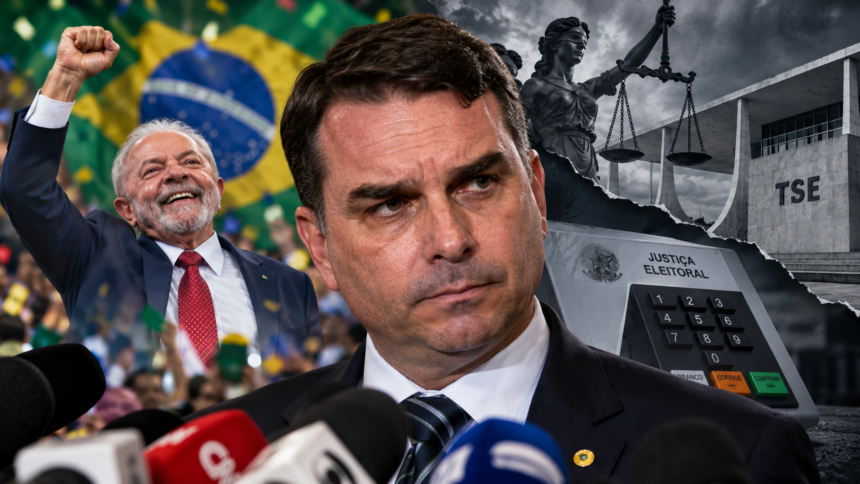
Brazil is facing a new post-election dispute after defeated presidential candidate Flávio Bolsonaro refused to recognize Luiz Inácio Lula da Silva’s victory and announced plans to challenge the result in court. The controversy centers on an unprecedented decision to extend voting by two hours, even though both presidential campaigns had sought additional voting time.
Brazil’s presidential runoff on Sunday, October 25, delivered a historic fourth term for President Luiz Inácio Lula da Silva. But the election’s conclusion has been followed by a political and legal confrontation, with his defeated opponent, Senator Flávio Bolsonaro, questioning the legitimacy of the voting process.
Speaking to journalists after the result became clear, Bolsonaro said he would seek to annul the election, arguing that the extension of voting hours had compromised the process.
The announcement comes despite a victory margin of more than 4.4 million votes for Lula, according to Brazil’s Superior Electoral Court (TSE).
Official results confirm Lula’s victory
The TSE announced the following national results:
| Candidate | Votes | Share |
|---|---|---|
| Luiz Inácio Lula da Silva (PT) | 64,256,232 | 51.79% |
| Flávio Bolsonaro (PL) | 59,826,041 | 48.21% |
Lula won by 4,430,191 votes, a margin of 3.58 percentage points.
Approximately 128.2 million Brazilians participated in the runoff, with abstention estimated at 19.2%.
The outcome marked an extraordinary reversal from the first round, when Flávio Bolsonaro finished ahead of Lula. The president ultimately recovered enough support to secure another term in office.
The official result remains in force despite Bolsonaro’s announcement that he intends to challenge it.
Why is Bolsonaro challenging the election?
At the center of the dispute is a decision by Supreme Federal Court Justice Cristiano Zanin to extend voting until 7 p.m., two hours beyond the normal closing time.
The decision followed reported difficulties affecting voters attempting to reach polling stations, including transportation disruptions and severe weather in parts of Brazil.
Bolsonaro described the intervention as unacceptable and questioned whether the election could be recognized under those circumstances.
However, there is an important complication for his legal argument.
According to reporting by Reuters and Brazil’s public news agency Agência Brasil, both presidential campaigns had requested measures to address voting disruptions.
Bolsonaro’s own campaign had also sought additional voting time because of heavy rainfall in southern Brazil, where he enjoyed significant electoral support.
The Supreme Court decision therefore responded to concerns raised by both sides, even though Bolsonaro subsequently challenged its consequences.
The extension did not operate identically at every polling station. Voting locations that had already closed were not simply reopened, while some locations remained open under the court’s instructions.
These procedural differences may become relevant if Bolsonaro’s lawyers formally pursue their challenge.
Could Brazil’s election result be overturned?
The distinction between announcing a legal challenge and successfully overturning an election is crucial.
Bolsonaro has said that his legal team will seek annulment, but that announcement does not itself invalidate the certified vote count or demonstrate electoral fraud.
Analysts cited by Reuters consider the prospect of overturning the result unlikely, particularly given Lula’s margin of more than four million votes and the fact that Bolsonaro’s campaign also requested a voting extension.
Any formal challenge would have to be assessed by the competent judicial authorities, based on evidence and applicable electoral law.
At the time of writing, there is no verified judicial finding that the voting extension changed the election’s outcome.
The central unanswered questions are whether Bolsonaro will submit a formal petition, what specific legal grounds his lawyers will invoke and how electoral authorities will respond.
The Bolsonaro family’s political legacy returns to the spotlight
The refusal to concede also carries broader historical significance.
Flávio Bolsonaro is the son of former president Jair Bolsonaro, whose defeat by Lula in 2022 was followed by prolonged political tensions.
On January 8, 2023, supporters of Jair Bolsonaro stormed Brazil’s principal government institutions in Brasília.
Jair Bolsonaro was subsequently convicted for his role in a plot to overturn the democratic order and sentenced to 27 years in prison.
The younger Bolsonaro’s rejection of the 2026 result has therefore revived questions about how the country’s political institutions will manage another contested presidential transition.
Nevertheless, a legal challenge and an attempt to overturn the constitutional order are fundamentally different matters. There is no basis for treating future unrest as inevitable.
Lula faces a difficult fourth term
Lula’s victory represents another major chapter in a political career that has already included multiple presidential terms, imprisonment, the annulment of previous corruption convictions and a return to office.
The president has promised to govern for all Brazilians.
Yet his new mandate will begin against a complex political backdrop.
Bolsonaro-aligned lawmakers and other right-wing parties retain considerable strength in Congress, potentially complicating the president’s legislative agenda.
Brazil also faces substantial economic challenges, including high public debt, elevated borrowing costs and pressure on household finances.
Financial markets reacted negatively to Lula’s reelection, reflecting concerns among some investors over the country’s fiscal outlook.
The election result has also attracted international attention, particularly in Washington, where the Trump administration had backed the Bolsonaro family’s return to power.
What happens next?
The immediate focus now shifts from vote counting to the legal and political aftermath.
The TSE has announced Lula’s reelection, but Bolsonaro’s proposed challenge could prolong public debate over the voting process.
Several developments will determine how the situation unfolds: whether a formal annulment request is filed, whether the courts accept the arguments presented and how Bolsonaro’s supporters and other political actors respond.
For Brazil, the central issue is no longer who received the most votes. The official count has answered that question.
The question now is whether the country’s political leaders and institutions can resolve the dispute through established democratic and judicial procedures.
Votendi will continue monitoring official electoral decisions, legal developments and reactions to Brazil’s 2026 presidential election result.
Sources: Brazil’s Superior Electoral Court (TSE); Reuters, October 26; Agência Brasil.
Votendi Editorial Team | October 26, 2026