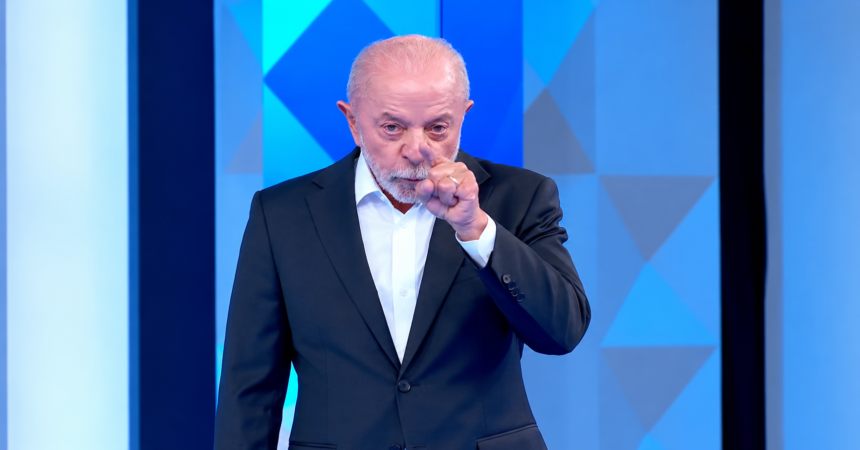
Flávio Bolsonaro had delivered a first-round shock and became the overwhelming favourite on prediction markets. Then, in Brazil’s final presidential debate, he mocked the finger Lula lost in a factory accident. Two days later, Lula had turned the election around. Did that exchange help cost Bolsonaro the presidency?
It is a compelling question after an extraordinary campaign. Bolsonaro finished ahead in the opening round on October 4, only for Luiz Inácio Lula da Silva to recover and win the October 25 runoff. Reuters described the result as the first presidential victory in Brazil for a candidate who had finished behind in the first round.
But identifying the most memorable moment of a comeback is easier than proving what caused it. The debate exchange offers a revealing account of political communication; the evidence does not establish that one remark decided the election.
From first-round shock to overwhelming market favourite
Bolsonaro’s stronger-than-expected first-round performance transformed the contest. Polymarket’s published market context described a finish of approximately 47%, ahead of Lula at approximately 45%, and an implied victory probability of 86% during the runoff campaign.
Those figures help explain the scale of Lula’s reversal, but their timing matters. There was no single, fixed 85% probability throughout the final days. EXAME’s account records Bolsonaro reaching 89% on October 9 and standing at 80.2% in its October 24 snapshot.
Prediction-market prices express traders’ expectations. They are neither vote shares nor guarantees. Bolsonaro was heavily favoured in that market, but the election still had to be won at the ballot box.
The insult that gave Lula an opening
During the October 23 Globo debate, Bolsonaro argued that Lula gave with one hand and took away with “nine fingers”. The remark referred to the missing little finger on Lula’s left hand, lost while he was working in a factory as a teenager.
Lula responded by invoking his experience of industrial work, night shifts and workplace injuries. He demanded an apology. UOL’s contemporaneous report confirms that Bolsonaro subsequently apologised.
The excerpt below shows Lula’s response. It does not contain the complete exchange, including Bolsonaro’s initial remark and subsequent apology.
How a personal attack became a story about work
Votendi’s reading of the exchange is that Bolsonaro gave Lula an opportunity to change the emotional terms of the argument.
A discussion of taxation and purchasing power became a confrontation over lived experience: a factory worker’s injury, the dignity of manual labour and whether an opponent understood that world. Lula could present the missing finger as evidence of the biography behind his politics.
That interpretation explains why the footage is powerful. It does not establish how many people changed their votes after seeing it, whether they moved towards Lula, or whether other events mattered more.
The polling complicates the turning-point story
A Datafolha survey reported by Folha after the debate found an even split over who performed better: 36% chose Lula and 36% Bolsonaro. Only 2% said the programme changed their vote, while 98% said it did not.
For the performance question, Datafolha interviewed 1,867 people on October 24; the reported margin of error was two percentage points.
Those findings do not measure the isolated effect of the missing-finger exchange. Nor do they capture every possible effect on turnout or later exposure to clips. They nevertheless provide no basis for claiming a demonstrated, decisive shift caused by the remark.
A defining image of the comeback — but was it the cause?
Lula’s victory is established; the precise contribution of this exchange remains uncertain. The strongest conclusion is that Bolsonaro supplied his opponent with an unusually effective opportunity to make a personal and political case at the campaign’s climax.
It may become one of the defining images of an election in which the favourite lost. Whether it was the moment that made him lose is a harder question — and one the available evidence cannot settle.
Read more: Brazil’s final results and election-night archive and Bolsonaro’s response to defeat.
Sources: Reuters via UOL; Polymarket market context; EXAME; UOL; Folha/Datafolha. Video: user-supplied excerpt of TV Globo’s debate, redistributed with RT branding and English subtitles. The excerpt is presented for analysis; allegations made within it are the speaker’s claims.