



- The latest numbers: a majority on paper
- PP and Vox already have a working relationship
- Feijóo wants a PP government. Vox wants influence.
- What concessions could Vox demand?
- Would Vox need to enter the cabinet?
- Is there a parliamentary majority for PP without Vox?
- Could PSOE allow a PP minority government?
- The three questions that matter after 29 November
- Sources and methodology
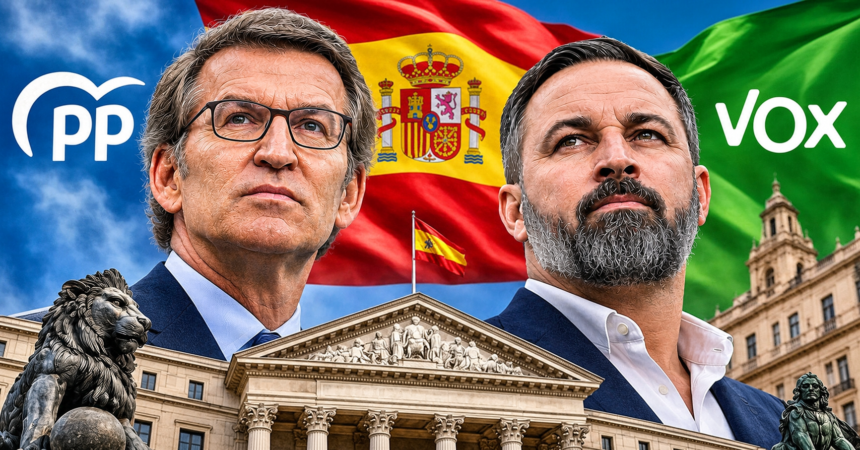
With eight days until Spain’s general election, a new poll points to a parliamentary majority for PP and Vox. Yet Alberto Núñez Feijóo and Santiago Abascal remain divided over the terms of cooperation — and the alternatives are politically complicated.
Spain’s general election on 29 November could produce a parliament in which the centre-right People’s Party (PP) and the right-wing Vox party have enough seats to form a majority. But whether that would lead to a coalition government, a PP minority administration or a prolonged negotiation remains unresolved.
The latest 40dB tracking survey, published on 20 November for El País and Cadena SER, projects 189 seats for PP and Vox together — 13 above the absolute-majority threshold of 176 in Spain’s 350-seat Congress of Deputies.
That arithmetic is significant. However, parliamentary support and participation in government are different political commitments. Feijóo has repeatedly expressed his preference for a single-party PP government, while Vox leader Santiago Abascal continues to demand clarity about potential post-election alliances.
On Saturday, 21 November, Abascal again criticised PP campaign appeals for a tactical vote and challenged Feijóo to explain whom he would negotiate with after the election.
The dispute highlights an increasingly important distinction: the two parties have experience governing together, but they have not agreed on the composition or full programme of a future national government.
The latest numbers: a majority on paper
The 40dB survey conducted between 16 and 20 November interviewed 2,000 respondents online and produced the following estimates.
| Party | Vote share | Projected seats |
|---|---|---|
| People’s Party (PP, including UPN alliance) | 31.9% | 133 |
| Socialist Party (PSOE) | 31.2% | 124 |
| Vox | 17.1% | 56 |
| PP/UPN + Vox | 49.0% | 189 |
The combined seat estimate would exceed the 176-seat threshold, even though the two parties’ estimated vote shares add up to less than 50%.
This is possible because Spain allocates congressional seats through 52 constituencies, rather than distributing all 350 seats according to a single national proportional formula.
The projection is a model produced by 40dB, not an election result or an independent Votendi seat forecast. Constituency-level uncertainty means the eventual distribution could differ.
There is another important dimension.
Votendi’s Spain election polling tracker displayed weighted national averages of 30.6% for PP, 28.1% for PSOE and 18.5% for Vox, in its 18 November update.
Those averages differ from the latest 40dB release, particularly for PSOE and Vox.
The 20 November 40dB survey places the Socialists 3.1 percentage points above Votendi’s displayed average, while Vox is 1.4 points below it.
This does not demonstrate that the wider electorate has shifted by those amounts. Individual polling organisations have different methodologies, and daily tracking waves may reuse respondents across overlapping fieldwork periods.
The distinction matters when translating survey percentages into potential parliamentary majorities.
PP and Vox already have a working relationship
Relations between PP and Vox are no longer defined solely by the failed attempt to form a national government following the 2023 election.
The parties currently govern together in four autonomous communities: Extremadura, Aragón, Castilla y León and Andalusia.
Their regional agreements include policies on immigration, housing, family support, taxation and public administration. Vox has also obtained executive responsibilities through vice-presidencies and regional ministries.
These arrangements followed an earlier breakdown in relations in 2024, when Vox withdrew from several regional coalition governments.
The subsequent return to formal cooperation demonstrates that both parties are capable of negotiating new agreements despite past disputes.
They have also reached an electoral understanding concerning Senate candidacies.
However, agreements at the regional level do not automatically establish the terms of a national coalition.
The central government would have responsibility for immigration law, national taxation, relations with the European Union, foreign policy and other areas that create additional political and legal constraints.
Feijóo wants a PP government. Vox wants influence.
Feijóo has maintained that his preferred outcome is a government composed exclusively of PP ministers.
In an interview published on 8 November, he did not exclude a coalition with Vox but argued that a single-party administration would be preferable.
He has also said that Abascal has not formally demanded specific national ministries or vice-presidential positions in their conversations.
On 18 November, Feijóo reiterated that he would not accept an agreement at any price. He described the conversations with Abascal as constructive while insisting that any deal must remain within Spain’s constitutional and European legal framework.
For Vox, meanwhile, the question extends beyond which politicians occupy cabinet seats.
Abascal wants commitments on government policy and is seeking an explicit answer about whether PP might instead negotiate with PSOE or other parties.
His comments on 21 November also illustrated the competition between the two parties during the campaign: Vox opposes suggestions that its voters should support PP simply to increase the larger party’s seat total.
The relationship therefore involves both cooperation over potential government formation and competition for votes.
What concessions could Vox demand?
Vox published its 115-point election programme on 12 November, organised around 13 policy areas.
The document places particular emphasis on immigration, national preference in public services, deregulation, tax reductions and changes to the territorial organisation of Spain.
If Vox’s parliamentary votes were required for a PP administration, these proposals could become the starting point for negotiations.
Immigration and residency
Vox proposes tougher immigration controls, restrictions on regularisation, expanded deportation measures and a policy it calls remigration.
It also advocates removing the arraigo route through which certain foreign residents can regularise their status after establishing ties to Spain.
Feijóo has taken a different approach to the concept of national preference, arguing that access criteria should be based on legal residence and established ties rather than nationality alone.
This is a fundamental policy disagreement, not merely a dispute over terminology.
Housing and social benefits
Vox wants preferential access for Spanish nationals to social housing and certain public benefits, along with changes to eligibility for the minimum income scheme.
PP supports changes to housing and welfare policy but has not endorsed every nationality-based restriction proposed by Vox.
A national agreement would have to define which measures could be implemented under existing constitutional and European obligations.
Taxation and economic policy
Both parties advocate tax reductions, but Vox proposes a particularly extensive programme of cuts to personal income tax, VAT and corporate taxation.
It also wants to reverse aspects of labour-market regulation and reduce administrative restrictions on businesses.
Negotiations would therefore involve fiscal costs, spending commitments and the national budget.
Energy and environmental policy
Vox wants to reverse Spain’s planned nuclear phase-out and opposes major elements of the European Green Deal.
Some energy priorities overlap with positions advocated by PP, but national legislation and European obligations would still constrain implementation.
Gender equality and social legislation
Vox proposes repealing gender-related legislation and replacing parts of the existing legal framework.
Feijóo has presented equality policy and the protection of established rights as important limits on any negotiations.
Regional autonomy
One of the clearest differences concerns Spain’s territorial system.
Vox advocates stronger central control and a reduction in the political role of autonomous institutions.
PP, despite its opposition to Catalan and Basque independence movements, supports the current decentralised constitutional system.
Feijóo has explicitly rejected recentralisation as a condition of an agreement.
These disagreements mean that a possible pact would require compromises on specific legislation rather than a simple merger of the parties’ political programmes.
Would Vox need to enter the cabinet?
Not necessarily.
A party can support the election of a prime minister without participating directly in the government. It can also agree to support annual budgets or selected legislation while remaining outside the cabinet.
For PP and Vox, two principal arrangements are therefore conceivable.
Under the first, PP would form a single-party administration with Vox providing parliamentary support. Such an agreement could contain commitments on legislative priorities, immigration, spending and the government programme.
Under the second, PP and Vox would negotiate a formal coalition, including the distribution of ministerial responsibilities.
The regional agreements provide examples of both policy concessions and executive power-sharing, but neither national arrangement has been agreed.
The distinction would matter for accountability. A Vox minister would exercise direct executive responsibilities, while an external parliamentary partner would influence policy primarily through negotiations and votes.
Is there a parliamentary majority for PP without Vox?
This is where the alternatives become more difficult.
Spain has several regional and nationalist parties that can play important roles in negotiations. But they have different priorities, and some have explicitly rejected agreements that would bring Vox into government or give it decisive influence.
According to the 20 November 40dB seat estimates, the hypothetical arithmetic looks like this:
| Hypothetical combination | Seats |
|---|---|
| PP including UPN | 133 |
| PP/UPN + PNV | 136 |
| PP/UPN + PNV + Junts | 139 |
| PP/UPN + PNV + Junts + Coalición Canaria | 140 |
| Absolute majority required | 176 |
These figures are an illustrative addition of the pollster’s party estimates, not a proposal for a coalition.
Even combining PP with these three regional forces would leave it 36 seats short of an absolute majority.
There are also major political obstacles.
The Basque Nationalist Party (PNV) has rejected cooperation involving Vox. Its candidate Maribel Vaquero said in a 15 November interview that the parties’ positions are incompatible.
Junts has also ruled out supporting Feijóo’s investiture. On 19 November, its leading candidate Míriam Nogueras reiterated the party’s position while also criticising PSOE.
Coalición Canaria is more open to negotiations. Its candidate Cristina Valido said on 14 November that the party could support either Feijóo or Sánchez if its programme for the Canary Islands were accepted.
That flexibility, however, would not compensate for the much larger numerical gap.
The latest arithmetic therefore illustrates the difficulty of assembling an alternative PP-led majority solely through smaller regional parties.
Could PSOE allow a PP minority government?
There is a constitutional distinction between forming an absolute majority and winning an investiture vote.
Under Article 99 of Spain’s Constitution, a prime ministerial candidate must obtain an absolute majority in the first vote.
If that fails, a second vote takes place 48 hours later, requiring a simple majority: more votes in favour than against.
Abstentions can therefore affect whether a candidate takes office.
In principle, Feijóo could become prime minister without a formal coalition if enough lawmakers abstained rather than voting against him.
One theoretical route would involve PSOE abstaining to permit a PP government without Vox ministers. Another would require a different combination of supporting and abstaining parties.
But the constitutional possibility should not be confused with an existing agreement.
Feijóo has not presented PSOE abstention as his preferred strategy, while Abascal has repeatedly challenged him to rule out a post-election understanding with the Socialists.
Such an arrangement would also raise significant questions about whether a PP government could subsequently pass budgets and other legislation.
Winning the investiture vote is only the beginning of parliamentary government.
The three questions that matter after 29 November
The election result will determine the distribution of seats, but several important decisions could remain unresolved after polling day.
The first is whether PP and Vox together have sufficient representation to support a government without additional parties.
The second is what type of agreement they would be prepared to negotiate. A written programme supporting a minority administration would have different implications from a formal coalition with shared cabinet responsibilities.
The third is whether parties outside the PP–Vox bloc would be prepared to support or abstain in an investiture vote, particularly if negotiations between Feijóo and Abascal became difficult.
These possibilities depend on the actual result and subsequent decisions by party leaders.
The central uncertainty is not simply whether PP and Vox can reach 176 seats. It is how parliamentary arithmetic could be translated into a functioning government — and which policy commitments would be required to secure that support.
For now, Spain’s election polls describe possible parliamentary configurations, not a settled government agreement.
Sources and methodology
This analysis uses the 40dB tracking poll published on 20 November 2026 (2,000 online interviews, fieldwork 16–20 November), the 18 November snapshot of the Votendi Spain polling tracker, reports from EFE, RTVE and El País, Vox’s published election programme and Article 99 of the Spanish Constitution.
The 189-seat combination is the pollster’s projection, not Votendi’s own election forecast. Hypothetical parliamentary combinations are arithmetic illustrations, not predictions of coalition formation.
Key references: Abascal’s 21 November remarks, EFE · 40dB poll detail on Votendi · Feijóo’s position on coalition negotiations, EFE · Vox’s election programme · Regional PP–Vox agreements, RTVE · Junts’ position, RTVE · Coalición Canaria, EFE · Spanish Constitution, Article 99.