
- What Elabe actually says about Christine Lagarde
- France’s 9 November presidential poll tells a different story
- Macron’s confidence rating falls to 13%
- Why Lagarde’s ECB departure has revived speculation
- A parallel decision: who succeeds her at the ECB?
- What Votendi will watch next
- Sources and survey methodology
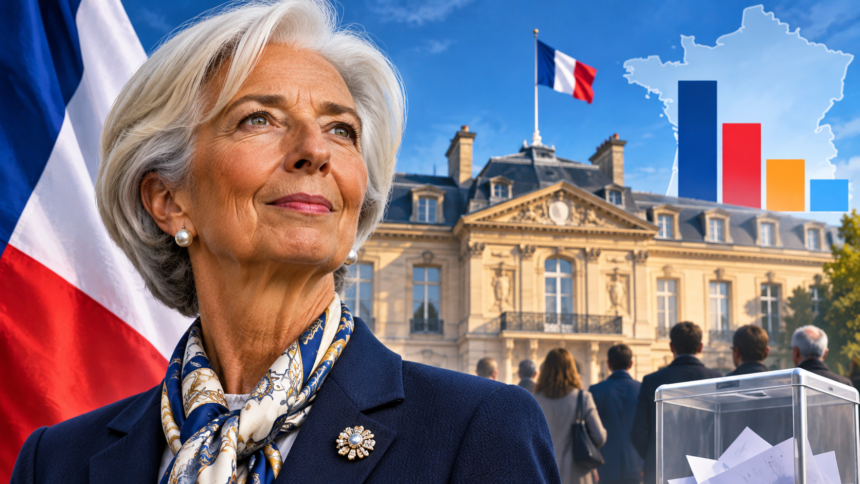
Christine Lagarde has a 62% positive image among voters who backed Emmanuel Macron in the first round of France’s 2022 presidential election, according to a new Elabe political barometer. But a separate presidential voting-intention poll released on Monday, 9 November, does not test the outgoing European Central Bank president as a candidate. The difference between personal popularity and actual electoral support is central to understanding her possible role in 2027.
PARIS | 9 November 2026 — France’s presidential debate is unfolding along two tracks. A new Elabe survey gives Christine Lagarde a notable profile among the former Macron electorate, while the latest Toluna–Harris Interactive poll for RTL and M6 measures continued pressure on established centrist contenders in hypothetical first-round scenarios. Lagarde appears in the former survey but not the latter.
What Elabe actually says about Christine Lagarde
In Elabe’s November political barometer, published on 5 November, 27% of French respondents expressed a positive image of Lagarde, three percentage points above her March reading. Édouard Philippe also stood at 27% in the national positive-image measure; Gabriel Attal registered 22%. These percentages are assessments of political personalities, not intended first-round votes.
The distinction becomes even more relevant in the subgroup of people who voted for Macron in the first round of 2022:
| Political figure | Positive image among Macron’s 2022 first-round voters |
|---|---|
| Christine Lagarde | 62% (+5 points since March) |
| Édouard Philippe | 62% (–8 points from the previous reading) |
| Gabriel Attal | 54% (–7 points) |
| Gérald Darmanin | 50% (+1 point) |
| Raphaël Glucksmann | 47% (+10 points) |
Source: Elabe, L’Observatoire politique – November 2026. Subgroup percentages are not comparable with a general-election voting-intention question.
This helps explain why Lagarde’s name is repeatedly mentioned in discussions about the centre’s political future. It does not establish that 62% of Macron’s former voters would vote for her for president. A respondent can express a favorable opinion about several public figures simultaneously, while a presidential ballot asks for a specific choice from a named set of candidates.
France’s 9 November presidential poll tells a different story
A separate Toluna–Harris Interactive survey, released on 9 November and conducted for RTL and M6, reports first-round intentions across five different candidate lineups. Marine Le Pen receives between 34% and 36% across those configurations, while Jean-Luc Mélenchon stands at 18%–19%.
Édouard Philippe’s estimated support varies with the candidate field: he reaches 14% when tested as the single main centrist contender, compared with 11% in a scenario in which Gabriel Attal also runs. In a lineup that includes David Lisnard and Dominique de Villepin, Philippe registers 12% and Mélenchon 19%. The figures are scenario-specific; they should not be averaged or treated as one ballot.
Crucially, Lagarde is not among the candidates tested in the newly released presidential scenarios. That means the new voting-intention study cannot answer whether she would attract support similar to Philippe’s, alter the balance of the political centre or compete for a place in a hypothetical runoff. Any such claim would go beyond the published evidence.
The poll also reports that 66% of respondents supported the idea of a joint primary across the centre and right. That is a measure of opinion about a selection process, not a finding that such a primary has been agreed or that Lagarde would participate in it.
Macron’s confidence rating falls to 13%
The wider political context is challenging for France’s incumbent administration. The same Elabe November barometer gives President Emmanuel Macron a 13% confidence rating, down four points in a month, while 82% say they do not trust him to deal effectively with France’s main problems. Prime Minister Sébastien Lecornu registers 17% confidence.
Macron’s personal confidence rating, Lagarde’s positive-image score and the presidential vote shares measured by Toluna–Harris are three different survey indicators collected for different questions and samples. They cannot be placed on the same polling-average line or interpreted as interchangeable percentages.
Why Lagarde’s ECB departure has revived speculation
The European Central Bank confirmed on 29 October that Lagarde would step down on 7 February 2027, nearly nine months before the scheduled end of her term. She has said that leaving the bank would allow her more freedom to speak and engage on matters beyond monetary policy, which requires the ECB president to maintain political neutrality.
Yet a presidential candidacy remains unconfirmed. In a September interview with La Croix, she argued that running would not be a good idea, referring to the demands of the office. In late October she declined to say whether she would endorse a candidate. Le Monde’s reporting on 7 November described speculation among centrist and conservative politicians but found no visible campaign preparations. The same reporting identified a possible future leadership role at the World Economic Forum as another explanation for her plans.
For now, being discussed as a potential political figure is not equivalent to declaring a candidacy, obtaining the required endorsements or appearing on an actual presidential ballot.
A parallel decision: who succeeds her at the ECB?
While French politicians consider the implications of her departure, euro-area governments are also negotiating the succession at the ECB. According to Euronews, countries were asked to submit nominees by 6 November, with finance ministers scheduled to review the field on 9 November. Former Dutch central-bank governor Klaas Knot and former Bank of Spain governor Pablo Hernández de Cos are two publicly backed names in that discussion.
The EU appointment process is separate from the French presidential election, although the early exit allows European leaders to consider the ECB transition before France votes in 2027. As of publication, a meeting scheduled for today should not be confused with a confirmed final appointment.
What Votendi will watch next
The next meaningful development in Lagarde’s electoral story would be a formal political announcement or a published voting-intention poll that explicitly includes her in a named candidate lineup. Until then, the 27% national positive-image reading and the 62% figure among Macron’s 2022 voters remain popularity measurements — not a presidential polling result.
Lire cette analyse en français →
For context, see Votendi’s earlier analysis, France 2027: Christine Lagarde’s ECB exit fuels presidential speculation, and its French-language explainer.
Sources and survey methodology
Elabe: L’Observatoire politique, 5 November 2026, fieldwork 3–4 November among 1,004 French adults, using a quota-based representative sample. Its measures concern political confidence and positive or negative views of public figures.
Toluna–Harris Interactive: Presidential voting-intention study, released 9 November 2026, online fieldwork 3–5 November with 2,101 registered voters drawn from a representative adult sample of 2,436. Results vary by candidate lineup. Additional coverage: RTL and Reuters, 9 November.
Institutional and political context: ECB departure announcement, Euronews on ECB succession, and Le Monde on presidential speculation.
Votendi does not infer hypothetical presidential vote shares from favorability surveys and does not count an undeclared candidate in its presidential polling average without a suitable published voting-intention poll.