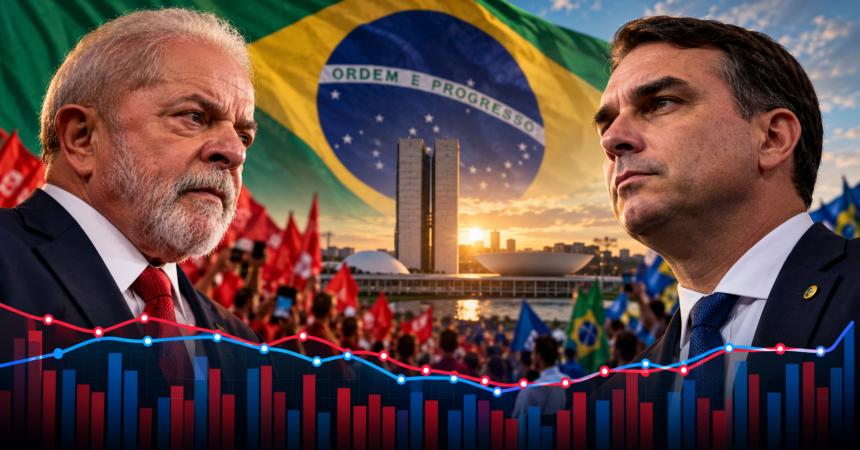
Brazil enters its October 25 presidential runoff after an extraordinary final day of polling. Twelve national surveys released on October 24 and early October 25 show a highly competitive contest between President Luiz Inácio Lula da Silva and Senator Flávio Bolsonaro, with Votendi’s latest publicly confirmed weighted polling average standing at 51.1% for Bolsonaro and 48.9% for Lula.
- Twelve late polls released on October 24–25
- Update: Veritá and election-day PoderData/Aya added
- Futura’s final poll finds an almost even split
- Datafolha, Quaest and AtlasIntel show similar narrow margins
- Colectta provides a different numerical result
- Votendi polling average: 51.1% to 48.9%
- Why the polling methods matter
- What happens next?
The final 24 hours of Brazil’s presidential campaign have brought a wave of opinion polls, with leading research institutes publishing their last measurements before Sunday’s vote.
The results consistently describe a close electoral contest, although individual surveys differ in their samples, fieldwork periods and collection methods.
An election-day PoderData/Aya release adds a 51%–49% result to the final polling picture. Futura Inteligência/100% Cidades recorded the narrowest gap in this roundup, just 0.2 percentage points.
Twelve late polls released on October 24–25
The following table presents the reported valid-vote shares, except where otherwise indicated. It covers eleven national presidential runoff surveys released on Saturday, October 24, plus PoderData/Aya, published just after midnight on October 25 in Brasília time.
| Pollster | Flávio Bolsonaro | Lula | Sample |
|---|---|---|---|
| Futura / 100% Cidades | 50.1% | 49.9% | 2,000 |
| AtlasIntel / Bloomberg | 50.8% | 49.2% | 4,990 |
| Quaest | 51.0% | 49.0% | 3,702 |
| Datafolha | 51.0% | 49.0% | 4,050 |
| Gerp | 52.0% | 48.0% | 2,400 |
| Palver* | ≈50.5% | ≈49.5% | 5,000 |
| Nexus / BTG | 50.5% | 49.5% | 2,000 |
| Instituto Colectta | 49.7% | 50.3% | 3,000 |
| CNT / MDA | 50.7% | 49.3% | 2,032 |
| Instituto França | 51.4% | 48.6% | 1,537 |
| Veritá | 51.56% | 48.44% | 15,554 |
| PoderData / Aya (Oct 25) | 51.0% | 49.0% | 4,000 |
Palver reported 50% for Bolsonaro and 49% for Lula among all responses, with 1% choosing neither candidate. The approximately 50.5%–49.5% figures are normalized estimates, not separately published valid-vote shares. Because the original figures were rounded, they should not be interpreted as exact measurements.
Together, the twelve studies report 50,265 survey interviews, although that total does not represent a single combined sample.
Update: Veritá and election-day PoderData/Aya added
PoderData/Aya, published by Poder360 at 00:01 Brasília time on October 25, reports 51% for Flávio Bolsonaro and 49% for Lula among valid votes. The survey interviewed 4,000 voters on October 23–24 using automated telephone interviews (IVR/URA), with a reported margin of error of ±1.6 percentage points at 95% confidence. Its TSE registration is BR-02828/2026.
This is a new survey wave, separate from the October 22 PoderData/Aya release, even though both report the same 51%–49% split. Source: Poder360 — PoderData/Aya final poll.
Veritá’s October 24 release reports valid-vote shares of 51.56% for Bolsonaro and 48.44% for Lula. Its 15,554 automated telephone interviews were conducted on October 19–23; the reported margin of error is ±1 percentage point at 95% confidence. Registered as BR-03181/2026, it is distinct from Veritá’s October 23 release, which covered October 18–22. Source: Exame — Veritá final poll.
Futura’s final poll finds an almost even split
The latest Futura/100% Cidades survey, released at 8:35 p.m. Brasília time on October 24, recorded 50.1% for Flávio Bolsonaro and 49.9% for Lula among valid votes.
The institute interviewed 2,000 voters on October 23–24 using computer-assisted telephone interviews (CATI). Its reported margin of error was ±2.2 percentage points.
Compared with Futura’s October 21 release, which showed 51.1% for Bolsonaro and 48.9% for Lula, the latest figures show a smaller numerical gap. The difference between the two waves remains within the surveys’ sampling uncertainty.
The study is registered with Brazil’s Superior Electoral Court (TSE) under BR-09726/2026.
Source: Exame — Futura final poll
Datafolha, Quaest and AtlasIntel show similar narrow margins
Three major institutes released their final presidential measurements during Saturday evening.
Datafolha reported 51% for Bolsonaro and 49% for Lula after interviewing 4,050 voters in person on October 23–24. Its margin of error was ±2 percentage points.
Quaest reported the same valid-vote split, 51% to 49%, based on 3,702 face-to-face interviews conducted over the same two days.
AtlasIntel/Bloomberg recorded Bolsonaro at 50.8% and Lula at 49.2%. Its survey covered 4,990 respondents between October 18 and 23 using digital recruitment, with a reported margin of error of ±1 percentage point.
The numerical similarity of their results is notable because the institutes use different sampling and interviewing approaches. However, similar point estimates do not eliminate the possibility of shared polling errors.
Datafolha results · Quaest results · AtlasIntel results
Colectta provides a different numerical result
Among the twelve surveys in this roundup, Instituto Colectta was the only one to report a valid-vote point estimate numerically higher for Lula.
Its survey put the president at 50.3% and Flávio Bolsonaro at 49.7%, based on 3,000 interviews conducted on October 23.
The survey, commissioned by Editora Brazil Economy, is registered with the TSE under BR-05601/2026.
Its 0.6-point difference is within the reported ±2 percentage-point margin of error.
Other Saturday surveys included Gerp, Nexus/BTG, CNT/MDA, Instituto França and Palver. All reported close contests, although their numerical differences varied.
Votendi polling average: 51.1% to 48.9%
Votendi’s latest publicly verified weighted polling average shows:
Flávio Bolsonaro: 51.1%
Luiz Inácio Lula da Silva: 48.9%
That published snapshot covers 54 presidential runoff polls. Votendi weights surveys according to recency, sample size, pollster grade, methodology and editorial weighting.
The public hub and chart have been checked after the Futura, Veritá and election-day PoderData/Aya additions. The displayed average remains 51.1%–48.9%, a 2.2-percentage-point Bolsonaro lead.
The weighted average is not a simple arithmetic mean of these twelve late polls. It incorporates earlier surveys and therefore represents a broader measurement of polling sentiment.
It is also not a forecast of the election result. A narrow polling gap does not establish a winner, and an aggregation may retain uncertainty from shared errors, turnout differences and methodological limitations.
Explore Votendi’s Brazil presidential runoff polling tracker
Why the polling methods matter
Saturday’s research included face-to-face interviews, telephone surveys and digital recruitment.
Datafolha, Quaest, CNT/MDA and Colectta used in-person interviews. Other institutes, including Futura, Nexus and Gerp, used telephone-based methods. AtlasIntel employed digital recruitment, while Palver used online research and weighting.
Differences in questionnaire design, sampling, contact methods and likely-voter assumptions may affect estimates.
The published margins of error apply to individual surveys under their reported methodological assumptions. They cannot simply be transferred to Votendi’s combined average.
Brazil’s TSE registration numbers identify officially registered election surveys; registration does not constitute an endorsement of their accuracy.
What happens next?
Brazilians vote in the presidential runoff on Sunday, October 25.
Once polls close, the focus shifts from opinion surveys to official counting by the Superior Electoral Court.
Votendi will follow the vote through its election hub and live-results coverage, distinguishing verified official results from earlier polling estimates.
Readers can follow the latest developments through the Brazil election hub and the Votendi election-night coverage.
The final surveys provide an important picture of voter intentions immediately before election day. The official count, not the polling average, will determine the outcome.