


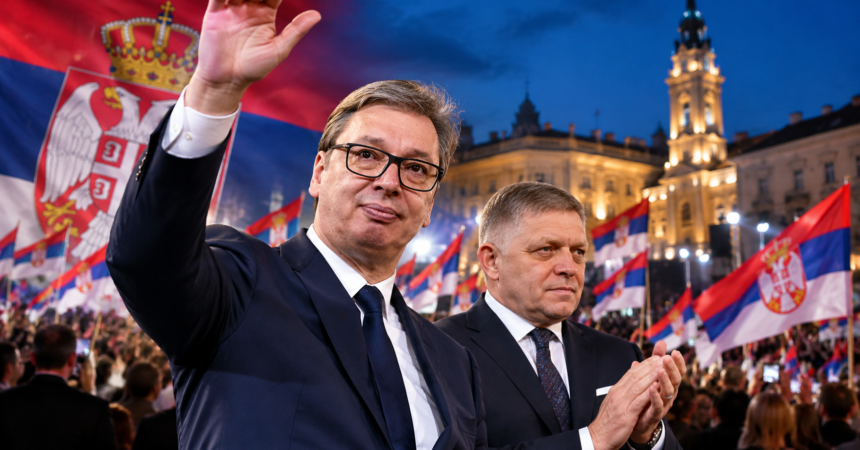
Nine days before Serbia’s 25 October parliamentary election, Aleksandar Vučić returned to Novi Sad for a major campaign rally, accompanied by Slovak Prime Minister Robert Fico. The choice of venue was politically significant: Novi Sad was the starting point of mass protests after a railway station canopy collapsed in November 2024, killing 16 people. The rally offered the ruling Serbian Progressive Party (SNS) an opportunity to demonstrate its organizational strength, but it took place as international observers were raising concerns about the conditions surrounding the vote.
A rally in a city central to the protest movement
Thousands of supporters gathered at Freedom Square on Friday evening, 16 October. According to reporting by the Associated Press and Serbia’s Insajder, people traveled to Novi Sad from other parts of the country, with traffic restrictions and a substantial logistical operation around the city centre. Vučić and Fico were the two principal speakers.
The location carried more meaning than a routine campaign stop. The November 2024 station disaster became a focal point for student-led demonstrations demanding accountability and action against alleged corruption and institutional failures.
Returning to Novi Sad allowed Vučić to address an issue that has shaped Serbia’s political debate for almost two years, in front of his own supporters.
Vučić again said foreign interests had helped organize or finance the protest movement, but presented no publicly verifiable evidence for that accusation at the rally. He also promised accountability for the station tragedy.
Student representatives had urged residents to avoid confrontation with rally participants. The Associated Press reported no major incidents at the gathering.
Why Robert Fico’s appearance matters
Slovakia’s prime minister spoke in Serbian and publicly supported Vučić, emphasizing sovereignty and the right of countries to make independent political decisions. His presence added an international dimension to a domestic campaign event.
The two leaders’ emphasis on sovereignty echoes a broader theme in Vučić’s campaign: presenting Serbia’s political future as a choice that should be decided without external pressure.
This is a campaign message, not evidence that any particular foreign actor has interfered in the election. Fico’s endorsement also should not be mistaken for a position taken by the European Union as a whole.
Election observers are focusing on the rules of the contest
The pre-election context is not limited to campaign rallies.
In an interim report dated 9 October, the OSCE Office for Democratic Institutions and Human Rights (ODIHR) documented issues raised during its observation mission, including unresolved concerns over voter-register accuracy, allegations of pressure on activists, and earlier recommendations that had not been fully implemented.
Separately, the EU delegation and representatives of the Parliamentary Assembly of the Council of Europe raised concerns this week about violence, political rhetoric and whether all contestants can campaign on equal terms.
These are pre-election observations and concerns, not findings about votes that have yet to be cast or counted.
Government-aligned reporting has highlighted electoral administration changes, including the public broadcasting of election commission proceedings.
Three things to watch before 25 October
First, will campaign activity remain peaceful as political leaders and the student-backed electoral list intensify their final appeals?
Second, will institutions respond transparently to questions about voter lists, overseas voting and complaints?
Third, can competing political narratives be tested against reliable evidence rather than the size of individual rallies or social-media impressions?
Rally attendance is not a scientific measure of electoral support, and an endorsement from a foreign political leader does not establish how Serbian voters intend to vote.
Those distinctions are especially important during the final days of a polarized campaign.
What this means for Votendi’s Serbia coverage
Votendi follows Serbia’s parliamentary election as a curated election hub, combining verified election information, published polling data and explanatory reporting.
The 16 October rally is an important campaign development, but it does not itself justify changing a polling trend or inventing a new voting-intention estimate.
Explore the Serbia Parliamentary Election 2026 hub for election information, political lists, key dates and relevant updates.