


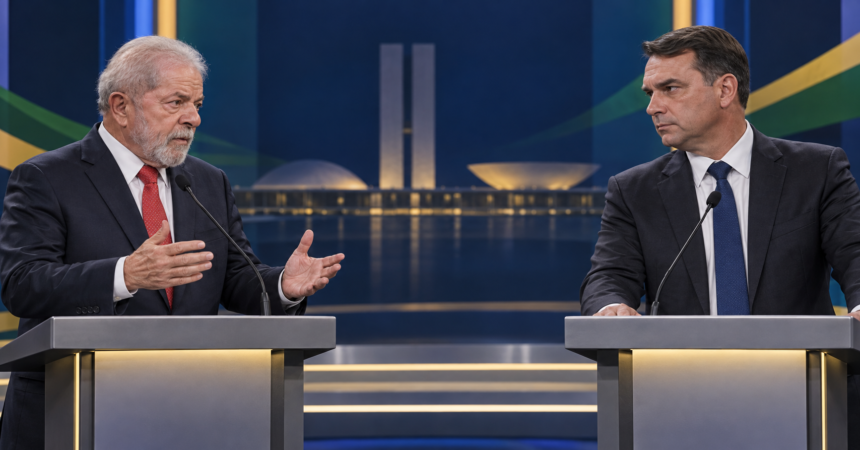
Lula and Flávio Bolsonaro meet in their first televised head-to-head debate of the presidential runoff on Sunday, October 18, with a week left before voting. The political opportunity is substantial: each can challenge the other’s account of Brazil’s direction in front of the same audience.
The Band debate begins at 8 p.m. Brasília time on October 18, or 1 a.m. CEST on October 19. Both candidates have confirmed participation. According to EXAME’s account of the announced format, Adriana Araújo and Eduardo Oinegue will moderate three blocks, including a direct exchange in which each candidate has 15 minutes to manage.
A close contest, with disagreement about the leader
Vox Brasil’s survey released on Sunday gives Lula 51% and Flávio Bolsonaro 49% of valid votes. It interviewed 2,100 voters from October 15 to 17 and reports a margin of error of ±2.15 percentage points, Poder360 reports. The poll is registered as BR-04332/2026.
That is a narrow numerical Lula lead in one survey. Recent polling has also produced Bolsonaro leads, as documented in Votendi’s earlier comparison of the divergent surveys. The useful starting point for the debate is therefore uncertainty about the balance of support, rather than a confident claim that either candidate has secured the race.
Valid-vote estimates exclude blank and null votes and undecided respondents. They should be compared with the same measure in other surveys, rather than placed beside all-respondent percentages without explanation. A change between two polling firms is also not, by itself, a change in voter opinion.
Lula’s task: make continuity feel relevant
Votendi’s assessment is that an incumbent needs to connect a defense of his record with the concerns voters still want resolved. A retrospective argument alone leaves room for an opponent to define the election as a choice about dissatisfaction. Lula’s opportunity is to make the case for another term concrete and forward-looking while testing the credibility of his rival’s alternative.
For voters still weighing the choice, the important question is whether he offers a convincing response to their present circumstances. A successful exchange would give them a reason to support him that goes beyond rejecting Bolsonaro.
Flávio’s task: turn a demand for change into confidence
For the challenger, dissatisfaction with the government provides an opening, but does not automatically establish readiness to govern. Votendi’s reading is that Flávio must make change sound credible and specific while answering scrutiny of his own proposals and political identity.
Direct confrontation raises the cost of relying on a familiar campaign message: the other candidate can immediately challenge it. How each responds under that pressure may matter as much as which attack dominates the first clips shared online.
What would show that the debate mattered?
The first evidence will be the arguments and exchanges themselves. Claims that the debate changed the electoral balance require later evidence. Surveys conducted before Sunday cannot measure its impact, even when their results are published afterward. Post-debate fieldwork, comparable questions and repeated findings will be more informative than instant declarations of a winner.
Follow the Votendi Brazil runoff tracker for individual surveys and the polling average. This article is a pre-debate assessment; it does not describe an event that has already taken place.