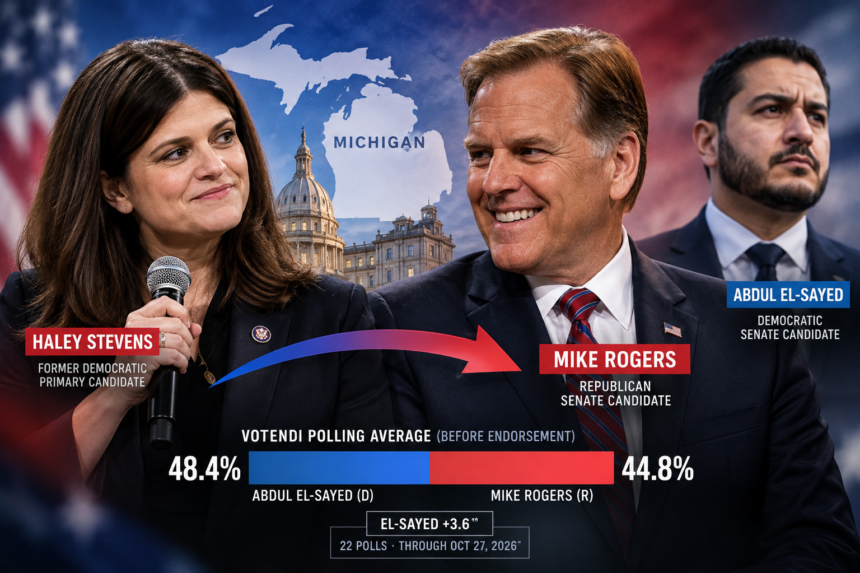
Just two days before the November 3 election, a prominent Michigan Democrat has crossed party lines to endorse the Republican Senate nominee. Votendi’s pre-endorsement polling average showed Abdul El-Sayed leading Mike Rogers by 3.6 percentage points.
In a stunning final-weekend development in Michigan’s US Senate race, Democratic Representative Haley Stevens endorsed Republican Mike Rogers on Sunday, November 1, abandoning her earlier support for Democratic nominee Abdul El-Sayed, who narrowly defeated her in the August primary.
Stevens appeared alongside Rogers at Perfecting Church in Detroit before announcing her endorsement in a video. She said El-Sayed’s campaign had told her she was no longer welcome at its events, citing that breakdown in relations as a reason for backing the Republican.
The endorsement, reported by the Associated Press, represents a dramatic reversal for Stevens, who had publicly reaffirmed her intention to vote for El-Sayed only days earlier.
The repercussions were immediate. According to AP, Stevens’ longtime chief of staff resigned, while additional staff departures were expected.
Votendi polling average before the endorsement: El-Sayed 48.4%, Rogers 44.8%
The political break comes against a closely contested polling backdrop.
Before Stevens publicly endorsed Rogers, the Votendi Michigan Senate tracker showed the following weighted polling average:
| Candidate | Polling average |
|---|---|
| Abdul El-Sayed (Democrat) | 48.4% |
| Mike Rogers (Republican) | 44.8% |
| El-Sayed’s polling lead | +3.6 percentage points |
The average is based on 22 published polls, with the latest fieldwork included through October 27, 2026. Votendi’s methodology weights surveys by recency, sample size, pollster grade, methodology and editorial weight, using a 30-day recency half-life.
Crucially, these figures reflect the polling picture before Stevens’ November 1 endorsement. They do not measure whether her decision has changed voter preferences.
The distinction is important: a political endorsement, however prominent, cannot automatically be translated into a specific number of votes or a change in the polling margin.
How the Democratic dispute escalated
The conflict between Stevens and El-Sayed has roots in their bitter Democratic primary campaign, in which El-Sayed narrowly defeated the congresswoman.
After the primary, Stevens backed the Democratic nominee, but disagreements over Israel, campaign messaging and outside political advertising continued.
The latest confrontation concerned an advertisement by Rebellion PAC, an independent political group, linking rising grocery prices to American support for Israel.
Stevens criticized the advertisement as antisemitic and urged El-Sayed to condemn its message.
El-Sayed said the advertisement had not been produced by his campaign and that he disagreed with its contents. He also accused Stevens of reopening divisions from the primary rather than focusing on the general election.
The political disagreement intensified when plans for a joint appearance at a Detroit church service collapsed.
Two churches, two competing political messages
Sunday’s events produced an unusually striking contrast.
Stevens attended a service with Rogers and his wife at Perfecting Church in Detroit. Her fiancé, Jason Turkish, had already publicly declared his support for Rogers, citing concerns about El-Sayed’s statements on Israel.
Meanwhile, El-Sayed attended a separate church service alongside prominent Democrats, including Representative Jim Clyburn, Representative Debbie Dingell and Senator Angela Alsobrooks.
Dingell, who had tried to arrange a joint appearance to demonstrate Democratic unity, said she had asked Stevens not to attend after the controversy became a distraction.
The dispute highlights divisions within Michigan’s Democratic coalition, particularly over Israel and the relationship between the party’s progressive and more establishment-oriented figures.
Why Michigan matters for control of the Senate
The November 3 contest will determine who succeeds retiring Democratic Senator Gary Peters.
Republican Mike Rogers, a former member of Congress, is challenging El-Sayed for a seat currently held by Democrats.
Michigan is one of the states being closely monitored in the national contest for Senate control. Any change in voter support or turnout in this race could become relevant to the final balance of seats, although the effects of Stevens’ endorsement remain unmeasured.
The controversy also follows a period of intense campaigning over economic policy, immigration, US foreign policy and the Trump administration.
For Rogers, the endorsement provides public support from a prominent figure in the opposing party. For El-Sayed, the immediate task is to continue campaigning while responding to renewed questions about unity among Democrats.
Neither development establishes how voters will respond on Election Day.
What happens next?
With voting already underway and Election Day approaching, the central question is whether Stevens’ endorsement remains primarily a conflict among political leaders or translates into a measurable change in voter behavior.
There is not yet a verified post-endorsement survey demonstrating such a change.
For now, Votendi’s 48.4% to 44.8% polling average, based on data available through October 27, remains the documented pre-endorsement reference point.
The November 3 result, rather than speculation about the impact of the endorsement, will provide the decisive electoral evidence.
Follow the Votendi Michigan Senate polling tracker for updated polling data and see our earlier report on the Stevens–El-Sayed dispute for background.
Sources: Associated Press, November 1, 2026; Reuters, October 31, 2026; Votendi Election Pulse, Michigan Senate polling average through October 27, 2026.