
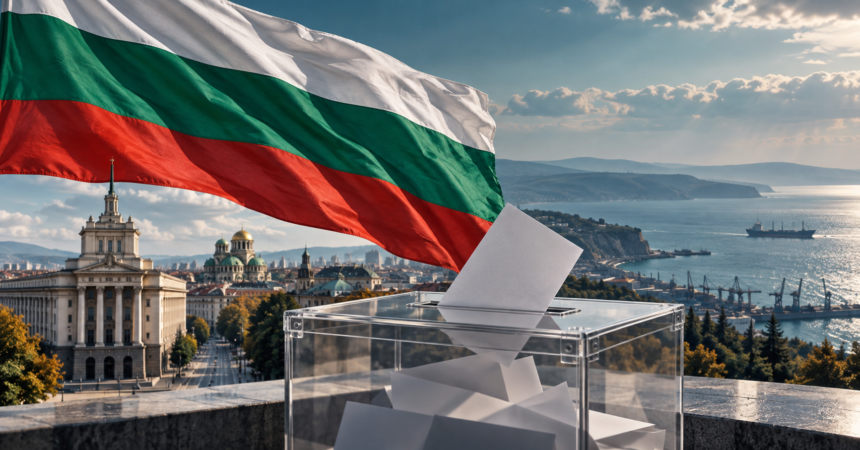
Bulgarians are voting on Sunday, November 1, in a presidential runoff between Iliana Iotova and former caretaker prime minister Andrey Gyurov, with a narrow first-round gap and exceptionally low turnout leaving mobilisation at the centre of the contest.
The election comes amid economic concerns and heightened anxiety over attacks on merchant shipping in the Black Sea. It also presents voters with competing approaches to Russia, support for Ukraine and Bulgaria’s role within its Western alliances. Reuters reports.
Just 42,719 votes separated the finalists
Iotova received 528,951 votes in the October 25 first round, compared with Gyurov’s 486,232 — a difference of 42,719 votes. Their reported shares were 34.76% and 31.95%, respectively.
Turnout was only 22.98%, according to Bulgarian National Radio’s account of the official figures. That makes the ability to bring previous non-voters to the polls potentially decisive. Neither finalist can assume that voters who supported eliminated candidates will automatically transfer their support.
Early turnout offers no clear breakthrough
Initial election-day estimates suggested participation was broadly similar to the first round.
Alpha Research put turnout at approximately 2% by 9 a.m. Bulgarian time, while Myara estimated 2.1%, BNR reported. These are polling-agency estimates of participation, not official results or measures of support for either candidate.
The early figures alone do not establish whether turnout will ultimately rise or which finalist would benefit.
Russia and Ukraine divide the candidates
Iotova, backed by Prime Minister Rumen Radev’s Progressive Bulgaria party, favours negotiations with Moscow and opposes military assistance to Ukraine. Gyurov, supported by pro-Western reformists, has advocated stronger support for Kyiv and a firm NATO role.
Attacks on Black Sea shipping have sharpened that foreign-policy divide. Alongside the immediate security debate, the election raises a domestic question: whether the presidency will reinforce the governing camp or provide a stronger institutional counterweight. Critics of Iotova have warned about concentrating power, while her supporters present her as a source of continuity. Associated Press coverage.
Why the presidency matters
Bulgaria’s president does not direct everyday government policy, but the office has a role in the country’s institutional balance.
The president holds consultations with parliamentary groups and issues mandates to form a government. When parliamentary parties cannot agree on an administration, the presidency also has a constitutional role in the caretaker-government process.
The runoff therefore concerns both the country’s international voice and the relationship between its principal institutions.
When to expect results
Polling stations are scheduled to close at 8 p.m. Bulgarian time — 7 p.m. in Central Europe — with voting extendable until 9 p.m. where queues remain.
Exit polls may be released after the scheduled close. They should be distinguished from the subsequent official count. Unlike the first round, the runoff has no minimum-turnout requirement: the ticket receiving the most votes wins. Voting information from BNR.
Read more: Bulgaria runoff voting hours and results guide and the wider Russia–Europe debate.