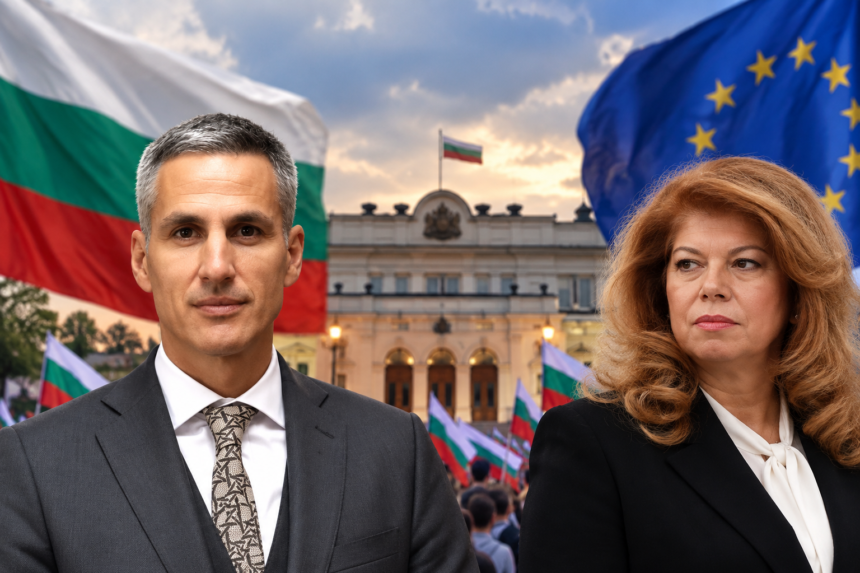
Two days before Bulgaria’s presidential runoff, three former prime ministers and two former presidents have publicly backed Andrey Gyurov, highlighting how the November 1 election has become a debate about security, relations with Russia and the country’s place in the European Union and NATO.
In an open letter released on Friday, October 30, former prime ministers Boiko Borissov, Ivan Kostov and Nikolai Denkov endorsed Gyurov and his vice-presidential running mate, Georgi Kandev, against incumbent President Iliana Yotova and her running mate, Kiril Valchev. Former president Rosen Plevneliev also signed the letter, along with Sofia mayor Vassil Terziev and former ministers, military officers, diplomats and public figures. Another former president, Petar Stoyanov, had expressed support for Gyurov earlier in the week in a television interview, according to The Sofia Globe.
Why the endorsements matter
The signatories come from different parts of Bulgaria’s political establishment. Borissov’s position is particularly notable: his GERB-UDF alliance did not field a presidential candidate, and he did not endorse either leading contender in the first round. His public support now adds a new political element to the final days of the campaign.
The letter argues that concerns about Black Sea security and Russia’s actions should take precedence over past party disagreements. Its authors say Bulgaria must make fuller use of its cooperation with EU and NATO allies and accuse the authorities of underestimating regional threats. Those are the signatories’ political assessments, not findings established by the election itself.
The letter also frames Gyurov as an institutional counterweight to the policies of Prime Minister Rumen Radev, whose Progressive Bulgaria party supports Yotova. BGNES published details of the appeal on October 30.
A first-round gap of just 2.81 percentage points
The runoff follows a close first round held on October 25. Bulgaria’s Central Election Commission reported 528,929 votes, or 34.76%, for Yotova and Valchev, compared with 486,214 votes, or 31.95%, for Gyurov and Kandev. That is a difference of 42,715 votes.
Kostadin Kostadinov and Petar Volgin finished third with 12.55%, while 4.43% selected the option not to support any candidate. Turnout was approximately 22%, meaning participation and the decisions of first-round voters whose preferred candidates were eliminated remain central questions ahead of Sunday. These figures are certified first-round results, not a runoff opinion poll. Radio Bulgaria published the commission’s figures.
Two different approaches to Russia and Ukraine
Gyurov, a former caretaker prime minister backed by reformist pro-European forces, has advocated strong support for Ukraine and close cooperation with NATO and European partners.
Yotova, who assumed the presidency following Radev’s resignation earlier in 2026, is supported by Progressive Bulgaria and the Socialists. She also supports Bulgaria’s European integration but has stressed diplomacy over the war in Ukraine and a different approach to relations with Russia. Those contrasting positions have been documented by Associated Press.
That divide does not mean the president can single-handedly determine Bulgaria’s foreign policy. The country has a parliamentary system, and the government holds substantial executive authority. Nevertheless, the presidency carries constitutional powers and political influence, particularly during institutional disputes and periods of government instability.
What happens before Sunday’s vote?
Gyurov and Yotova met in a televised debate on October 29. Friday, October 30, is the final day of campaigning, ahead of the November 1 runoff.
The endorsements do not establish how many votes will shift to Gyurov. The first-round result leaves open how supporters of eliminated candidates will vote, whether they will abstain and whether turnout will recover from the unusually low first round.
The immediate test is therefore electoral, not rhetorical: whether this cross-party appeal changes the composition of Sunday’s electorate. Until ballots are counted, the effect of the endorsements remains unknown.
For context, read Votendi’s earlier analysis: Bulgaria’s presidential runoff: A battle over Russia, Europe and the balance of power, and our runoff voting-hours and results guide.
Sources: The Sofia Globe and BGNES (October 30, 2026); Radio Bulgaria/Central Election Commission (October 26); Associated Press background reporting.