




New polling, trading pressure and paid promotion offer different explanations for a volatile final week. The available evidence does not establish market manipulation.
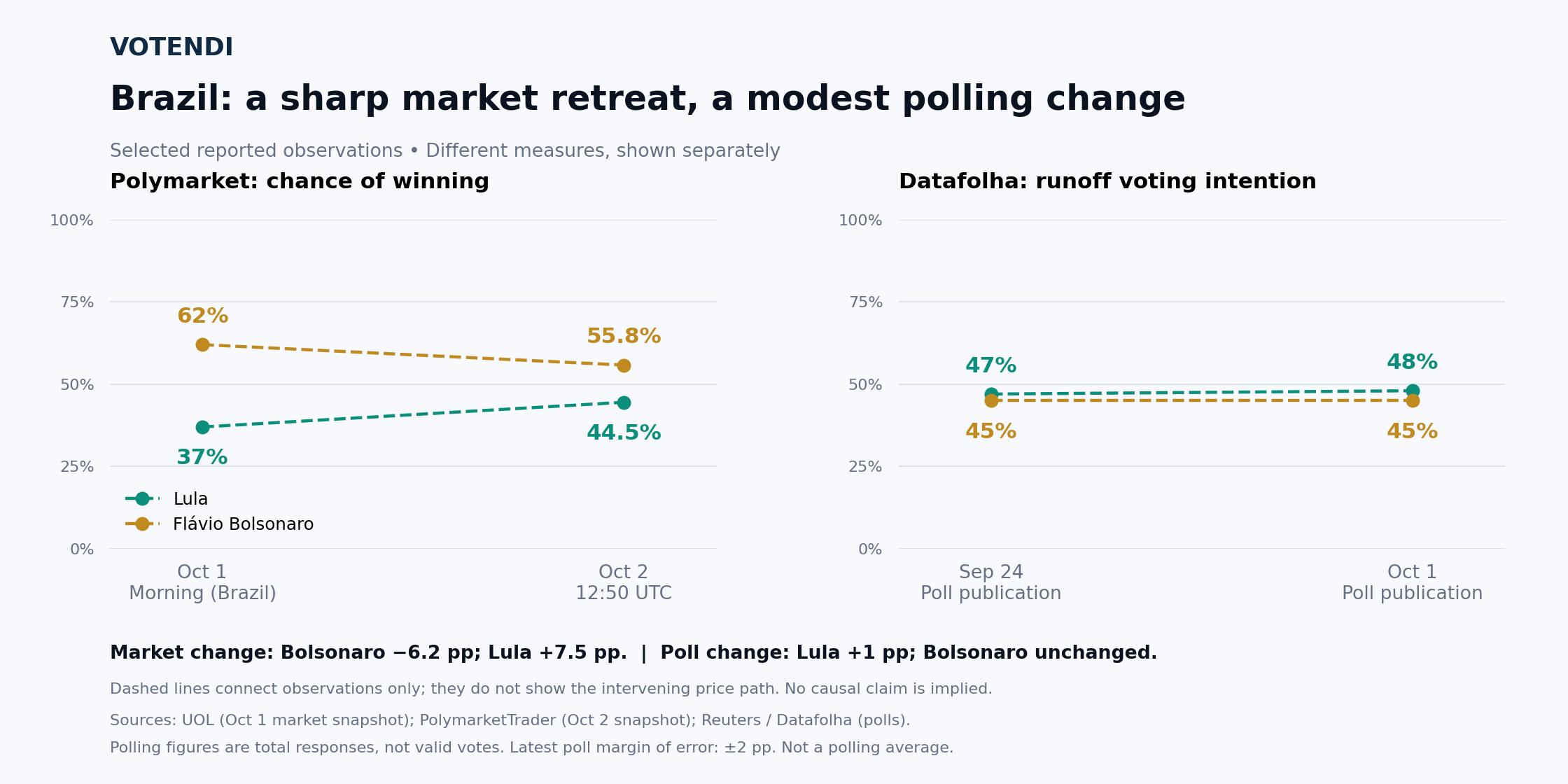
Flávio Bolsonaro’s advantage on Polymarket widened and then contracted ahead of Brazil’s October 4 presidential election. On the morning of October 1, UOL recorded a 62% market-implied probability of victory for Bolsonaro, against 37% for President Luiz Inácio Lula da Silva. Source: UOL.
By October 2 at 12:50 UTC, independent tracker PolymarketTrader recorded Bolsonaro at 55.8% and Lula at 44.5%. That represents a decline of roughly six percentage points for Bolsonaro between the two observations, substantially narrowing his market advantage. These are dated snapshots from different sources, rather than a complete transaction-level reconstruction. Source: PolymarketTrader.
What changed? A new poll offers one plausible explanation. Trading dynamics offer others. Separately, reporting about paid promotion of Bolsonaro’s market advantage raises questions about how these prices are being used politically.
A new Datafolha poll preceded the lower market reading
Datafolha’s October 1 survey put Lula ahead by 48% to 45% in a hypothetical runoff, compared with 47% to 45% previously. In the first round, both candidates gained two points, leaving Lula’s four-point lead unchanged at 42% to 38%. The survey interviewed 2,506 people between September 29 and October 1 and reported a two-point margin of error. Source: Reuters/Datafolha.
The poll therefore supplied some encouraging information for Lula, but did not reveal a dramatic reversal in voter preferences.
Its publication preceded the lower Bolsonaro market reading on October 2. That sequence is consistent with traders reassessing his chances after the survey. It does not establish that the poll caused the entire decline: without a detailed price history aligned with publication times and individual trades, the strength and speed of that response remain unverified.
A modest polling change can nevertheless produce a larger probability adjustment when traders believe a race is close. For Brazil, the question is whether the observed move reflected that reassessment, additional news, or a change in trading pressure.
Large transactions are another possible explanation—not a demonstrated cause
Polymarket prices are formed through trading. The platform’s own guidance explains that lower liquidity increases the price impact of buying and selling. A substantial order can therefore move the displayed odds even without a corresponding change in public opinion. Source: Polymarket.
Several mechanisms could account for part of Brazil’s swing: new purchases of Lula contracts, sales of Bolsonaro positions, profit-taking after Bolsonaro’s rise, or thinner offers around the prevailing prices.
Those are hypotheses. The evidence reviewed for this article does not identify a particular large trader, establish coordinated activity, or calculate the amount required to produce the observed move.
Nor would identifying a large purchase alone establish manipulation. A trader may be expressing a sincere forecast. Evidence of an attempt to create a misleading price would require a stronger account of trading behaviour and purpose.
The $162 million headline does not settle the question
The Brazilian presidential-winner event displayed approximately $161.9 million in cumulative trading volume when checked. That figure covers its various candidate contracts and trading since the event opened. Source: Polymarket.
Cumulative turnover does not reveal how much money was available to absorb an order at a particular moment. The same contracts can trade repeatedly. For this episode, the relevant missing evidence is the depth of buy and sell offers around the prices immediately before the movement.
Consequently, neither “the market is too large to influence” nor “a small payment caused the reversal” is supported by the headline volume.
Paid promotion adds a separate, concrete concern
On September 20, Diário do Centro do Mundo reported that international accounts including Iran Observer and OSINTdefender published posts labelled as paid partnerships, highlighting Bolsonaro’s roughly 58% Polymarket probability. The report described similar graphics and closely timed publications. Source: Diário do Centro do Mundo.
That episode predates the latest week’s swing. It is relevant as context for the commercial amplification of the market’s message, not as evidence that those accounts caused the October price movement.
It also creates a distinction worth preserving: promoting a favourable market price and engineering that price are different activities. The reporting supports scrutiny of the former; it does not demonstrate the latter.
An inference follows: market odds can become part of the campaign information environment when paid posts distribute them as evidence of political momentum. Whether that publicity subsequently attracted trades or affected voters remains unestablished.
What Brazil’s swing supports—and what remains unresolved
The available snapshots show a sizeable retreat from Bolsonaro’s October 1 advantage. A newly published Datafolha survey provides a plausible informational trigger. Position adjustments and large trades remain possible contributors. Reporting about paid promotion supplies a reason to examine how the odds are being amplified.
None of those observations, separately or together, establishes manipulation.
The next evidentiary step is to align historical prices and trading volumes with poll releases, then examine transactions and order-book depth around the sharpest movements. Until that reconstruction is available, Brazil’s Polymarket swing is best understood as a documented change in traders’ pricing whose precise causes remain unresolved—not a demonstrated six-point shift among voters.