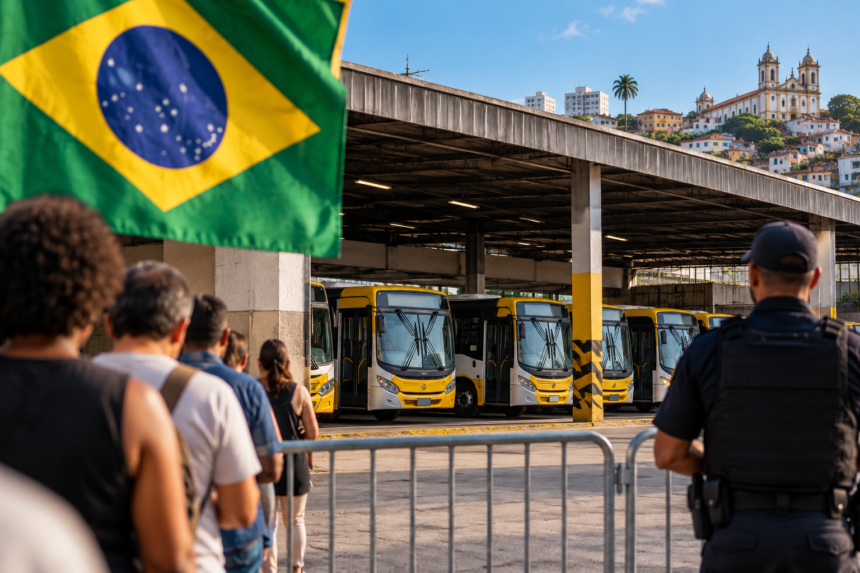
An electoral court in the Brazilian state of Bahia ordered the arrest of Salvador’s municipal mobility secretary on Sunday, October 25, after buses were held in depots during the presidential runoff. The court demanded the immediate restoration of free public transport, while President Lula’s Workers’ Party asked Brazil’s top electoral court to extend voting hours in three cities.
The president of Bahia’s Regional Electoral Court (TRE-BA), Judge Maurício Kertzman Szporer, issued an arrest order targeting Pablo Souza, Salvador’s municipal secretary of mobility, amid allegations that a reduction in public bus services was preventing voters from reaching polling stations.
The arrest order does not mean that Souza has been detained. As of the reports reviewed for this article, there was no official confirmation that federal police had carried out the order. Folha de S.Paulo reported that Souza was outside Brazil at the time.
Court orders the full bus fleet back on the streets
The dispute followed a petition from the Federação Brasil da Esperança alliance, which includes Lula’s Workers’ Party (PT), the Communist Party of Brazil (PCdoB) and the Green Party (PV). The alliance alleged that bus services had been reduced by more than half compared with normal weekday operations.
According to Bahia Notícias, which reported details of the court decision, an inspection found buses parked in depots. The court ordered the immediate deployment of the entire scheduled fleet, with weekday-equivalent routes and frequency and free travel for passengers.
The ruling gave the authorities and bus operators one hour after notification to demonstrate compliance and provided for a penalty of R$1 million per hour of continued noncompliance. That is a potential fine under the order, not evidence that such an amount has already been imposed or collected.
Separately, Folha reported that Bahia’s consumer-protection agency found 252 buses capable of operating but standing idle at three depots. The finding adds to questions about service availability, although it does not by itself establish why every vehicle was parked.
Mayor says delays were linked to political stickers
Salvador Mayor Bruno Reis, of União Brasil, denied deliberately restricting public transport to influence the vote. He acknowledged that 75 buses had been retained at a depot, but argued that union members associated with the PT had placed electoral stickers on the vehicles and that services resumed after the material was removed.
The municipal mobility department likewise attributed the disruption to problems involving electoral advertising on buses and said operations had been normalised. Those accounts are disputed by Lula’s allies. Folha reported the competing explanations and the court’s intervention.
Responsibility for any deliberate interference with voters has not been established in a final judicial finding. The order and related proceedings should not be treated as a conviction.
PT asks for voting to continue until 7pm
The Workers’ Party has also asked the Superior Electoral Court (TSE) to extend voting until 7 p.m. local time in Salvador, Feira de Santana and Lauro de Freitas. The request followed reports that voters had faced long waits or difficulty travelling because of reduced transport services, according to UOL.
No approval of the requested extension had been confirmed at the time of this report. Under the standard nationwide election schedule, polling stations close at 5 p.m. Brasília time (8 p.m. UTC; 9 p.m. in Croatia).
Why the transport dispute matters on runoff day
Sunday’s vote is the second round of Brazil’s presidential election between incumbent Luiz Inácio Lula da Silva and challenger Flávio Bolsonaro. Reliable, accessible transport matters to residents who depend on buses to reach their assigned polling stations. The extent to which Salvador’s disruption affected voter participation remains unknown.
There are currently no verified figures showing how many people were unable to vote because of the bus shortages, and no basis to conclude that the disruption changed the national election result. The central outstanding questions are whether the transport order was complied with, whether the arrest order was executed and how the TSE responds to the voting-extension request.
For broader election coverage and the official counting process, follow Votendi’s Brazil election hub.