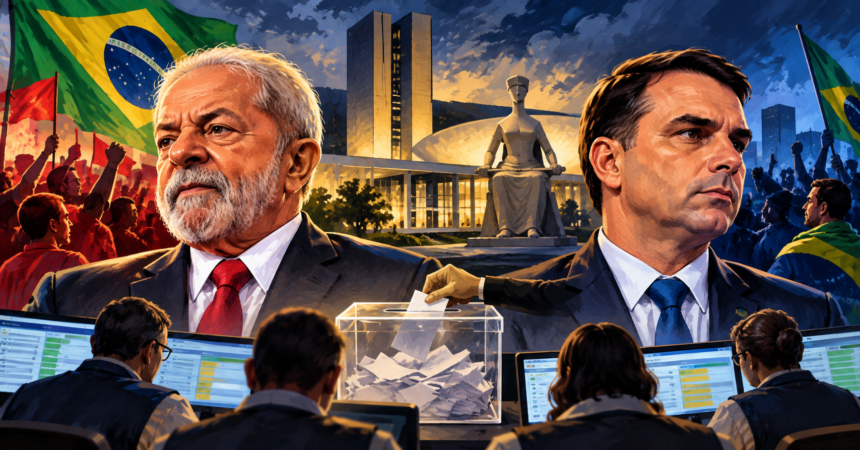
Allies of Brazilian presidential candidate Flávio Bolsonaro raised allegations of electoral manipulation on Sunday, October 25, after a last-minute Supreme Court ruling extended voting in the presidential runoff. No evidence of vote fraud was presented in the statements reported by Brazilian media.
- Latest update: TSE clarification and federal police inquiries
- Lula campaign responds as Bolsonaro allies challenge the court’s role
- What triggered the accusations?
- Bolsonaro campaign chief criticizes judicial intervention
- Both campaigns had asked for extra voting time
- Why the dispute matters beyond election night
- What we know — and what remains unverified
Latest update: TSE clarification and federal police inquiries
Updated after 20:00 Brasília time on 25 October 2026. The Superior Electoral Court (TSE) confirmed that the Supreme Court’s two-hour extension applied only to polling stations where voting had not ended by 17:00. Polling stations already closed did not reopen. The TSE said receipt of electronic ballot reports, vote tabulation and publication of results would resume after 19:00. Official provisional counting has since resumed, and its figures continue to change. Read the TSE’s clarification and follow the Votendi Brazil runoff live-results page for the count rather than relying on an earlier snapshot.
Federal police are examining possible interference with voters’ access to transport. The Polícia Federal said it was looking into allegations in Bahia, São Paulo, Piauí, Sergipe and Alagoas. According to a CNN Brasil report updated at 19:25, a formal investigation had been opened in Sergipe, while fact-finding and interviews continued elsewhere. Separately, Folha de S.Paulo reported that the Ministry of Justice had received reports of public-transport problems in seven states. These inquiries concern alleged impediments to voting; they do not constitute findings that ballots or the official vote count were falsified.
Lula campaign responds as Bolsonaro allies challenge the court’s role
Edinho Silva, the coordinator of Lula’s campaign, alleged that restrictions on bus services could amount to electoral offences if officials failed to guarantee legally required transport for voters. Lula campaign representative Camilo Santana also questioned the impact on election fairness. On the other side, São Paulo Governor Tarcísio de Freitas accused the Workers’ Party of seeking to disrupt the electoral process through its intervention with Justice Cristiano Zanin, while Bolsonaro campaign coordinator Rogério Marinho criticized what he called judicial interference. These are opposing political accusations, not established findings against either campaign. CNN Brasil reported the exchanges.
In an election-night report updated at 19:42, Folha also described Bolsonaro allies discussing challenges to the court’s decision and the PL instructing its poll watchers to return to their assigned locations and document possible irregularities through official channels. Calling a judicial decision improper is not evidence of tampering with votes. At this update, the sources reviewed had not established electoral-count fraud. Any documented complaints and court decisions should be assessed separately as they emerge.
What triggered the accusations?
Supreme Court Justice Cristiano Zanin ordered a two-hour extension of voting, until 7 p.m. Brasília time, following reports that public transport disruptions had made it difficult for voters to reach polling stations. The decision arrived around the scheduled 5 p.m. closing time, after voting had already ended at some locations.
The electoral authority, the Superior Electoral Court (TSE), temporarily paused its publication of results. Authorities subsequently clarified that polling stations already closed would not reopen, while locations still conducting voting could remain open until the extended deadline.
Bolsonaro campaign chief criticizes judicial intervention
Rogério Marinho, the senator coordinating Flávio Bolsonaro’s presidential campaign, attacked the intervention and raised the prospect of a “judicial coup,” according to Folha de S.Paulo.
Other Bolsonaro allies suggested that the extension could favor President Luiz Inácio Lula da Silva or questioned the integrity of the process. Folha reported that Eduardo Bolsonaro, Alexandre Ramagem and Paulo Figueiredo raised suspicions during a broadcast from the United States. Such allegations are political claims, not verified findings of fraud.
Criticism of the court’s timing is also distinct from an allegation that votes were falsified: the two claims should not be conflated.
Both campaigns had asked for extra voting time
An important detail is that both rival campaigns had requested extensions, although their requests differed in geographic scope and reasoning. Lula’s coalition pointed to reduced bus services and transport barriers in multiple regions, while Bolsonaro’s campaign sought more time in areas affected by heavy rain and flooding, according to Reuters and Associated Press.
The nationwide court order went further than the geographically limited requests associated with some of those disruptions. The ruling’s timing, combined with different closing conditions across polling places, created legal and administrative uncertainty.
Why the dispute matters beyond election night
Brazilian legal commentators have warned that the unprecedented timing could prompt challenges over whether every voter enjoyed equivalent access to the ballot. That concern does not by itself establish tampering, unlawful counting or an invalid election.
The country’s recent electoral history makes the distinction particularly important. Accusations without substantiating evidence can erode confidence even while courts and election administrators are still processing official results.
As counting resumes, the critical questions are whether the TSE publishes consistent, auditable results, whether any formal challenges identify specific legal violations, and how the competent courts respond. Neither campaign’s rhetoric is a substitute for documented evidence.
What we know — and what remains unverified
The voting extension, temporary interruption of published counting, and objections from Bolsonaro allies have been reported by multiple outlets. An exact timestamp for the first individual fraud allegation has not been independently established. Nor has there been verified evidence, in the sources reviewed for this article, of manipulation of the official vote count.
Sources: Folha de S.Paulo; Reuters; Associated Press; UOL.