
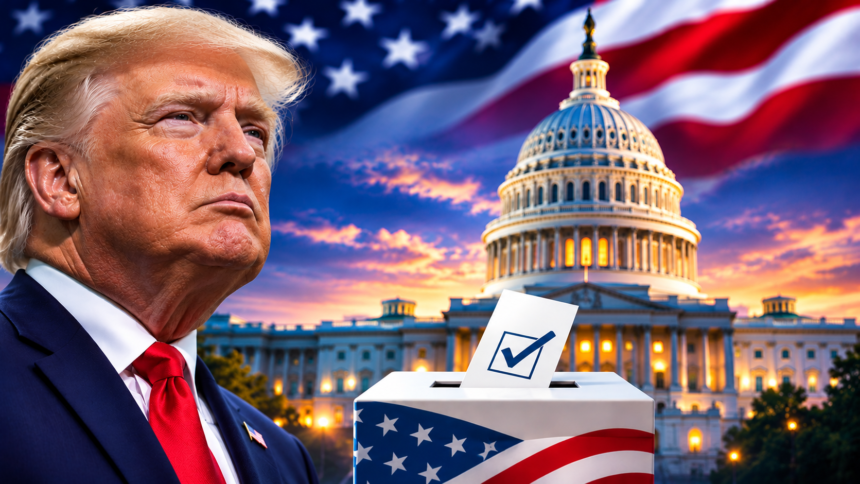
Early findings from the 2026 US midterm voter survey reveal a dissatisfied electorate: roughly six in ten voters disapprove of President Donald Trump’s performance, while the economy and the state of American democracy emerge as the two most frequently cited national concerns. With House and Senate control being decided on November 3, the findings provide an initial view of what is motivating voters — not an advance declaration of who has won.
- Trump approval at 38% as voters express dissatisfaction
- Economy 39%, democracy 32%: the leading national issues
- Cost of living matters to voters across party lines
- About 70% want Congress to exercise more checks on presidential power
- What the findings mean for the House and Senate races
- How to read the early exit-poll figures
Trump approval at 38% as voters express dissatisfaction
The CBS News assessment of the early Voter Poll puts Trump’s job approval at 38%. Separately, approximately 60% say they disapprove of how he is handling the presidency, according to the Associated Press figures reported by the Guardian.
About three-quarters of respondents say they are dissatisfied or angry with the direction of the country. The results suggest that frustration with national leadership is a major feature of the electorate, but dissatisfaction alone does not establish which party an individual voter supported.
According to CBS, roughly six in ten voters say Trump was a factor in their vote for the House of Representatives. Voters backing Democrats were particularly likely to describe opposition to the president as a motivation. Republican voters had a more varied relationship to Trump: among self-described MAGA Republicans, support for him remained an important motivation, while other Republican voters were less likely to say their House vote was about the president.
Economy 39%, democracy 32%: the leading national issues
When respondents were asked to name the single most important issue facing the country, the early national breakdown was:
- Economy: 39%
- State of democracy: 32%
- Immigration: 14%
- Healthcare: 8%
Those figures, reported from the AP Voter Poll, highlight two dominant but distinct concerns. Voters who supported Democrats were particularly focused on democracy and government accountability. Republican supporters were more likely to emphasize the economy and immigration.
The issue ranking should not be confused with the percentage of voters who consider a subject important in some way. A respondent can select the economy as their top issue while also describing democracy, immigration or the cost of living as major factors in their decision.
Cost of living matters to voters across party lines
In a separate question about influences on their vote, roughly nine in ten voters said the cost of living was a crucial or major factor, according to early reporting. That is a broader measure than the 39% who selected the economy as the country’s single top issue.
CBS reports that voters were more than twice as likely to say their personal finances had worsened as to say they had improved. Inflation has caused financial hardship for many households, including approximately one in five who described the hardship as severe.
The cost-of-living finding reaches across partisan lines, even as voters disagree about the causes of higher prices and which policies would address them. Economic dissatisfaction could shape individual races differently depending on local candidates, turnout and voters’ priorities.
About 70% want Congress to exercise more checks on presidential power
Another striking finding concerns the constitutional balance between the White House and Capitol Hill. Roughly seven in ten voters say Congress is not doing enough to provide checks and balances on presidential power, according to the AP survey figures.
CBS also reports that around nine in ten respondents view government corruption as a major factor in their voting decision, and about six in ten believe Trump puts his personal interests ahead of the country’s interests.
However, the dissatisfaction does not translate into universal enthusiasm for the opposition. CBS notes that neither major party enjoys favorable ratings from a majority of voters in the early survey. A substantial minority of Democratic House voters also express unfavorable views of their own party.
What the findings mean for the House and Senate races
The most important analytical distinction is between national voter attitudes and actual election outcomes. A nationwide measure of presidential approval cannot by itself tell us who won a closely contested Senate race in Michigan, Texas, Maine or Ohio. Likewise, the House majority depends on district-by-district results, rather than a single nationwide popular vote.
The early polling suggests cost pressures, presidential accountability and democracy are major cross-cutting issues. It does not establish that a particular party will win Congress. The relevant test comes as the official vote totals and individual race calls emerge.
For results and updates on the contests that determine control of the two chambers, follow Votendi’s live 2026 US midterm election coverage. For additional pre-election context, see Votendi’s Reuters/Ipsos polling analysis; it is a separate survey of registered voters and should not be conflated with Election Day voter interviews.
How to read the early exit-poll figures
The 2026 AP Voter Poll is conducted by SSRS for AP and a group of major US news organizations, including CBS and CNN. It blends a large survey of voters before the election with in-person interviews on Election Day in selected states. Findings are weighted and can be adjusted as further data become available. Reports from AP, CBS and CNN are therefore not three independent polls.
Data note: This analysis is based on the first nationally reported Voter Poll findings published on November 3, 2026, including CBS News’ 5:28 PM ET update. Numbers are approximate, may change through the night and do not represent certified election results.
Sources: CBS News exit-poll analysis; Associated Press Voter Poll methodology; The Guardian’s AP Voter Poll reporting; Forbes election coverage.