
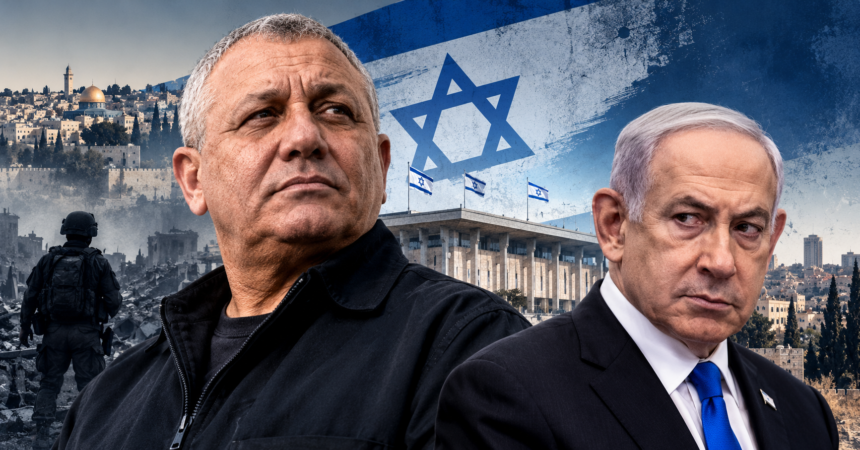
He was Israel’s military chief, served in Benjamin Netanyahu’s wartime leadership and lost his son in combat in Gaza. Now Gadi Eisenkot is leading a centrist party that finished ahead of Netanyahu’s Likud in three major final election polls. But even if Yashar becomes the Knesset’s largest faction on October 27, that would not automatically make Eisenkot Israel’s next prime minister.
At 66, Gadi Eisenkot is at the centre of a contest that could reshape Israeli politics. As voters prepare for the country’s first parliamentary election since the Hamas-led attacks of October 7, 2023, the former Israel Defense Forces (IDF) chief is seeking to replace the country’s longest-serving prime minister.
Eisenkot heads Yashar, a new centrist party whose Hebrew name can be translated as “straight” or “honest.” His public appeal draws on a four-decade military career, a background outside Israel’s traditional political elite and an intensely personal experience of the Gaza war.
From Eilat to the top of the Israeli military
Eisenkot was born on May 19, 1960, in Tiberias, to a family of Moroccan Jewish origin, and grew up in the southern city of Eilat. He entered the Golani Brigade in 1978 and rose through its command structure before serving in senior positions in the West Bank and along Israel’s northern border.
He commanded Northern Command after the 2006 war with Hezbollah and became the IDF’s 21st chief of staff in February 2015. He remained in that post until January 2019, retiring after 41 years in the military. His military career and dates are recorded in the IDF’s official biography.
His social background also matters. Eisenkot belongs to Israel’s Mizrahi Jewish community, with family roots in North Africa and the Middle East. A government led by Eisenkot would mark the first time Israel had a Mizrahi prime minister, a distinction noted in TIME’s October 25 profile.
The deaths of his son and two nephews
In December 2023, Eisenkot’s 25-year-old son, Gal Meir Eisenkot, was killed while serving as a reservist in Gaza. Two nephews also died during the war.
Eisenkot was serving in Israel’s emergency wartime leadership at the time. In an interview published by TIME on October 25, 2026, he described returning to cabinet business after the traditional Jewish mourning period. That experience has become a significant part of his public biography, although the personal loss does not by itself explain his policy positions.
Eisenkot had entered politics in 2022 alongside former defence minister and military chief Benny Gantz. After October 7, he joined Netanyahu’s emergency government as an observer in its war cabinet. He and Gantz resigned in June 2024, criticising the government’s strategy and the absence of a sufficiently clear political plan for Gaza after the fighting.
After separating from Gantz politically, Eisenkot launched Yashar in September 2025.
Why Eisenkot is not simply a peace candidate
Although he is challenging Netanyahu, Eisenkot is a former senior military commander with a record of advocating extensive military force against armed threats. His views do not amount to a wholesale rejection of Israel’s established security policy.
In 2008, while heading Northern Command, Eisenkot publicly described a doctrine of disproportionate force against Lebanese locations from which Hezbollah attacks were launched. Those remarks became associated with what is commonly called the Dahiya doctrine; the approach has drawn criticism over its potential consequences for civilian areas. Reuters reported his remarks at the time.
On current issues, Eisenkot rejects a Palestinian state under present conditions and advocates dismantling Hamas’s military capacity while pursuing security and diplomatic arrangements for Gaza. He has also opposed annexation of the West Bank and has called for a more clearly defined political strategy. These differences are important, but they should not be mistaken for a fundamental abandonment of Israel’s security-first approach.
His position toward Iran combines a stated commitment to preventing a nuclear weapons capability with support for diplomatic arrangements where they could verifiably achieve that goal.
What Yashar promises to change
Yashar’s platform calls for Israel to remain a Jewish and democratic state while strengthening public institutions and restoring trust in government. It advocates:
- An independent state commission of inquiry into the October 7 attacks and the conduct of the war.
- Military or national service rules that apply more broadly across Israeli society, including to ultra-Orthodox men.
- Constitutional reform to clarify the balance between the government, parliament and judiciary.
- Investment in public education, the periphery and efforts to reduce social inequality.
- A revised national-security doctrine and greater emphasis on long-term planning.
These are commitments described in the Israel Democracy Institute’s party profile and Yashar’s own published programme. Promises made in opposition, of course, are not yet a governing record.
What the final polls actually show
Three major Israeli television surveys published on Friday, October 23, placed Yashar ahead of Likud in projected Knesset seats. Channel 12 gave Yashar 23 seats and Likud 21; Channel 13 showed 22 to 19; and Kan 11 projected 22 to 20.
Those figures are poll projections for the 120-seat parliament, not percentages of the popular vote. Crucially, none of the three surveys showed a straightforward 61-seat majority for either major political camp. Different scenarios depend on smaller parties, including Ra’am and the Joint List, and on which lists clear the 3.25% electoral threshold.
See the final-polls comparison by The Times of Israel and Votendi’s analysis of divergent polling scenarios.
Why the largest party does not automatically win power
Israelis vote for party lists, not directly for a prime minister. After the election, the president consults parliamentary factions and chooses a politician to attempt to form a government. A candidate needs enough parliamentary support to sustain a governing coalition; leading the biggest single party is insufficient on its own.
That creates a problem for Eisenkot. Other opponents of Netanyahu include the Together alliance of former prime ministers Naftali Bennett and Yair Lapid, Avigdor Lieberman’s Yisrael Beytenu and Yair Golan’s Democrats. These parties have differing views on religion, security, the Palestinians and cooperation with Arab parties.
Some leading opposition politicians have publicly ruled out governing with Arab parties, while Ra’am leader Mansour Abbas has said he is open to joining an alternative coalition. The resulting arithmetic could complicate government formation for any candidate. The Council on Foreign Relations explains the coalition rules; Votendi has also reported on Eisenkot’s minority-government dilemma.
What is really at stake on October 27?
Netanyahu’s supporters emphasise his lengthy experience in office and confrontational approach to regional threats. His critics question decisions surrounding the failures of October 7, the Gaza war and the functioning of Israel’s institutions. Netanyahu also faces an ongoing corruption trial and denies wrongdoing.
Eisenkot presents a leadership alternative rooted in military experience and institutional reform. Whether that translates into a governing majority depends on the actual vote and the negotiations that follow — not simply on who finishes first in a poll.
On election night, two numbers will matter: the seat count for each party and the combinations that could reach 61. The first will be decided by voters; the second may take much longer to resolve.
Follow Votendi’s Israel Election 2026 hub for parliamentary results, seat counts, polling context and coalition developments.
Votendi Editorial Team · October 26, 2026. Featured image: AI-generated editorial illustration, not a documentary photograph.