
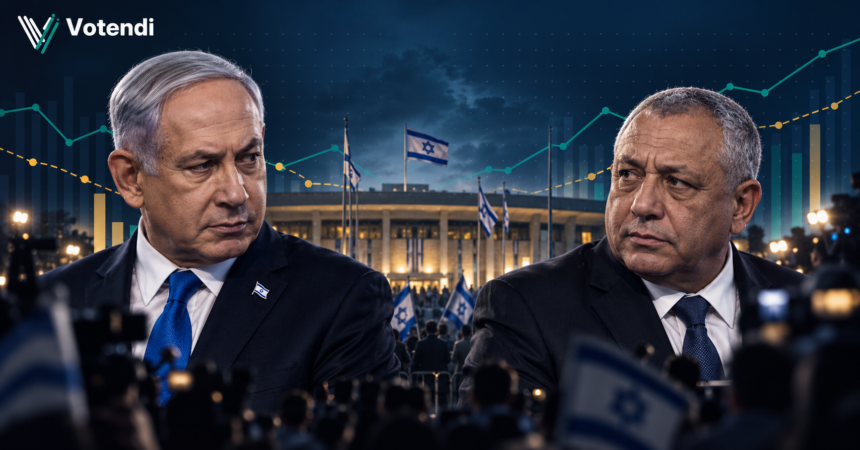
Israel’s election campaign enters its final day on Monday, October 26, with Prime Minister Benjamin Netanyahu and former military chief Gadi Eisenkot making their last appeals to voters ahead of Tuesday’s parliamentary election. Final polls show Eisenkot’s Yashar party ahead of Netanyahu’s Likud in several major surveys, but neither political camp has demonstrated a clear path to a governing majority.
- Final polls put Eisenkot’s Yashar ahead of Likud
- Neither major political bloc has secured the 61-seat threshold
- Netanyahu prepares a final digital campaign offensive
- Eisenkot appeals to voters seeking political change
- Smaller parties and the electoral threshold could reshape the Knesset
- Security, the Gaza war and Israel’s political direction
- When will Israel vote, and when will results be available?
- What happens if no bloc wins a majority?
- The key question is who can build a government
Israelis will vote on October 27 to elect the country’s 120-member Knesset, in an election that could determine whether Netanyahu remains prime minister or a new coalition takes power.
While much of the campaign has focused on the rivalry between Netanyahu and Eisenkot, the central question is increasingly about parliamentary arithmetic.
Winning the largest number of seats does not automatically guarantee the premiership. A government normally needs the support of at least 61 lawmakers, and the final opinion polls suggest that assembling such a majority could prove difficult.
Final polls put Eisenkot’s Yashar ahead of Likud
The last major television polls published on Friday, October 23, placed Eisenkot’s Yashar party ahead of Netanyahu’s Likud.
The three leading television surveys produced the following projections:
| Party | Channel 12 | Channel 13 | Kan 11 |
|---|---|---|---|
| Yashar – Gadi Eisenkot | 23 | 22 | 22 |
| Likud – Benjamin Netanyahu | 21 | 19 | 20 |
| B’Yachad – Naftali Bennett | 15 | 14 | 14 |
| Netanyahu’s outgoing coalition | 50 | 50 | 50 |
These are projected Knesset seats, not percentages of the popular vote.
The figures illustrate a fragmented political landscape in which several parties could play important roles in the eventual formation of a government.
Although Yashar leads in these surveys, Eisenkot would still need agreements with other parliamentary factions to secure a majority.
Netanyahu, meanwhile, retains a significant electoral base, and some surveys using different methodologies have reported more favorable results for his political bloc.
The final vote, rather than the polling averages, will determine the composition of the next Knesset.
Neither major political bloc has secured the 61-seat threshold
The most consequential finding of the final surveys is the absence of a clear parliamentary majority.
Channel 13 projected 54 seats for the principal anti-Netanyahu Zionist parties and 50 for Netanyahu’s outgoing coalition. Channel 12 put those figures at 56 and 50 respectively, while Kan projected 52 and 50.
Arab-led parliamentary lists and smaller parties account for the remaining projected seats, although their possible participation in or support for a governing coalition remains politically contested.
Another aggregation, published by the Middle East Forum, showed Netanyahu-aligned parties and the principal opposition parties averaging 53 seats each, with Arab parties on 14.
The difference between these projections highlights both methodological variation and uncertainty over the eventual distribution of seats.
Crucially, parties categorized within the same broad political camp are not necessarily prepared to govern together.
Some opposition leaders have ruled out cooperation with Netanyahu, while disagreements also remain over the potential role of Arab parties in government formation.
The election could therefore produce a complicated negotiation process, regardless of which individual party finishes first.
Netanyahu prepares a final digital campaign offensive
Netanyahu’s Likud party is concentrating heavily on voter mobilization during the final hours before voting begins.
According to Ynet, the campaign plans to distribute hundreds of digital videos across social platforms, reinforcing its messaging on security, national leadership and the political consequences of replacing the current government.
Netanyahu has emphasized his experience as prime minister and his approach to Israel’s security challenges.
The campaign is also seeking to prevent right-wing votes from shifting toward rival parties or being lost to smaller electoral lists that may fail to enter parliament.
For Likud, maximizing turnout among its established supporters could be especially important in an election where a small change in vote distribution might alter the number of seats allocated to coalition partners.
Eisenkot appeals to voters seeking political change
Eisenkot, a former chief of staff of the Israel Defense Forces, has sought to present himself as an alternative to Netanyahu’s leadership.
His campaign has emphasized government accountability, institutional stability and the need to rebuild public confidence following years of political division and the consequences of the Gaza war.
Reuters reported on Sunday that voters who previously supported Netanyahu have become an important target for rival parties across Israel’s political spectrum.
However, the competition is not simply between two individuals.
Naftali Bennett’s B’Yachad party, which polls at approximately 14–15 seats in the final television surveys, represents another important component of the political landscape.
Other opposition parties, including the Democrats and Yisrael Beytenu, may also be important in negotiations after the election.
For Eisenkot, securing the largest party delegation would be a significant electoral achievement, but the more difficult challenge could be translating that result into a workable parliamentary coalition.
Smaller parties and the electoral threshold could reshape the Knesset
Israel uses a nationwide system of proportional representation, with parties required to receive at least 3.25% of valid votes to enter the Knesset.
Parties that fall below this threshold receive no seats.
That rule creates uncertainty for several smaller political movements, including parties polling close to the threshold in the final surveys.
The difference between a party entering parliament with four seats and failing to win representation can affect the distribution of mandates among larger parties and political blocs.
The role of Arab-led parties also deserves close attention.
Their combined representation could become important in parliamentary negotiations, although different political leaders have expressed conflicting positions on coalition cooperation.
The result may therefore depend not only on support for Netanyahu or Eisenkot, but also on turnout, the survival of smaller parties and the willingness of parliamentary factions to negotiate after election day.
Security, the Gaza war and Israel’s political direction
Security has remained a central issue throughout the campaign.
The war in Gaza, questions of national responsibility, relations with the United States and the future of Israeli-Palestinian relations have shaped the political debate.
Netanyahu has defended his security record and argued for continuity in leadership.
His opponents have challenged aspects of the government’s handling of security crises and emphasized the need for institutional and political change.
Domestic issues, including the cost of living, military service arrangements and relations between religious and secular communities, have also influenced the campaign.
The next government will have to address these questions regardless of which political bloc leads it.
When will Israel vote, and when will results be available?
Polling stations across Israel will open on Tuesday, October 27.
Most will operate from 7 a.m. until 10 p.m. Israeli time, corresponding to 6 a.m. until 9 p.m. in Central European Time.
Some special polling stations, including those serving smaller communities and certain institutions, operate on different schedules.
Israel’s major television broadcasters are expected to release exit polls when voting closes at 10 p.m. Israeli time.
These projections will provide the first indication of the election’s outcome, but they are not official results.
The Central Elections Committee will count and verify ballots over the following days, with the formal results process expected to conclude in early November.
Publication of new election polls has been restricted since the end of last week, making the October 23 surveys the final publicly available polling snapshot before election night.
What happens if no bloc wins a majority?
If Tuesday’s vote produces another fragmented Knesset, the government formation process could become the defining political story.
After the results are established, Israel’s president consults representatives of the parliamentary factions and assigns a Knesset member the task of attempting to form a government.
That responsibility does not automatically go to the leader of the largest party.
Instead, the president considers which candidate has a realistic prospect of forming a governing coalition.
If no candidate succeeds, additional rounds of political negotiations may follow.
In the event of a prolonged failure to form a government, Israel could ultimately face another election.
Such an outcome is not predetermined, but the final polling numbers illustrate why coalition negotiations could prove as consequential as the voting itself.
The key question is who can build a government
Tuesday’s vote will determine the distribution of parliamentary seats, but it may not immediately resolve who governs Israel.
Eisenkot’s Yashar party leads several of the final surveys, while Netanyahu remains a central figure in the competition for parliamentary support.
The electoral threshold, smaller parties and possible coalition agreements will all influence the political process after the ballots are counted.
For voters and international observers, the distinction between winning an election and securing a governing majority will be essential.
Votendi will follow Israel’s October 27 election, including exit polls, official results, projected Knesset seats and the subsequent coalition negotiations.
Votendi Editorial Team | October 26, 2026
Sources: The Times of Israel, Reuters, Ynet, The Jerusalem Post, Middle East Forum Poll of Polls and election information published through Israel’s electoral authorities.