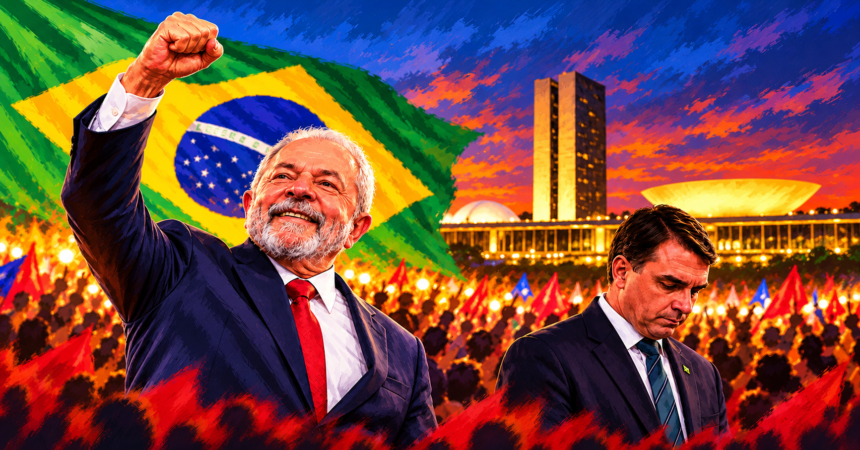
Brazilian President Luiz Inácio Lula da Silva has won the country’s 2026 presidential election, defeating Senator Flávio Bolsonaro in the 25 October runoff and securing an unprecedented fourth non-consecutive term. Brazil’s electoral authority confirmed Lula’s victory after an election night marked by dramatic shifts in the count and a dispute over the extension of voting hours.
At 21:27:53 Brasília time on 25 October, the official TSE results feed displayed by Votendi put Lula on 51.76% of valid votes (64,149,501) against 48.24% for Flávio Bolsonaro (59,778,349), with 99.88% of polling sections processed. These are a time-stamped, near-complete official-count snapshot, not necessarily the eventual final numerical totals. The result itself was confirmed by Brazil’s electoral authority, as reported by Reuters. Votendi continues to provide the official runoff results and source updates.
From first-round setback to runoff victory
Lula’s reelection follows an exceptional turnaround. In the first round on 4 October, Bolsonaro finished narrowly ahead, with approximately 47% of valid votes compared with Lula’s roughly 45%. The runoff therefore became a second opportunity for the incumbent to consolidate support beyond his original electoral base.
The 80-year-old president becomes the first candidate since Brazil’s return to democracy to finish behind in the first round and win the presidential runoff. Having served two terms from 2003 to 2010 and returned to office in 2023, Lula now prepares for a fourth non-consecutive term — a landmark in the country’s political history. The Guardian also reported the historic nature of the reversal.
How the election-night count turned around
The national race looked extraordinarily close as counting began. Bolsonaro briefly led in the early returns, but the balance changed when additional votes from different states entered the TSE tally. Lula moved ahead and continued to widen his advantage as the count neared completion.
Brazil’s regional political geography was central to the shifting national picture. Bolsonaro drew strong support in parts of the South, Southeast and Center-West, while Lula posted especially large margins across much of the Northeast. Results from states and municipalities are reported at different speeds, which means an early nationwide lead does not necessarily reflect the eventual distribution of all votes.
Polling institute Datafolha projected Lula’s victory at approximately 20:46 Brasília time, before the electoral authority’s confirmation. The statistical projection drew on the TSE count and regional patterns, but was separate from the official declaration. Folha de S.Paulo reported Datafolha’s election-night call.
Voting-hour extension triggers dispute
The runoff was overshadowed by an unusually late judicial intervention. Supreme Court Justice Cristiano Zanin ordered a two-hour extension of voting following concerns that public-transport interruptions had prevented some voters from reaching polling stations. Authorities subsequently clarified that voting could continue until 19:00 Brasília time only at locations that had not already closed.
The decision disrupted the expected timetable for reporting the count and prompted objections from Bolsonaro’s political allies. Some questioned the judicial process and raised claims of irregularities. Lula’s camp, in turn, had alleged that disruptions to public transport restricted access to the ballot. Claims of improper voting access must be distinguished from allegations that ballots or official vote totals were manipulated; none of the latter were established by the evidence reviewed in Votendi’s election-night reporting.
Any formal electoral complaints and court proceedings should be assessed on their own evidence. They do not change the fact that Brazil’s electoral authority has announced Lula as the election winner. See Votendi’s related analysis of the judicial interference and fraud allegations.
The challenges of a fourth term
The election result renews Lula’s mandate but does not end Brazil’s political divisions. Economic pressures, living costs, fiscal policy, security and the relationship between the presidency and a conservative-leaning Congress are set to shape the new administration. The campaign also highlighted different approaches to foreign policy and Brazil’s relationship with US President Donald Trump.
The immediate focus will now shift to the electoral authority’s final numerical tabulation, any legal challenges, responses from both political blocs and preparations for Lula’s next term. As of this report, Votendi has not independently verified a formal concession of defeat by Flávio Bolsonaro.
For live and historical election data, visit the Brazil runoff results and the Brazil election hub.
Sources: Brazil’s Superior Electoral Court (TSE); Reuters; Associated Press; The Guardian; Folha de S.Paulo / Datafolha. The quoted vote totals reflect the TSE’s 25 October 21:27:53 Brasília-time snapshot, with 99.88% of polling sections processed, and are not presented as 100% complete certified numerical totals.