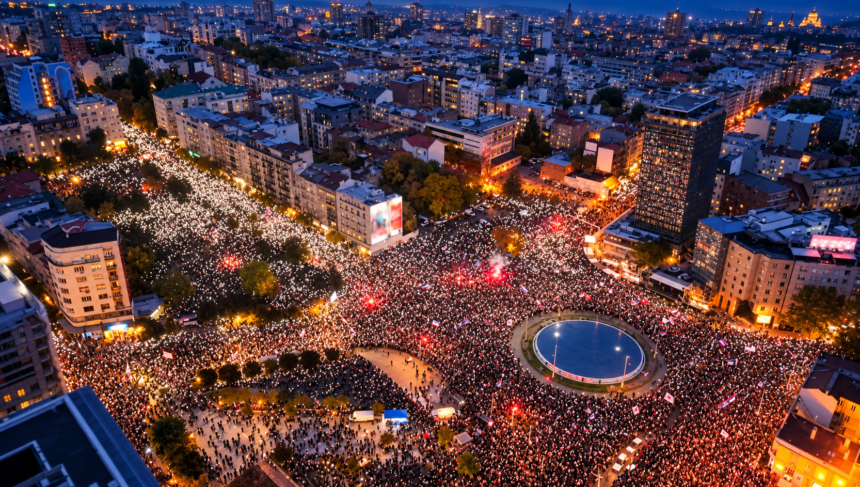
A large final campaign gathering in Belgrade and disputes over voting access abroad have brought two issues into focus ahead of Serbia’s October 25 parliamentary election: political mobilisation at home and the practical ability of citizens overseas to cast their ballots.
Serbia entered its final pre-election period on Friday, October 23, following a major rally organised by the Student List in central Belgrade. At the same time, questions surrounding overseas polling stations and voting hours have intensified, with election authorities defending their arrangements against criticism from opposition figures and voters abroad.
Independent group estimates 150,000 at Belgrade rally
An estimated 150,000 people attended the Student List’s final campaign gathering at Slavija Square on Thursday evening, October 22, according to the independent Archive of Public Gatherings.
The organisation said its estimate was based on footage recorded at 7 p.m., using calculations of occupied space and average crowd density.
The figure is an independent estimate, not an officially verified attendance count.
Thousands of participants converged on Slavija Square from different parts of Belgrade, filling the square and surrounding streets. The event brought the student movement’s election campaign to a close before the start of the legally required campaign silence.
The student-led movement emerged from protests following the collapse of a railway station canopy in Novi Sad on November 1, 2024, which killed 16 people.
Demands for accountability and investigations into the disaster subsequently developed into a broader political movement calling for institutional reforms and early elections.
The ruling Serbian Progressive Party (SNS), associated with former president Aleksandar Vučić, is seeking to retain its position in government. Vučić also held a separate campaign gathering in Belgrade on Thursday.
Overseas voters face long journeys and unusual voting hours
A separate controversy concerns arrangements for Serbian citizens voting abroad.
According to an Associated Press investigation, some registered voters have been assigned polling stations significantly farther from their homes than in previous elections.
One example involves Irina Djordjic, a Serbian voter living in Vancouver, Canada, who told AP that her polling location had been moved to Toronto, approximately 3,500 kilometres away.
The new arrangements also require overseas voting hours to correspond to Serbian time, creating inconvenient schedules in countries across different time zones.
AP reported that approximately 100,000 Serbian citizens registered to vote abroad in 2026, compared with around 39,000 in 2023.
Serbia’s election commission approved 93 overseas polling stations, an increase of 12 compared with the previous parliamentary election.
However, nine of those additional locations are in Bosnia and Herzegovina, according to AP, while voters in some more distant countries continue to report accessibility problems.
Authorities reject allegations of deliberate restrictions
Opposition figures have accused the authorities of introducing arrangements that could discourage overseas participation.
Those accusations remain contested.
Foreign Minister Marko Đurić has defended the selection of polling stations, explaining that decisions take account of registered voter numbers as well as logistical, security, space and staffing requirements.
The election commission has rejected complaints about the arrangements.
Meanwhile, volunteers have organised assistance through VoteBnB, a nonprofit initiative connecting overseas Serbian voters with transport and accommodation.
According to AP, the initiative has helped match hundreds of requests with offers of accommodation and shared transport.
What these developments mean ahead of October 25
The two developments highlight different aspects of Serbia’s parliamentary election.
The Belgrade gathering provides a visible measure of political mobilisation, but attendance figures cannot be directly converted into national vote shares or parliamentary seats.
The overseas voting controversy raises a separate issue: whether registered citizens can exercise their voting rights without disproportionate travel or scheduling difficulties.
Neither the existence of logistical obstacles nor the allegations surrounding them establish electoral misconduct. Their practical consequences will need to be assessed against verified participation figures and observations of election-day procedures.
Serbia’s campaign silence began at midnight on October 23 and continues until polling stations close at 8 p.m. on Sunday, October 25.
Eighteen electoral lists are competing for 250 parliamentary seats.
For polling data, individual surveys and election-system information, visit the Votendi Serbia Parliamentary Election 2026 hub.
Votendi has also previously examined concerns raised by Council of Europe election observers.