
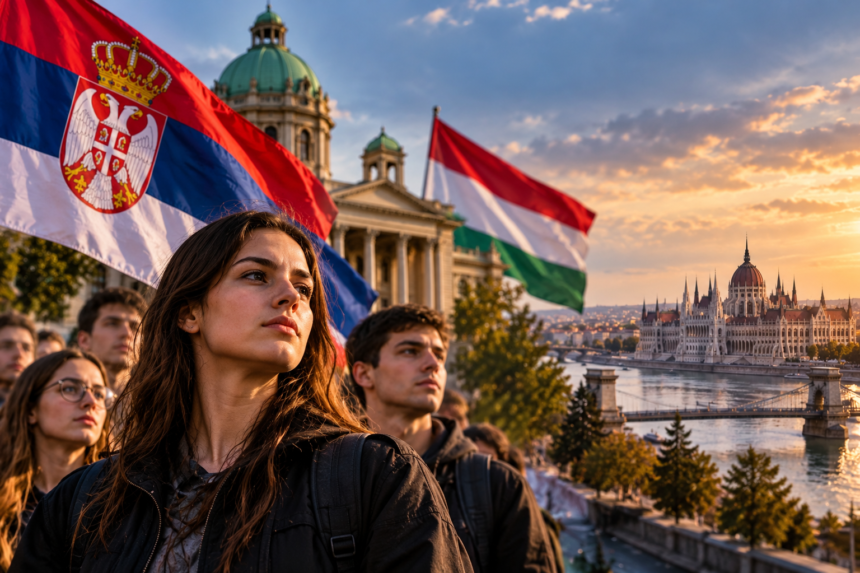
With Serbia heading into an early parliamentary election on October 25, supporters of the student-backed opposition are drawing comparisons with the political upheaval that brought Péter Magyar to power in Hungary. An Austrian analyst argues that the comparison has limits: the strategy for defeating an entrenched government is not necessarily a blueprint for governing afterward.
In a guest commentary published by Die Presse on October 19, historian and legal scholar Péter Techet asks whether Serbia is approaching a “Hungarian-style” turning point. His assessment highlights both the appeal and the potential pitfalls of an anti-establishment electoral breakthrough.
Why the Hungary comparison matters
Magyar’s Tisza party won 141 of the 199 seats in Hungary’s National Assembly in April 2026, ending Viktor Orbán’s long period in power. That result showed that a dominant incumbent political network could be defeated at the ballot box. The Inter-Parliamentary Union’s election record confirms both the scale of the victory and Tisza’s commanding parliamentary majority.
Serbia’s October 25 contest also features a challenger seeking to transform dissatisfaction with corruption and institutional accountability into electoral support. But the country’s Students’ List did not grow out of a split within the ruling Serbian Progressive Party (SNS). It grew from a grassroots protest movement following the November 2024 railway station canopy collapse in Novi Sad, which killed 16 people.
The Republic Electoral Commission formally proclaimed the Students’ List in September, giving the movement an official electoral vehicle. Whether its mobilisation translates into a parliamentary majority remains to be seen.
A centralised party versus a decentralised movement
Techet identifies a fundamental organisational difference. Magyar was a former insider of the Hungarian governing establishment who built a highly centralised electoral operation around his leadership. Serbia’s student movement, by contrast, emerged through university assemblies, decentralised organisation and collective decision-making.
Those methods can be strengths during protests: they create a broad sense of ownership and make the movement less dependent on a single personality. Electoral politics, however, requires candidate selection, national campaign coordination and potentially difficult decisions about coalition-building and policy priorities.
The comparison therefore raises a practical question that will survive election night: can a movement built to challenge an entrenched system develop the structures needed to govern while retaining its commitment to accountability?
Opposition to a government is not necessarily a new foreign policy
Techet also cautions against assuming that a change of government in Belgrade would automatically bring a dramatic change in Serbia’s positions on Kosovo, Russia or European integration. In his interpretation, both Magyar and the Serbian student movement have sought broad coalitions by emphasising corruption and public services over polarising ideological debates.
That is the analyst’s argument, not a settled judgement about the views of every supporter or candidate. Serbian voters have varied political priorities, and any future government’s programme would have to be assessed on its actual commitments and decisions.
For Brussels, the distinction matters. A government committed to stronger institutions and fairer political competition would not necessarily agree with every EU foreign-policy objective. Domestic democratic reform and international alignment are connected but separate questions.
The electoral arithmetic may also be different
Tisza’s 141-seat result gave Magyar a constitution-changing parliamentary majority. Serbia elects its 250-member National Assembly through a proportional system, making the distribution of votes among multiple lists important to the final balance of seats. A highly competitive race between two leading camps does not by itself establish who can form a government.
Votendi’s Serbia election hub shows why the picture remains uncertain. The latest eligible polls from different organisations give conflicting indications of which side is ahead. Votendi compares the surveys individually rather than publishing a single Serbia polling average, because the questionnaires and electoral-list configurations vary materially across pollsters.
If the Students’ List does not secure enough seats to govern alone, smaller parties could play a decisive role. Techet suggests such a coalition could be more fragile than Hungary’s single-party majority, but might also allow for a more pluralistic political landscape. Both outcomes are possibilities, not predictions.
What the October 25 vote will test
The first test is whether student-led protest mobilisation can become nationwide electoral participation, including beyond Serbia’s biggest cities. The second is how votes translate into seats — and whether the resulting parliamentary arithmetic allows a stable government. The third is whether the election process and the treatment of its outcome increase public trust in democratic institutions.
Techet’s underlying warning is about the period after a political breakthrough. Replacing a dominant leader does not, by itself, guarantee independent institutions, effective scrutiny or a more open political system. Those outcomes depend on the decisions of those who take power.
Hungary’s 2026 result is therefore relevant to Serbia, but it cannot provide a ready-made forecast. The Serbian student movement has a different origin, political structure and electorate. On October 25, voters will determine whether it has translated that difference into electoral strength; the quality of any political transition would be judged only afterward.
Sources: Die Presse (Péter Techet, guest commentary, October 19, 2026); Serbian Republic Electoral Commission; Inter-Parliamentary Union. Techet’s criticisms of current Hungarian political practice are his interpretations, not independently verified findings by Votendi.