


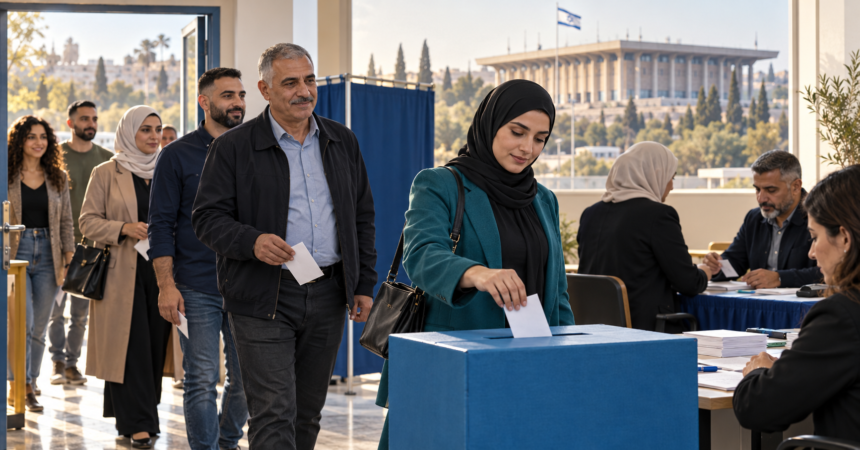
Arab voter turnout is one of the important unknowns in Israel’s October 27 election. Its significance reaches beyond the number of seats won by Arab-led parties: the eventual balance will also depend on which parties are willing to cooperate after the vote.
An AFP report published on October 18 describes Arab citizens who previously boycotted elections now considering voting, alongside local mobilization efforts. Interviewees cite concerns about the outgoing government, home demolitions and personal security. These accounts identify political motivations; they do not establish how much turnout will rise nationally.
The gap that makes mobilization consequential
The report puts turnout among Arab and Druze voters in the 2022 election at around 53%, compared with roughly 70% overall. That historical gap explains why participation attracts attention in a close parliamentary contest. It does not mean every previous nonvoter is available to the same party or motivated by the same issue.
Votendi’s interpretation is that mobilization has two tests. Parties need to persuade citizens that participating can make a difference, and then demonstrate that their parliamentary representation can produce useful results. Political frustration can encourage voting, but it can also reinforce withdrawal from institutions.
Thirteen seats do not form a coalition by themselves
The Zman Yisrael/Tatika Research & Media survey published October 15 gives Jewish-led opposition parties 54 seats and the pro-Netanyahu bloc 49. The Joint List receives eight and Ra’am five; the nonaligned Reservists receive four. The survey interviewed 500 respondents on October 14–15 and reports a ±4.4% margin of error, The Times of Israel reports.
That snapshot leaves both principal camps below the 61 seats required for a majority. Adding Arab-led parties to an opposition total produces an arithmetic sum, not evidence of an agreed governing arrangement. A government’s formation depends on political commitments as well as the distribution of seats.
Ra’am and the Joint List are distinct actors
The AFP report notes that Ra’am participated in the 2021–2022 governing coalition and is more open to negotiation with the right. Treating all Arab-led parties as a single automatic extension of the Jewish-led opposition would erase a politically important difference.
For analysts, the questions should therefore remain separate: how many citizens vote, which lists they choose, and what cooperation those lists and potential partners are prepared to accept afterward. An increase in representation does not answer the third question on its own.
The uncertainty is political as well as statistical
Seat estimates can move when participation assumptions change or a small list crosses the electoral threshold. In a closely divided chamber, such changes can affect the options available to several parties at once. A simple claim that higher Arab turnout guarantees a particular prime minister would go beyond the evidence.
The useful signs to watch are repeated participation findings, changes in the relative support for Arab-led lists, and explicit statements about post-election cooperation. Anecdotes from individual communities are valuable reporting, but should not be presented as a national turnout forecast.
Votendi’s Israel election hub presents individual seat polls and political context. The scenarios discussed here are analytical possibilities, not a proprietary forecast or an assumption that a coalition deal already exists.