



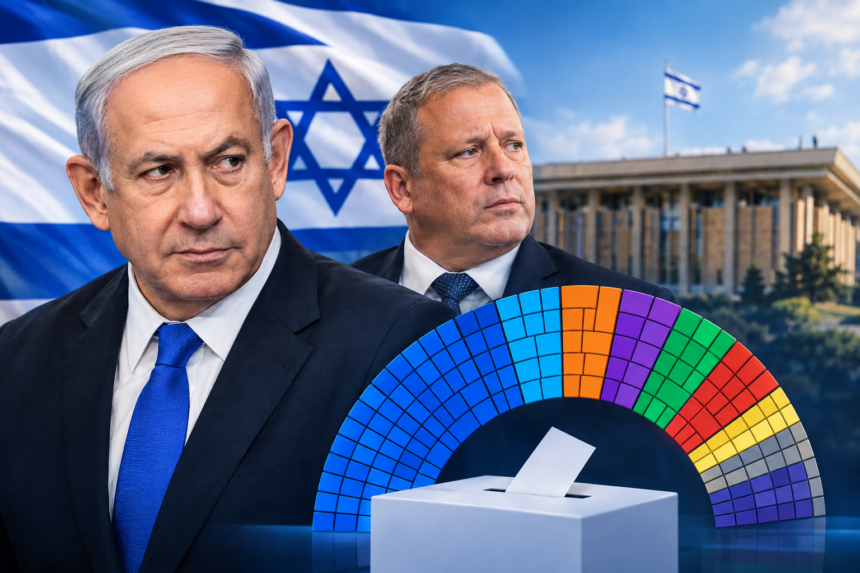
A new Channel 14 election poll gives Prime Minister Benjamin Netanyahu’s bloc a razor-thin 61-seat majority in Israel’s 120-member Knesset. The October 12 survey, conducted by NEXT DATA, puts Likud first on 29 seats and Gadi Eisenkot’s Yashar second on 20, while a smaller electoral list enters the projected parliament.
The result is two seats below the 63-seat bloc projection in Channel 14’s October 7 survey. It is also sharply different from a KAN/Kantar poll published a day earlier, underscoring how much uncertainty remains ahead of Israel’s October 27 election.
Likud and Yashar both lose seats in Channel 14’s series
In the new NEXT DATA survey, Likud falls from 31 to 29 seats and Yashar declines from 23 to 20 seats compared with the same pollster’s October 7 figures. Shas holds 10 seats, while the Democrats rise to 10. United Torah Judaism remains at eight.
The Joint List rises to eight seats, Religious Zionism–Zehut gains one to seven, while Otzma Yehudit and Naftali Bennett’s B’Yachad are both on seven. Yisrael Beytenu and Ra’am receive five seats each.
| Party or list | Projected seats |
|---|---|
| Likud | 29 |
| Yashar | 20 |
| Shas | 10 |
| The Democrats | 10 |
| United Torah Judaism | 8 |
| Joint List | 8 |
| Religious Zionism–Zehut | 7 |
| Otzma Yehudit | 7 |
| B’Yachad | 7 |
| Yisrael Beytenu | 5 |
| Ra’am | 5 |
| Reservists–Economic Party | 4 |
| Total | 120 |
Source: NEXT DATA / Channel 14, October 12, 2026. These are projected Knesset seats from one survey, not vote percentages, election results or a Votendi polling average.
A 61-seat majority leaves virtually no margin for error
Channel 14’s bloc classification assigns 61 seats to Netanyahu’s supporting parties, 46 to the principal opposition grouping and 13 to Arab parties. Compared with its October 7 survey, the Netanyahu bloc is down two seats.
The 61-seat threshold matters because a government needs support from a majority of the 120-member Knesset. At this level, even one seat changing hands would remove the bloc’s outright majority.
These broadcaster-defined blocs are analytical groupings, however, not binding coalition commitments. Actual government formation would depend on the parties elected and their subsequent negotiations.
A smaller party enters the projected Knesset
One potentially decisive change is the appearance of the Reservists–Economic Party, which is projected to win four seats after polling below the electoral threshold in Channel 14’s previous survey. Its entry changes the distribution of seats even though the two largest parties remain dominant.
Israel’s 3.25% electoral threshold means that votes for parties falling short of the threshold do not translate into seats. Small shifts near that line can therefore have an outsized effect on the parliamentary arithmetic. The Religious Zionism projection in this survey includes Zehut.
Why the KAN poll looks so different
A KAN/Kantar survey published October 11 gives Netanyahu’s wider grouping 53 seats, with Eisenkot’s Yashar on 22 and Likud on 20. Channel 14 instead puts Likud nine seats ahead of Yashar and shows a narrowly viable 61-seat Netanyahu bloc.
The broadcasters’ bloc definitions are not identical, so the two bloc totals should not be treated as a perfectly like-for-like comparison. Nevertheless, the large difference in Likud’s projected seats shows that this is more than a technical disagreement about political groupings.
Differences in sampling, survey methods, fieldwork dates and treatment of near-threshold parties can all influence results. A single poll is a snapshot, not a reliable forecast on its own.
What to watch before October 27
The final weeks of Israel’s campaign will test whether Channel 14’s narrow-majority scenario is sustained by further polling and whether smaller parties continue to cross the electoral threshold.
For the opposition, the question is not only whether Yashar or other parties gain seats but also whether the resulting parliamentary groupings can assemble a governing majority. For Netanyahu, a 61-seat projection offers a path to power with no room for defections.
The takeaway is not that the election has been decided, but that the shape of the next Knesset remains highly sensitive to small electoral movements. Follow Votendi’s Israel 2026 election hub for developments and individual poll releases.
Survey details and sources
The NEXT DATA poll was published by Channel 14 on October 12 and reported a sample of 538 Israeli adults. Shlomo Filber was credited with analysis. The survey mode and margin of error were not specified in the source information reviewed.
Sources: Channel 14, October 12; Channel 14, October 7; Votendi’s KAN/Kantar poll analysis, October 11.
Featured visual: editorial illustration created for Votendi.