



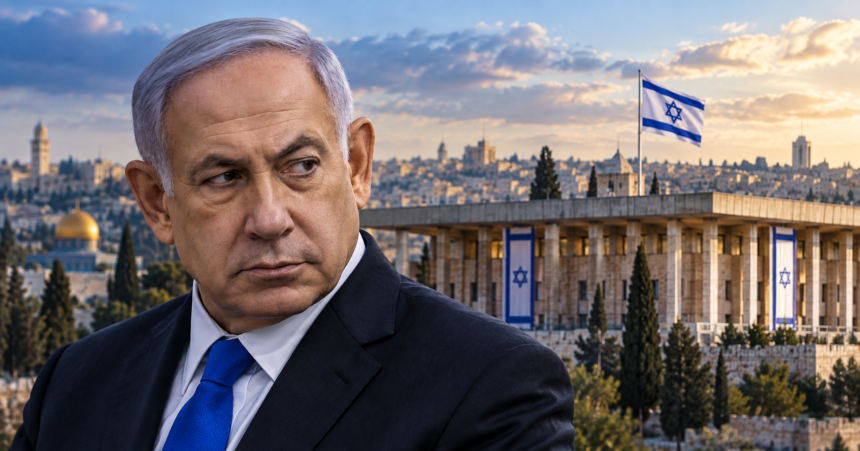
With Israel’s election just three weeks away, Benjamin Netanyahu faces a political situation very different from the one that brought his current coalition to power.
The latest polling does not tell us who will form Israel’s next government. But it does show something increasingly important: there are plausible parliamentary combinations in which Netanyahu is no longer prime minister after the October 27 election.
A new Channel 12 poll released on October 5 gives Netanyahu’s current political bloc just 49 seats in the 120-member Knesset, far below the 61 required for a majority. At the same time, the main Zionist parties opposed to Netanyahu reach 54 seats, Arab parties hold another 13, and the uncommitted Hendel–Zelekha list receives four.
The central question in Israel’s election is therefore becoming less about which single party finishes first and more about whether either side can assemble 61 seats after the vote.
The latest poll: Eisenkot 23, Netanyahu 21
Channel 12’s October 5 survey puts Gadi Eisenkot’s centrist Yashar party first with 23 seats, while Netanyahu’s Likud rises to 21.
Naftali Bennett’s B’Yachad follows with 13 seats. The Democrats and Avigdor Liberman’s Yisrael Beytenu receive nine each.
On Netanyahu’s side, United Torah Judaism receives eight seats, Shas seven, Otzma Yehudit seven and the Religious Zionism–Zehut alliance six.
The Joint List receives eight seats and Ra’am five. The Hendel–Zelekha alliance receives four seats. Ofer Winter’s Amcha Yisrael, potentially important for Netanyahu’s bloc in earlier polls, drops below the 3.25% electoral threshold at just 1.5%.
That produces the following bloc picture:
Netanyahu bloc: 49
Zionist anti-Netanyahu parties: 54
Arab parties: 13
Hendel–Zelekha / uncommitted: 4
The survey was conducted on October 5 among 501 respondents representing Israel’s adult population, using internet and telephone interviews. The reported maximum sampling error is ±4.4 percentage points.
Netanyahu can fall short — but that does not automatically produce another government
This is the crucial distinction.
Netanyahu does not need Likud to be the largest party. He needs enough parties willing to recommend and support a government led by him.
The same is true for Eisenkot and the opposition.
On the latest Channel 12 numbers, the main Zionist anti-Netanyahu parties reach 54 seats. Adding Hendel and Zelekha’s four seats would bring that combination to 58 — still three short of a majority.
Ra’am, led by Mansour Abbas, is polling at five seats. A combination of the 54-seat Zionist opposition bloc, the four Hendel–Zelekha seats and Ra’am would mathematically reach 63 seats.
But parliamentary arithmetic is not the same as a coalition agreement. Some opposition leaders have indicated a willingness to cooperate with Ra’am, while others have ruled out such an arrangement.
That makes the Arab parties — and particularly Ra’am — potentially important to the post-election negotiations.
The issue became even more relevant after Israel’s Supreme Court overturned attempts to bar Arab parties from participating in the election, keeping them in the contest ahead of October 27.
Other polls show a much tighter race
Channel 12 is not the only measure of the political landscape, and Israeli polls currently differ substantially.
A recent Kan poll put Yashar on 23 seats and Likud on 21, but showed the Netanyahu bloc on 51 seats and the main change bloc on 52. Arab parties received 13 seats and Hendel–Zelekha four. The poll surveyed 553 people and reported a ±4.2-point margin of error.
A Maariv poll published October 2 put Netanyahu’s coalition bloc on 51 seats and the Zionist opposition on 53.
Channel 13 has produced somewhat stronger numbers for Netanyahu: an October 1 survey put his supporting parties on 54 seats, against 52 for the opposing Zionist bloc, with Arab parties holding the balance outside those two groups.
The differences are important. They show why individual polls should not be treated as forecasts.
What is more consistent across several recent surveys is that neither Netanyahu’s traditional bloc nor the main Zionist opposition bloc is comfortably above the 61-seat threshold on its own.
October 7 remains at the centre of the election
The election is Israel’s first national vote since the Hamas-led attack of October 7, 2023 and the wars that followed.
Netanyahu is campaigning heavily on security, regional threats and his record of confronting Hamas, Hezbollah and Iran. Reuters reported in late September that Likud’s campaign is again presenting Netanyahu as the leader best equipped to protect Israel and resist international pressure.
But October 7 also remains one of Netanyahu’s major political vulnerabilities.
In the October 5 Channel 12 poll, 65% of respondents said Netanyahu bears “a lot” of responsibility for the October 7 failure, while another 22% attributed some responsibility to him. Among current coalition voters, opinions were substantially different from those of opposition voters, illustrating the deep political divide over the issue.
Former IDF chief Gadi Eisenkot has emerged as Netanyahu’s principal challenger. His security background gives this election an unusual dynamic: the debate over national security is not simply a traditional right-versus-left contest.
Reuters notes that this is the first election Netanyahu has fought after being prime minister during a security failure on the scale of October 7.
The smaller parties may decide everything
The most consequential numbers over the next three weeks may therefore not be the difference between Yashar and Likud.
They may be the numbers around the electoral threshold.
Ofer Winter’s Amcha Yisrael had previously supplied several projected seats to the broader Netanyahu-aligned camp. In the latest Channel 12 poll it falls to just 1.5%, meaning those votes would produce no Knesset seats if that result were repeated in the election.
At the same time, Hendel and Zelekha remain just above the threshold with four seats and have not fully committed themselves to either of the major blocs.
Small movements around Israel’s 3.25% threshold can therefore shift several Knesset seats at once — and potentially change the coalition arithmetic without a large change in the overall national vote.
So, can Netanyahu lose power?
Current polling demonstrates a parliamentary route by which Israel could have a government not led by Netanyahu, but it does not establish that such a government will be formed.
The October 5 Channel 12 poll gives Netanyahu’s bloc only 49 seats — twelve short of a majority. But the main Zionist opposition is also below 61.
That means the post-election result could depend on parties currently outside the two main blocs, especially Hendel–Zelekha and potentially Ra’am.
It also means an election in which Netanyahu’s bloc loses seats could still end without an alternative coalition being successfully assembled.
Reuters has noted that one possible outcome discussed by Israeli political analysts is another parliamentary stalemate, in which neither side succeeds in constructing a governing majority.
With the election scheduled for October 27, the most useful numbers to watch are therefore not only Likud versus Yashar, but three separate measures:
Netanyahu bloc vs. 61.
Zionist opposition bloc vs. 61.
And the number of seats held by parties capable of deciding which side, if either, can cross that line.
For now, Israel’s polling picture shows a genuinely open coalition contest — and the battle over who can assemble 61 Knesset members may matter more than who finishes first on election night.