


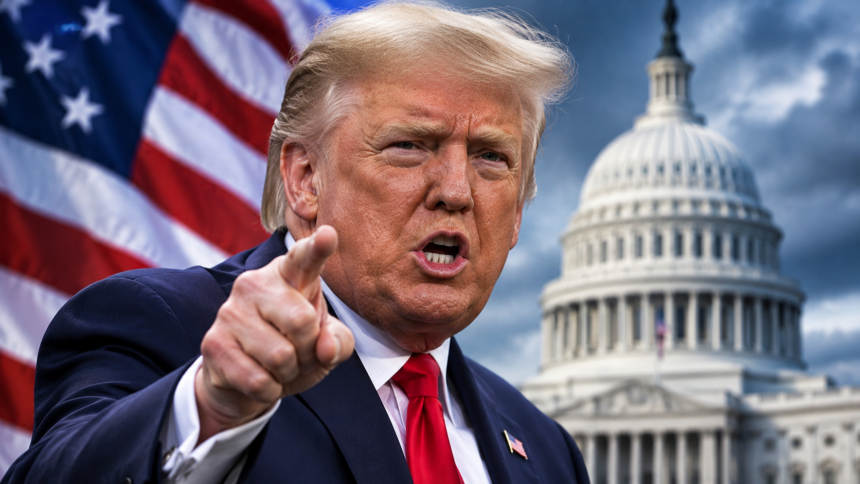
President Donald Trump has renewed his attacks on the integrity of American elections following the Republican Party’s defeat in the November 3 midterms, accusing the electoral system of being corrupt and demanding that votes in Alaska’s unresolved Senate contest be handled differently.
Speaking to reporters in the Oval Office on November 5, Trump declared: “Our elections are so crooked. You have no idea.”
The remarks came two days after Democrats secured control of both chambers of Congress, marking a major setback for the president’s Republican Party.
Although Trump initially signaled that he accepted the overall election results, his latest comments focused on alleged irregularities in Los Angeles and the closely contested Alaska Senate race.
Trump questions the Los Angeles result
During an Oval Office event, Trump criticized the Los Angeles mayoral election, saying he had expected Spencer Pratt to advance further in the contest.
He suggested that the subsequent counting of votes had changed the outcome under suspicious circumstances.
However, Trump offered no verified evidence of electoral manipulation.
Nithya Raman defeated incumbent Mayor Karen Bass, according to results reported by City News Service. In an update published November 5, Raman had 52.1% of counted votes compared with Bass’s 47.9%. Bass conceded the contest.
Trump’s allegations about the counting process remain unsubstantiated.
Alaska becomes the centre of Trump’s election complaints
The president also turned to the closely contested Alaska Senate election, where Democratic challenger Mary Peltola and Republican incumbent Dan S. Sullivan were separated by only hundreds of votes.
According to a November 6 Associated Press report, Peltola held a lead of 637 first-choice votes, with approximately 74% of ballots counted by AP’s measure.
Neither principal candidate had secured an outright majority.
Two additional candidates — Republican Gerald Heikes and Daniel J. Sullivan Jr., who shares the incumbent senator’s surname — received thousands of first-choice votes.
Trump alleged that the presence of another candidate named Sullivan was intended to confuse voters. He argued that votes cast for the lesser-known candidates should be assigned to the Republican incumbent.
But Alaska’s election law does not permit such automatic transfers.
Why Alaska’s ranked-choice voting rules matter
Alaska uses ranked-choice voting, allowing voters to indicate their preferences among candidates.
If no candidate receives a majority of first-choice votes, the lowest-performing candidate is eliminated and the affected ballots are transferred according to each voter’s next valid preference.
The procedure continues until a winner is determined.
This means votes cast for Gerald Heikes or Daniel J. Sullivan Jr. cannot simply be awarded to Dan S. Sullivan on the assumption that those voters intended to support him.
Some may have ranked the incumbent next. Others may have preferred Mary Peltola or chosen not to rank another candidate.
The distinction is particularly important because the contest remains unresolved and the state has not yet conducted its official ranked-choice tabulation.
The Alaska Division of Elections has scheduled that process for November 18, 2026, after outstanding eligible ballots have been reviewed.
Votendi has examined the implications in its separate analysis:
Alaska Senate race: Why Peltola’s narrow lead is not the final count
Democrats control Congress, but Trump retains significant powers
Trump’s renewed allegations come amid a transformed political landscape in Washington.
The Democrats’ midterm gains have secured control of both the House of Representatives and the Senate.
When the new Congress convenes in January 2027, Democratic lawmakers will have expanded powers to conduct oversight, investigate executive-branch activities and influence the legislative agenda.
The president, however, retains the ability to veto legislation and exercise constitutional executive powers.
The election results therefore create the conditions for sustained conflict between the White House and Congress during the final two years of Trump’s presidency.
Is there evidence that the midterms were rigged?
No credible evidence has emerged establishing widespread fraud capable of explaining the Democratic congressional victories.
An Associated Press fact-check published November 4 documented isolated allegations and election-administration problems, but found that major post-election fraud claims had not gained significant traction.
Many Republican candidates conceded their races, and election officials disputed several widely circulated allegations.
Individual election complaints can be investigated through established legal processes. They do not, by themselves, demonstrate that an election was manipulated.
What happens next?
Attention now turns to Alaska’s remaining ballots and its November 18 ranked-choice tabulation.
The eventual outcome must be determined by the ballots cast and the state’s prescribed counting procedures, not by assumptions about which candidates’ supporters should be grouped together.
For Votendi, the distinction between political claims, unofficial results, model-based scenarios and certified outcomes remains essential.
Follow the latest developments:
2026 US Midterm Election Results — Votendi Live Coverage
Sources: November 5 Oval Office transcript · AFP / France 24 · Associated Press election fact-check · Alaska Division of Elections · PolitiFact on Alaska’s candidates