



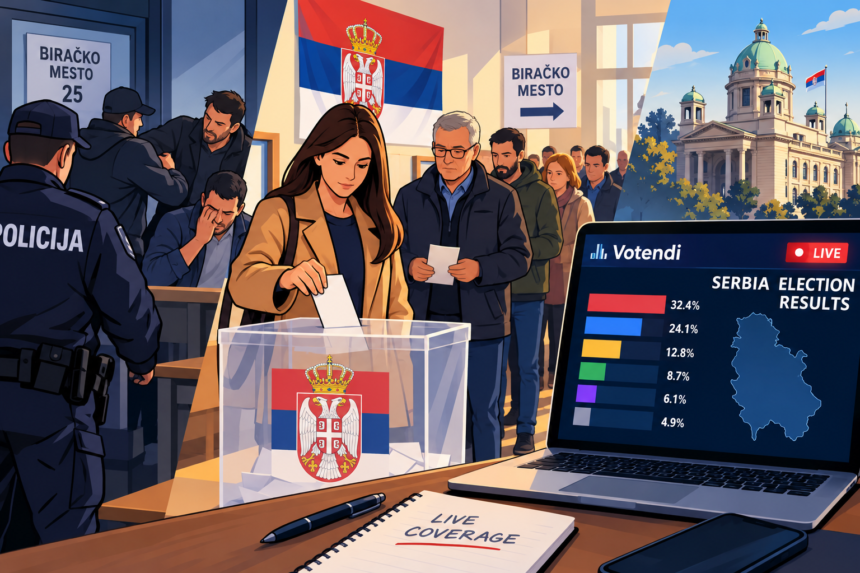
Turnout in Serbia’s snap parliamentary election reached an estimated 27.3% by 11:00 CET (10:00 UTC) on Sunday, October 25, compared with 15.1% at the same point in the 2023 election, according to CeSID/Ipsos. The high participation comes amid reports of attacks on journalists near Vranje, an assault on a Students’ List mobile-team member in Kragujevac and suspected vote-buying in Zaječar.
- CeSID/Ipsos: turnout reaches 27.3% by 11am
- Earlier CRTA estimate: 19.8% turnout by 10am
- Journalists attacked while investigating reports near Vranje
- Students’ List mobile-team member injured in Kragujevac
- Police attend reported vote-buying concerns in Zaječar
- Crowds at polling stations as observers report delays
- Polling board member attacked ahead of election day
- More than 6.4 million voters eligible to participate
- Election observers monitoring the voting process
- Votendi to follow Serbia’s election results live tonight
- What does the sharp increase in turnout mean?
The latest estimate is 12.2 percentage points above the corresponding 2023 figure, equivalent to approximately 81% higher turnout. CeSID and Ipsos published the update at 11:23 CET (10:23 UTC), based on 93.7% of their monitoring sample of 750 polling stations having been processed.
An earlier CeSID/Ipsos estimate showed turnout at 12.0% by 09:00, compared with 5.3% at the same time in 2023.
Votendi will provide live coverage of Serbia’s parliamentary election throughout election night, tracking official results, turnout developments and independent assessments as they become available.
CeSID/Ipsos: turnout reaches 27.3% by 11am
CeSID/Ipsos estimated that 27.3% of registered voters had voted by 11:00, compared with 15.1% at the same time in 2023. The gap is 12.2 percentage points, or approximately 80.8% in relative terms.
The estimate was released at 11:23 local time, with 93.7% of the sample of 750 polling stations processed. These are sample-based turnout estimates, rather than a final official count.
Earlier CRTA estimate: 19.8% turnout by 10am
According to CRTA’s official election-day update, published at 10:29 local time, 19.8% of registered voters had participated by 10:00.
At the equivalent point in the December 2023 parliamentary election, turnout stood at 9.8%.
The comparison highlights a substantial change in the pace of voting. While the 2023 election recorded relatively modest early participation, Sunday’s figures show significantly more voters casting their ballots during the opening hours.
The previous CeSID/Ipsos estimate, reported by Serbian public broadcaster RTS, put turnout at 12.0% by 09:00, compared with 5.3% in 2023. That estimate was based on 94% of the monitoring sample having been processed.
The two organisations use their own monitoring samples and methodologies, meaning their figures should not be interpreted as a single continuous measurement.
Higher turnout does not, by itself, reveal which political parties or electoral lists are benefiting. The geographic distribution of participation, voter preferences and the final turnout level will become clearer only as further information is released.
Journalists attacked while investigating reports near Vranje
InfoVranjske journalist Mihajlo Stojković and Večernje novosti reporter Jelena Stojković were attacked in Pavlovac, near Vranje, after going there to investigate alleged vote-buying, 021.rs reported. Jelena Stojković told Bujanovačke that a group threw stones at them and dragged and struck them. She reported injuries to her finger and bruising, while her colleague was taken to hospital, according to the account carried by Naslovi.net.
Students’ List mobile-team member injured in Kragujevac
Vreme reported that a member of the Students’ List mobile team was assaulted in Kragujevac. His daughter said he had begun filming suspected vote-buying before a group chased him and attacked him at a nearby petrol station. A subsequent report by Glas Šumadije, cited by Vreme, said he suffered a broken nasal bone and was in hospital. The vote-buying allegation remains an attributed claim.
Police attend reported vote-buying concerns in Zaječar
N1 reported suspected vote-buying in Zaječar and police attendance. Reports described alleged organised activity at a hospitality venue near a polling station. These suspicions do not establish that a criminal offence occurred; the circumstances and any responsibility remain for the competent authorities to determine.
Crowds at polling stations as observers report delays
CRTA reported that most polling stations opened on time, although queues were visible at several locations.
According to the organisation, opening procedures were delayed by more than 10 minutes at 16% of observed polling stations.
CRTA also reported that its observers were initially denied access to polling stations in several cases. Those access problems were subsequently resolved following intervention by Serbia’s Republic Electoral Commission (RIK).
The incidents underline the importance of independent monitoring during an election taking place amid prolonged political tensions.
However, procedural irregularities and access disputes must be assessed individually. Their occurrence does not automatically establish whether the broader election result has been affected.
Polling board member attacked ahead of election day
The election began against the backdrop of a violent incident in Šabac on Saturday, October 24.
A member of a polling board was injured following a confrontation with two men at polling station number 25 while election materials were being prepared.
According to information attributed to the Basic Public Prosecutor’s Office in Šabac, the incident began as a verbal dispute before one man pushed the polling board member out of the room and another struck him in the face.
The injured official, identified by the initials V.B., was referred for emergency medical attention.
Prosecutors instructed police to obtain witness statements, collect available surveillance footage and investigate the circumstances surrounding the incident.
The assault raises concerns about the safety of election officials, particularly in the context of a politically charged campaign. Criminal responsibility remains a matter for the competent authorities to establish.
More than 6.4 million voters eligible to participate
Polling stations opened at 07:00 local time on Sunday and are scheduled to remain open until 20:00 CET (19:00 UTC).
More than 6.4 million citizens are eligible to participate in the parliamentary election, which will determine the composition of Serbia’s 250-seat National Assembly.
A total of 18 electoral lists are contesting the election.
The vote follows a period of intense political confrontation, including sustained student-led demonstrations, disputes over democratic institutions and competing demands for political change.
The student protest movement gained national prominence following the November 2024 collapse of a railway station canopy in Novi Sad, which killed 16 people.
The tragedy prompted protests and intensified public debate over institutional accountability and governance.
Sunday’s election provides an opportunity for voters to determine the parliamentary balance through the ballot box.
Election observers monitoring the voting process
Domestic and international election observers are monitoring voting procedures, turnout and reported irregularities.
CRTA has deployed approximately 2,500 observers across a representative sample of 500 polling stations.
Its observation mission uses statistical sampling to estimate turnout and will also conduct parallel vote tabulation after polling stations close.
CeSID and Ipsos are separately monitoring a sample of 750 polling stations and publishing estimates during the election day.
International observation missions include representatives of the OSCE and other European institutions.
Their assessments will be important in evaluating the administration of the vote, the conduct of polling station officials and the handling of reported irregularities.
Votendi to follow Serbia’s election results live tonight
Votendi will provide dedicated election-night coverage, with updates based on official information and clearly identified independent projections.
The planned timetable is:
- 19:15 CET (18:15 UTC): Votendi’s dedicated election-night live pages are scheduled to open.
- 19:30 CET (18:30 UTC): Combined Serbia–Brazil election-night coverage begins on Votendi’s homepage.
- 20:00 CET (19:00 UTC): Polling stations in Serbia are scheduled to close.
- After 21:30 CET (20:30 UTC): CRTA expects to publish its preliminary results projection, subject to data availability.
- As official figures become available: Votendi will track confirmed results from Serbia’s Republic Electoral Commission.
All published results will be attributed to their sources, with timestamps and reporting status clearly identified.
Readers can follow the Votendi Serbia Election Hub for polling data, electoral context and election developments.
Our Serbia and Brazil election-night coverage also explains how the two elections will be monitored during the same evening.
What does the sharp increase in turnout mean?
The most significant development of the opening hours is the scale of the increase compared with previous elections.
By 11:00, the CeSID/Ipsos estimate of 27.3% was approximately 81% above the corresponding 2023 figure of 15.1%. Earlier, CRTA estimated turnout of 19.8% by 10:00, against 9.8% in 2023. These comparisons refer to different observation samples and reporting times.
Several explanations are possible, including greater public interest, increased political mobilisation and changes in when voters choose to cast their ballots.
However, no definitive conclusion about the reasons for the increase can be drawn from national turnout figures alone.
A higher turnout rate is not equivalent to increased support for a particular party, coalition or electoral list.
The key questions as the day progresses will be whether the elevated participation rate continues, how turnout varies geographically and whether election observers identify significant problems affecting the voting process.
Once polling stations close, attention will shift to official vote totals, the distribution of parliamentary seats and the assessments published by independent observers.
Votendi will continue monitoring Serbia’s 2026 parliamentary election, distinguishing verified official results from projections, opinion polls and preliminary estimates.
Sources: CRTA – Turnout at 10:00, CeSID/Ipsos – Morning turnout via FoNet, 021.rs – Šabac polling-station incident, CRTA Election Observation Mission.
Fantastic website you have here but I was curious if you knew of any community forums that cover the same topics
discussed here? I’d really like to be a part of community where I
can get feedback from other experienced individuals that share the same interest.
If you have any suggestions, please let me know. Thanks a lot!
Everything is very open with a really clear description of the issues.
It was really informative. Your site is useful.
Thanks for sharing!