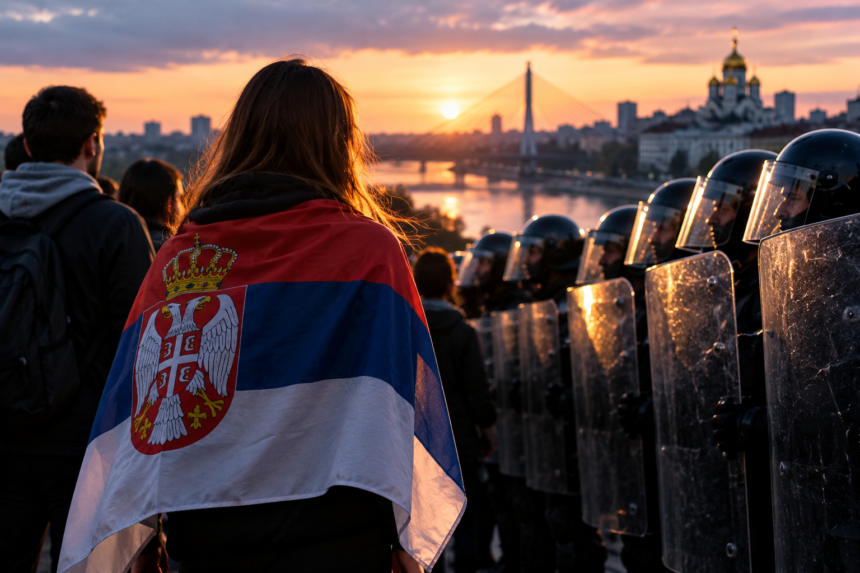
Police in Bosnia and Herzegovina’s Republika Srpska have banned a gathering planned in Banja Luka to support Serbia’s student-led election movement, adding a cross-border dimension to the final days before Serbia’s October 25 parliamentary vote. The authorities cited safety concerns, while the organisers said the decision was politically motivated.
The October 19 event was to be held at Trg Krajine, Banja Luka’s central square. It was the second event supporting Serbian students to be prohibited in Republika Srpska over the previous month, according to Associated Press reporting published on October 20. The police decision is a confirmed administrative action; the competing explanations for it remain contested.
What happened in Banja Luka?
The organisers had notified the authorities of plans for a gathering on Monday, October 19. According to Vreme’s account of the police decision, the original notification was submitted on October 14, with 75 to 125 people expected. The proposed programme included discussions with citizens and speeches in support of Serbia’s student movement.
Banja Luka police concluded that the gathering could pose risks to participants, organisers and other citizens, according to the published account of the prohibition. Those security concerns were the stated official reason for the ban. They are not, by themselves, proof of a political motive.
Organisers disputed the rationale. The informal group Students for Students said it intended to challenge the decision through legal channels. Opposition politician Nebojša Vukanović also criticised the prohibition, while students and other participants argued that freedom of assembly should be protected. Euronews Serbia reported those objections at a press conference on October 19.
Whether the specific security assessment was justified — or whether the ban was an improper restriction of assembly — requires evidence beyond the parties’ competing statements. The reporting reviewed for this article does not establish a final judicial ruling on the decision.
Why an election in Serbia is being debated in Bosnia
Republika Srpska is an entity within Bosnia and Herzegovina, not a part of the Republic of Serbia. But the two countries have closely connected Serbian communities, political parties and voters. Serbian nationals living or staying in Bosnia can cast a ballot abroad if they meet the applicable registration requirements.
This makes public events in Banja Luka politically visible during a Serbian national election campaign, even though local police and organisers operate under Bosnia and Herzegovina’s legal and constitutional arrangements.
The student-backed electoral list in Serbia emerged from a wider protest movement following the November 2024 collapse of a railway-station canopy in Novi Sad. That movement has since become a major participant in the October 25 parliamentary contest. Votendi recently examined why comparisons with the Hungarian opposition’s electoral strategy have limits and the concerns raised by election observers over campaign conditions.
28 polling stations in Bosnia — and a separate controversy
Beyond the dispute over assembly rights, the Serbian election has drawn attention to voting arrangements in Bosnia and Herzegovina. AP reported that approximately 19,800 people could vote at 28 polling stations in the country on October 25.
The location count can be checked against the Serbian Embassy’s official list published October 9, which names voting stations numbered 10 through 37 in locations including Sarajevo, Banja Luka, Mostar, Bijeljina and Brčko. The embassy says voters must be entered on the relevant overseas electoral register and bring a valid Serbian identity card or passport.
The existence of overseas polling stations and voting by registered Serbian citizens is not evidence of electoral misconduct. It is a recognised arrangement for nationals casting ballots from outside their country. The separate question is whether anyone is organising, coercing or improperly influencing voters, and whether polling and counting rules are applied consistently.
According to AP, opposition activists and independent monitors have previously alleged that Serbian political figures and allies in Bosnia organised voting by dual nationals to benefit Aleksandar Vučić’s Serbian Progressive Party (SNS). Vučić and Milorad Dodik have denied those accusations. The allegations should not be presented as established findings without independent evidence.
What this means for the final campaign days
The Banja Luka dispute draws together two different aspects of the election: the right of people to express support for political movements, and the rules governing voting across borders. The first concerns the justification and proportionality of a police restriction; the second concerns voter access, registration and administration.
They may be politically connected in the arguments made by participants, but neither question should be used as evidence to predetermine the other. A prohibited rally does not prove that ballots are being manipulated, just as the existence of overseas voting does not settle whether an assembly restriction was appropriate.
With the October 25 election approaching, the outstanding questions include whether organisers receive an independent review of the ban, whether overseas voters can access their designated stations under the published rules, and whether credible observers document any irregularities. Readers should distinguish documented administrative decisions from allegations by political actors.
Follow the Votendi Serbia Election 2026 hub for the election guide, polling information and further analysis.
Sources: Associated Press, October 20, 2026; Vreme, October 18; Euronews Serbia, October 19; and Embassy of Serbia in Bosnia and Herzegovina, October 9.