



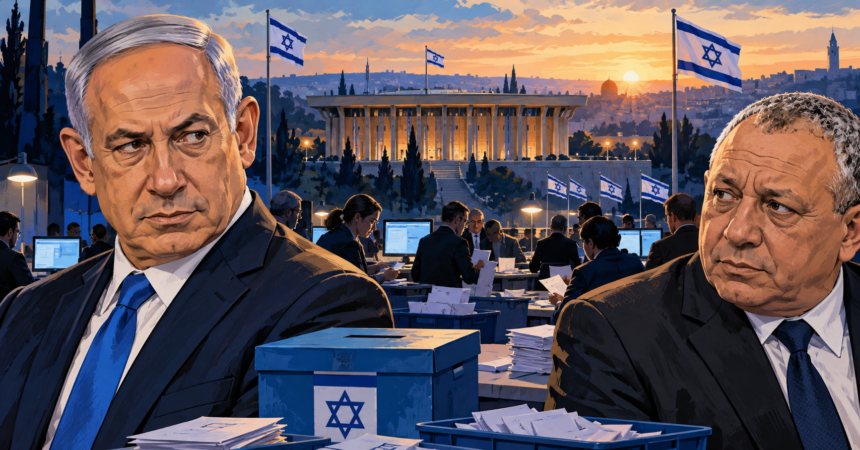
Israel’s election-night drama has taken a new turn. Benjamin Netanyahu’s bloc has moved ahead of Gadi Eisenkot’s opposition in projections based on the official partial vote count, reversing the picture suggested by the first exit polls. Yet neither camp has secured the 61 seats needed to form a government.
- Latest Israeli election results: 56–48–16
- From opposition celebrations to Netanyahu’s overnight comeback
- Likud remains the largest party, with Eisenkot’s Yashar second
- Netanyahu calls for a right-wing government
- Eisenkot insists voters demanded change
- Trump says his endorsement helped Netanyahu
- Record turnout and uncounted military ballots could still change the result
- What happens next in Israel?
Israel woke up on Wednesday, October 28, to a different political picture from the one that emerged when polling stations closed the previous evening.
With 66.2% of ballot boxes counted, figures published by Israel’s Central Elections Committee and reported by The Times of Israel indicate that Prime Minister Benjamin Netanyahu’s political bloc would hold 56 seats in the 120-member Knesset.
The bloc led by Gadi Eisenkot stands at 48 seats, while the two predominantly Arab parties are projected to secure a combined 16 seats.
These are provisional seat calculations based on partial official voting results, not certified seat allocations.
Latest Israeli election results: 56–48–16
According to the Central Elections Committee’s morning update at 9:20 a.m. Israel time, the parliamentary picture is:
| Political grouping | Projected seats |
|---|---|
| Netanyahu-led bloc | 56 |
| Eisenkot-led opposition bloc | 48 |
| Arab-led parties | 16 |
| Total | 120 |
A governing majority requires 61 seats.
Netanyahu’s bloc is therefore five seats short of that threshold, while Eisenkot’s bloc would need support from other parties to form a government.
The separate grouping of Arab-led parties should not be interpreted as an automatic coalition agreement with either camp.
The figures could still change substantially as the remaining ballots are processed.
From opposition celebrations to Netanyahu’s overnight comeback
The latest developments mark a significant shift from Tuesday night’s initial exit polls.
When Israel’s major broadcasters released their first projections, the political opposition appeared to hold a narrow advantage over Netanyahu’s existing coalition.
The initial figures suggested approximately 52 seats for the Jewish-led opposition bloc, 50 for Netanyahu’s bloc and 18 for the Arab-led parties.
The projections were subsequently revised, with broadcasters moving toward a much closer contest.
As official counting began, Netanyahu’s bloc gained ground in the provisional parliamentary calculations.
The partial count briefly suggested even larger advantages for the prime minister’s allies before the gap narrowed again as more polling stations reported.
By Wednesday morning, Netanyahu’s political bloc was ahead, but still lacked the parliamentary majority needed to secure another government.
Likud remains the largest party, with Eisenkot’s Yashar second
The official vote count also shows Netanyahu’s Likud leading the race between individual parties.
An Associated Press update based on approximately 60% of votes counted placed Likud at 21.4% and Eisenkot’s Yashar at 16.2%.
Those percentages refer to votes counted at that particular stage, rather than final national voting shares.
The distinction is important in Israel’s proportional representation system.
Winning the largest number of votes does not automatically give a party the right or ability to form a government. Parliamentary alliances, negotiations and the support of other elected parties ultimately determine who can govern.
Netanyahu calls for a right-wing government
Speaking to supporters in Jerusalem shortly after 3 a.m., Netanyahu called for the formation of a new right-wing government.
He argued that the election reflected substantial support for his political camp and said Israel needed a government capable of addressing its security challenges, including the confrontation with Iran.
Netanyahu also opposed the formation of any government dependent on support from Arab parties.
However, he did not declare a definitive electoral victory.
His speech came as the official vote count was still developing and the parliamentary distribution remained uncertain.
Eisenkot insists voters demanded change
Eisenkot, the former Israeli military chief who leads the centrist Yashar party, maintained that the election demonstrated public support for political change.
Addressing supporters in Tel Aviv, he called for a new political direction and promised to work toward forming a government.
His challenge is now increasingly focused on coalition arithmetic rather than the initial enthusiasm generated by the exit polls.
The Jewish-led opposition bloc does not currently have enough projected seats to govern independently.
Any attempt to establish an alternative administration could require negotiations involving Arab-led parties or other political groups outside the opposition’s established alliances.
Such an arrangement would present difficult political choices, particularly given disagreements among opposition parties over possible cooperation with Arab-led factions.
Trump says his endorsement helped Netanyahu
US President Donald Trump also commented on the developing election results.
Speaking to reporters on Wednesday, Trump said he had heard that Netanyahu performed well and suggested his late campaign endorsement had helped the Israeli prime minister.
Trump’s assessment reflects his own interpretation of the election. The precise electoral impact of his endorsement has not been independently established.
The American president’s comments underline the international significance of the vote, particularly for US-Israel relations and regional security policy.
Record turnout and uncounted military ballots could still change the result
Israel recorded turnout of approximately 77.7%, a substantial increase from the 2022 election.
The unusually high participation has added uncertainty to predictions based on historical voting patterns.
Another important factor is the counting of ballots submitted in double envelopes, including votes cast by military personnel.
These ballots are processed later than ordinary polling-station votes and could influence the final distribution of seats.
The electoral threshold of 3.25% also remains crucial.
Parties near that threshold can affect the seat allocation across the Knesset if they ultimately qualify for representation or fall short.
As of the morning update, the Reservists party and Ofer Winter’s People of Israel remained below the threshold.
What happens next in Israel?
The Central Elections Committee will continue counting and verifying ballots before the final official results are confirmed.
President Isaac Herzog will then consult political parties and select a candidate to attempt to form a government.
The candidate does not necessarily have to lead the single largest party. What matters is the prospect of obtaining sufficient parliamentary support.
Coalition negotiations may therefore become the decisive phase of this election.
For Netanyahu, the immediate objective is to turn his bloc’s current advantage into a viable governing majority.
For Eisenkot, the challenge is to determine whether parties opposed to Netanyahu can agree on a parliamentary arrangement that offers an alternative government.
Israel’s election has produced an emerging leader in the partial count, but not yet a confirmed governing majority.
The remaining ballots and subsequent coalition negotiations will determine whether Netanyahu stays in power or whether Eisenkot can assemble an alternative administration.
Follow Votendi’s Israel Election 2026 live results for the latest official vote count, Knesset seat calculations and coalition developments.
Sources: Israel Central Elections Committee, The Times of Israel – 66.2% count update, Reuters – Israel election results, Associated Press.
Updated October 28, 2026, based on results published at 9:20 a.m. Israel time. All seat figures are provisional calculations from a partial count and may change.