



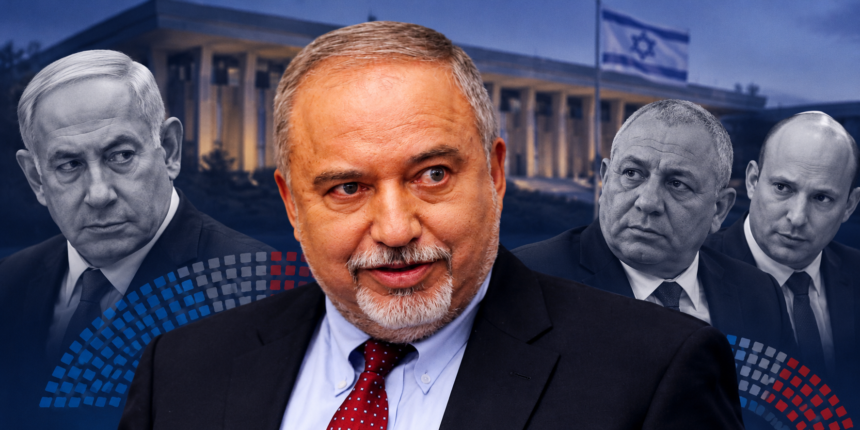
Israel’s post-election coalition crisis has deepened after reports that Avigdor Liberman has largely stopped communicating with fellow opposition leaders. His refusal to rely on Arab parties could leave Gadi Eisenkot one seat short of a parliamentary majority.
Israel’s opposition is facing a potentially decisive internal split just as the country begins navigating an uncertain coalition landscape following the October 27 election.
Avigdor Liberman, leader of Yisrael Beytenu, has reportedly reduced contact with his opposition partners and is not answering calls from Gadi Eisenkot or Naftali Bennett, according to a Channel 12 report cited by The Times of Israel on Wednesday evening.
The development threatens to complicate efforts to replace Prime Minister Benjamin Netanyahu, whose right-wing and religious bloc also remains short of a governing majority.
Liberman has reiterated two positions that are increasingly difficult to reconcile: he will not serve in a Netanyahu-led government, but he also refuses to support a minority government dependent on Arab parties.
Those conditions could prove decisive in a fragmented Knesset.
The coalition mathematics: Why seven seats matter
According to partial results released by Israel’s Central Elections Committee on October 28, Netanyahu’s bloc was projected to win 53 seats, while the opposition bloc led by Eisenkot held 48.
The predominantly Arab Joint List and Ra’am were projected to secure a combined 19 seats.
A parliamentary majority requires 61 of the Knesset’s 120 seats.
Under that distribution, Eisenkot’s bloc and the Arab parties would together control 67 seats, comfortably exceeding the majority threshold.
However, Liberman’s Yisrael Beytenu was projected to win seven seats.
If Liberman withheld his support, the remaining opposition parties and both Arab parties would have just 60 seats — one short of an absolute majority.
Even that calculation assumes cooperation among parties that have expressed significant political disagreements.
The figures remain provisional, with additional ballots still being counted.
Liberman’s position creates a political dilemma
According to the Channel 12 report, Liberman is maintaining his refusal to join Netanyahu while also rejecting an opposition minority government sustained by Arab-party support.
The report further suggests that Liberman expects mounting pressure on Eisenkot to enter a national unity government alongside Netanyahu and would prefer Eisenkot to make such a decision independently.
That does not mean Liberman himself has agreed to serve under Netanyahu. His own opposition to joining a Netanyahu-led government remains unchanged.
The distinction is important: Liberman appears willing to contemplate political arrangements he would not necessarily join himself.
His position also places pressure on Bennett, another opposition leader whose relationship with Arab-party participation could prove crucial to coalition negotiations.
The reported breakdown in communication follows earlier tensions among opposition parties over the composition of any future government.
Could Eisenkot and Netanyahu form a unity government?
A broad coalition between Eisenkot’s Yashar and Netanyahu’s Likud would offer a potential alternative to the parliamentary deadlock.
However, serious political obstacles remain.
Eisenkot has publicly ruled out serving in a Netanyahu-led government, including arrangements involving a rotation of the premiership.
A unity agreement would therefore require a significant shift in existing commitments and negotiations over leadership, policy and the future composition of the government.
There is currently no confirmed agreement between Eisenkot and Netanyahu.
Another possibility would be an opposition minority government supported from outside by Arab lawmakers, but that route would face opposition from Liberman and potentially other partners.
Failure to secure a workable coalition could prolong the caretaker government and potentially lead to another election.
What happens next?
President Isaac Herzog will play a central constitutional role once the election results are finalized, consulting parliamentary factions before assigning a candidate the task of forming a government.
The remaining vote count could still shift the precise distribution of seats, particularly as additional ballots are processed.
But the emerging political challenge extends beyond the numbers.
The parties opposed to Netanyahu may collectively possess enough parliamentary strength to deny him a straightforward majority, yet still lack agreement on how to establish an alternative government.
For Eisenkot, Liberman’s seven seats could therefore become one of the defining obstacles of the post-election negotiations.
The central question is no longer simply whether Netanyahu has lost his majority. It is whether the parties seeking to replace him can agree on a government of their own.
Follow Votendi’s Israel Election 2026 live results for updated vote counts, Knesset seat projections and coalition developments.