
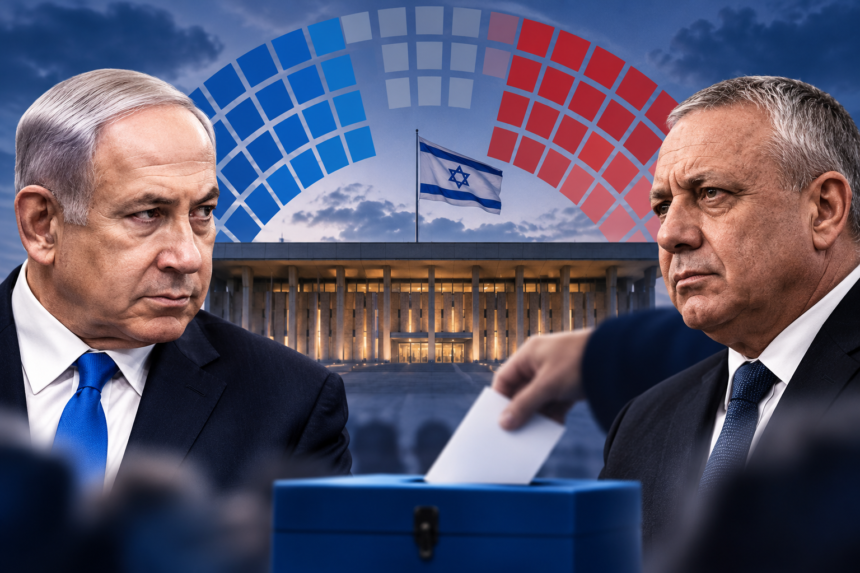
Three major television surveys show Gadi Eisenkot’s Yashar ahead of Benjamin Netanyahu’s Likud, while a fourth poll presents a substantially different parliamentary balance just days before Israel’s October 27 election.
Israel’s final pre-election opinion polls have produced contrasting pictures of the next Knesset, highlighting the uncertainty surrounding coalition formation ahead of Tuesday’s parliamentary election.
Surveys published by Kan 11, Channel 12 and Channel 13 on Friday, October 23, place Prime Minister Benjamin Netanyahu’s bloc at 50 seats in the 120-member parliament. Their projections for the principal opposition bloc range from 52 to 56 seats.
A separate i24NEWS survey conducted by Direct Polls presents a considerably different result: 59 seats for Netanyahu’s bloc, including four projected seats for Ofer Winter’s Amcha Israel party, compared with 47 for the bloc associated with Gadi Eisenkot.
None of the four surveys places either principal bloc independently above the 61-seat parliamentary majority threshold.
Final Israeli election polls: the numbers
| Pollster / Broadcaster | Kan 11 | Channel 12 | Channel 13 | i24NEWS |
|---|---|---|---|---|
| Yashar (Eisenkot) | 22 | 23 | 22 | 21 |
| Likud (Netanyahu) | 20 | 21 | 19 | 26 |
| B’Yachad (Bennett) | 14 | 15 | 14 | 12 |
| Netanyahu-aligned bloc | 50 | 50 | 50 | 59 |
| Principal opposition bloc | 52 | 56 | 54 | 47 |
| Arab parties | 14 | 14 | 16 | 14 |
| Other / unaligned | 4 | 0 | 0 | 0 |
Figures represent projected Knesset seats, not vote percentages. Bloc classifications follow the respective broadcasters and are not necessarily indicators of agreed coalition arrangements. The i24NEWS survey was conducted on October 22; the three other final television surveys were published on October 23.
Eisenkot leads in three polls, while i24NEWS puts Likud first
Gadi Eisenkot’s Yashar party is projected to be the largest single party in the final surveys from Kan 11, Channel 12 and Channel 13.
Channel 12 gives Yashar 23 seats against 21 for Likud. Kan 11 reports 22 seats for Yashar and 20 for Likud, while Channel 13 projects 22 and 19 respectively.
Naftali Bennett’s B’Yachad ranks third in all three surveys, receiving between 14 and 15 seats.
The picture changes substantially in the i24NEWS/Direct Polls survey, where Likud receives 26 seats, Yashar 21 and B’Yachad 12.
The differences between the four surveys should not be interpreted as evidence of a sudden shift in voter preferences. They represent separate measurements using different sampling approaches and seat-allocation models.
The coalition question: why 61 seats matters
Israel’s proportional electoral system requires a parliamentary majority of at least 61 lawmakers to establish a government.
In the three major television polls, Netanyahu’s aligned parties receive 50 seats, leaving them 11 short of that threshold.
The opposition’s position is more complicated. Although the three surveys give its principal Zionist parties between 52 and 56 seats, these totals do not automatically include the Arab parties, which receive between 14 and 16 seats.
Kan 11 also projects four seats for the Reservists-Economic Party led by Yoaz Hendel and Yaron Zelekha, classifying those seats outside the two principal blocs.
A numerical majority involving several parties does not necessarily amount to a politically viable coalition. Party leaders’ positions on potential governing partners remain an important consideration.
Small parties and the 3.25% electoral threshold
One of the most consequential differences between the final surveys concerns parties polling close to Israel’s 3.25% electoral threshold.
Ofer Winter’s Amcha Israel receives:
- 2.9% in the Kan 11 survey
- 2.5% in the Channel 12 survey
- 3.1% in the Channel 13 survey
All three figures place the party below the threshold, meaning it receives no projected parliamentary seats.
By contrast, Direct Polls projects Amcha Israel entering the Knesset with four seats, contributing to its 59-seat estimate for Netanyahu’s bloc.
The Reservists-Economic Party faces a similar uncertainty. Kan 11 gives the party four seats, while Channel 12 measures its support at 2.4% and Channel 13 at 3.0%, both below the threshold.
Because votes for parties that fail to qualify do not translate into seats, relatively small differences around the threshold can significantly affect the overall distribution of the Knesset.
Different samples and methodologies
The four surveys were conducted by separate polling organisations.
Kan 11’s final Kantar survey included 1,006 respondents. Channel 12’s Midgam survey, conducted with iPanel on October 22–23, included 1,018 respondents and used online and telephone interviews.
Channel 13’s research involved 1,875 respondents and was conducted by HaMadad in cooperation with additional research partners.
Direct Polls surveyed 5,124 adults for i24NEWS on October 22, using a digital sampling system combined with a panel.
Larger samples can reduce sampling uncertainty, but sample size alone does not determine a poll’s accuracy. Recruitment methods, weighting, nonresponse and turnout assumptions also affect results. Published margins of error concern measured survey estimates and should not be treated as direct margins of error for projected Knesset seats.
For that reason, the surveys should be examined individually rather than treating their seat differences as precise changes in electoral support.
What happens next?
Israelis vote on Tuesday, October 27, to elect the 120 members of the Knesset.
The final surveys leave several questions unresolved: which parties will cross the electoral threshold, how turnout will vary between voter groups, and whether the elected parties can agree on a governing majority.
The largest party does not automatically form the government. The parliamentary arithmetic and subsequent coalition negotiations will determine whether a viable majority can be assembled.
Votendi will continue following the election through its Israel Election 2026 hub, including published polls, the election calendar and political developments.
Sources and methodology
This analysis compares four published surveys, without calculating a proprietary polling average.
Primary and supporting sources:
- Channel 12 / Midgam — final poll, October 23
- Channel 13 — final election survey, October 23
- i24NEWS / Direct Polls — final survey
- Ynet — final Kan 11, Channel 12 and Channel 13 poll results
Published October 24, 2026. Polling figures are snapshots of voter intentions and projected parliamentary representation, not election results or forecasts by Votendi.