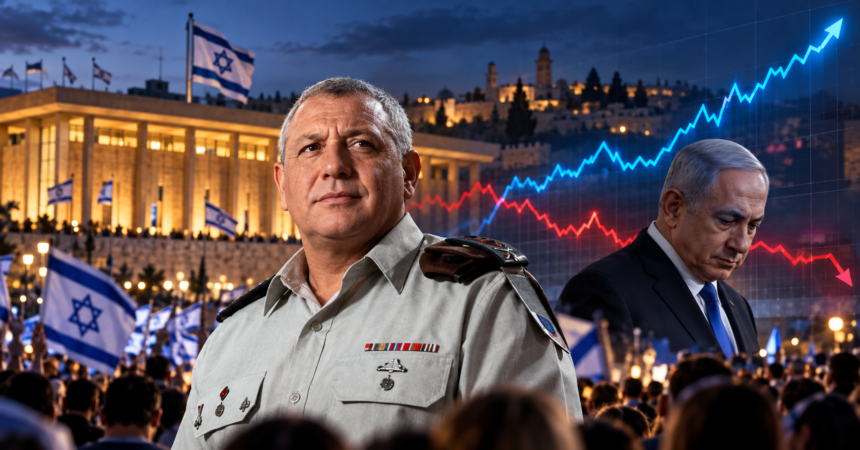
Former Israeli military chief Gadi Eisenkot has emerged as the leading name on Polymarket’s market for Israel’s next prime minister, with traders assigning him approximately 52% implied probability compared with 28% for incumbent Benjamin Netanyahu. The development comes just two days before Israel’s October 27 parliamentary election, as final opinion polls point to a fragmented Knesset and difficult coalition negotiations.
- Polymarket traders put Eisenkot ahead of Netanyahu
- Final election polls show Eisenkot’s Yashar ahead of Likud
- Why becoming prime minister is more complicated than winning the election
- Coalition negotiations could determine Israel’s political future
- Election follows an intense period of political debate
- What happens on October 27?
- Sources
With Israel preparing to elect its 26th Knesset on Tuesday, October 27, prediction markets are attracting renewed attention as voters consider the possibility of a change in government.
A Sunday, October 25 snapshot of Polymarket’s market titled “Prime Minister of Israel after the next election?” showed Gadi Eisenkot, the former Israel Defense Forces chief of staff and leader of the Yashar party, at approximately 52%.
Prime Minister Benjamin Netanyahu stood at approximately 28%, while former prime minister Naftali Bennett was trading in the low teens.
The market had recorded more than $52 million in cumulative trading volume.
However, these figures represent market-implied probabilities, not voter support, official projections or confirmed election outcomes.
Polymarket traders put Eisenkot ahead of Netanyahu
The gap between Eisenkot and Netanyahu reflects how prediction-market participants are pricing the possibility of Israel’s next government being led by someone other than the incumbent prime minister.
Polymarket allows participants to buy and sell contracts linked to future outcomes. The resulting prices are commonly interpreted as implied probabilities, although they can change quickly depending on trading activity, liquidity and incoming information.
The market specifically asks who will become Israel’s prime minister following the election.
It does not measure which party will receive the most votes, which list will secure the most parliamentary seats or whether a particular coalition has already been agreed upon.
A 52% market price for Eisenkot therefore does not mean that 52% of Israelis intend to vote for his party.
The market prices also do not establish that a transfer of power is inevitable.
View the Polymarket market for Israel’s next prime minister.
Final election polls show Eisenkot’s Yashar ahead of Likud
The latest prediction-market figures come against a backdrop of opinion polls placing Eisenkot’s Yashar party ahead of Netanyahu’s Likud in several major surveys.
According to a comparison of the final polls published by The Jerusalem Post on October 25, the race remains closely contested at the party level.
The final Maariv poll gives Yashar 21 seats, compared with 19 for Likud.
Channel 13 places Yashar at 22 and Likud at 19.
A KAN 11 survey projects 22 seats for Yashar and 20 for Likud.
Channel 12 gives Eisenkot’s party 23 seats against 21 for Netanyahu’s Likud.
Although Yashar leads in these surveys, the wider parliamentary picture remains considerably more complicated.
In the Maariv poll, Netanyahu’s bloc receives 48 seats, compared with 54 for the principal opposition bloc.
Channel 13 projects 50 seats for Netanyahu’s bloc and 54 for the opposition.
Channel 12 gives Netanyahu’s bloc 50 seats and the opposition 56, with Arab-majority parties holding the remaining 14.
These estimates reflect different polling methodologies and assumptions about political alliances.
None of the main blocs reaches the 61 seats required for an outright majority in the 120-member Knesset.
Readers can compare the latest available surveys and electoral context in the Votendi Israel Election 2026 Hub.
Why becoming prime minister is more complicated than winning the election
Israel’s prime minister is not directly elected by voters.
Instead, Israelis elect party lists to the 120-seat Knesset through a proportional representation system.
After the results are formally published, President Isaac Herzog consults the parliamentary factions and selects a Knesset member to attempt to form a government.
The selected candidate is normally given 28 days to negotiate a coalition, with the possibility of an extension of up to 14 additional days.
Importantly, the politician entrusted with forming the government does not necessarily have to lead the largest party.
What matters is the ability to assemble sufficient parliamentary support and obtain the Knesset’s confidence.
This distinction is particularly relevant to the 2026 election.
Even if Eisenkot’s Yashar becomes the largest party, he would still need to negotiate support from other factions.
Similarly, Netanyahu could remain prime minister if he manages to assemble a parliamentary majority or continues in a caretaker capacity while government formation remains unresolved.
The election result and the identity of the next prime minister are therefore separate questions.
Coalition negotiations could determine Israel’s political future
The final pre-election surveys indicate that neither Netanyahu’s existing political alliance nor the principal opposition parties can automatically rely on a parliamentary majority.
That leaves several potential factors influencing the post-election negotiations.
Naftali Bennett’s B’Yachad party, Avigdor Lieberman’s Yisrael Beytenu and other opposition factions could play significant roles in negotiations over a possible alternative government.
The parliamentary representation of Arab-majority parties could also become important, depending on the positions taken by potential coalition partners.
Another crucial issue is Israel’s electoral threshold of 3.25%.
Several smaller electoral lists have been polling close to that threshold. Whether they enter the Knesset could materially affect the distribution of parliamentary seats and the possible combinations of coalition partners.
These uncertainties help explain why a prediction market focused on the next prime minister can produce a different picture from polls measuring support for individual parties.
Election follows an intense period of political debate
Tuesday’s vote comes after a campaign shaped by national security, the October 7, 2023 attacks, military conscription, institutional accountability and the future of Netanyahu’s leadership.
Eisenkot, a former IDF chief of staff, has called for a state commission of inquiry into the failures surrounding the October 7 attacks and has emphasized security and military-service issues.
Netanyahu and Likud have campaigned on their record in government and their approach to national security, while rival parties have presented different proposals on governance and the country’s political direction.
Mass demonstrations in Tel Aviv on Saturday, October 24, also highlighted continuing public demands for an independent investigation into the events surrounding October 7.
The election will determine the balance of parliamentary representation, but the subsequent government-formation process could extend well beyond election night.
What happens on October 27?
Israelis will vote on Tuesday, October 27, with polling stations scheduled to close at 22:00 Israel time (20:00 UTC).
Exit polls are expected after voting ends, followed by official vote counting and the allocation of Knesset seats.
The central questions will be whether Yashar finishes ahead of Likud, how the smaller parties perform relative to the electoral threshold and whether any parliamentary grouping can assemble enough support to form a government.
Polymarket prices may react rapidly as new information becomes available, but those movements should remain clearly distinguished from verified election results.
At approximately 52%, Eisenkot’s Polymarket quotation represents a substantial market-implied probability of becoming Israel’s next prime minister. It is not confirmation that he will succeed Netanyahu.
Votendi will continue tracking the final polling picture, election-night developments and the parliamentary arithmetic behind the formation of Israel’s next government.
Sources
Polymarket – Prime Minister of Israel after the next election?
The Jerusalem Post – Final election polls and coalition comparison, October 25
The Times of Israel – Final polls show both blocs short of a majority
Israel Democracy Institute – How governments are formed after elections