
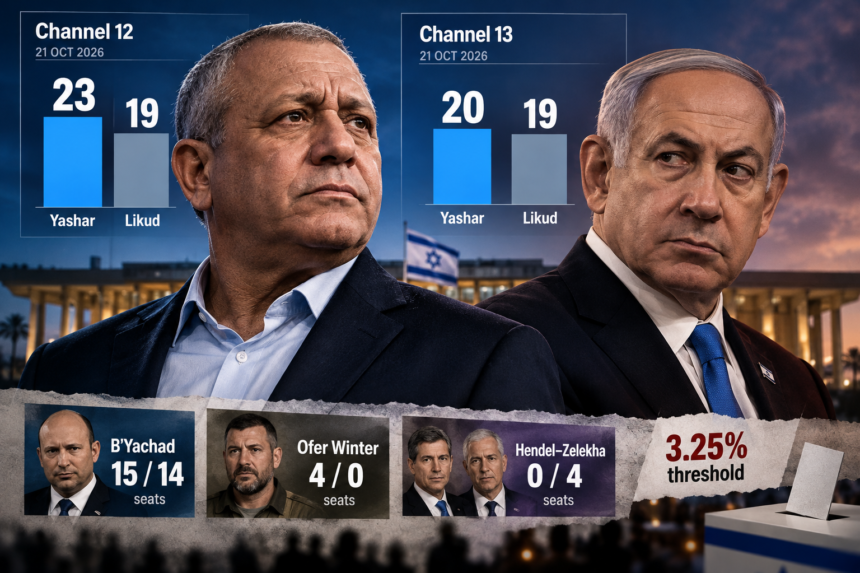
Two polls published on October 21 place Gadi Eisenkot’s Yashar ahead of Benjamin Netanyahu’s Likud, but conflicting results for smaller parties underline the uncertainty over Israel’s next parliamentary majority.
With Israel’s October 27 Knesset election just five days away, two new television polls have placed Gadi Eisenkot’s Yashar party ahead of Prime Minister Benjamin Netanyahu’s Likud.
Channel 12 projects 23 seats for Yashar and 19 for Likud, while Channel 13 gives Eisenkot’s party 20 seats and Netanyahu’s 19.
Yet the most consequential differences between the surveys concern two smaller electoral lists hovering around Israel’s 3.25% threshold. Their inclusion or exclusion changes the distribution of seats among the competing political blocs.
Two polls, two different parliamentary maps
Channel 12’s October 21 survey, conducted by Midgam under Mano Geva, gives Yashar a four-seat advantage over Likud. Naftali Bennett’s B’Yachad follows with 15 seats.
The main Zionist opposition parties receive a combined 55 seats, Netanyahu’s bloc 51, and the Arab parties 14.
Channel 13 presents a narrower gap between the two largest parties. Yashar receives 20 seats, Likud 19 and Bennett’s B’Yachad 14.
Its bloc breakdown is also different: the Zionist opposition receives 52 seats, Netanyahu’s bloc 49, the Arab parties 15, and the Hendel–Zelekha alliance four seats outside those three groupings.
| Party or bloc | Channel 12 | Channel 13 |
|---|---|---|
| Yashar – Gadi Eisenkot | 23 | 20 |
| Likud – Benjamin Netanyahu | 19 | 19 |
| B’Yachad – Naftali Bennett | 15 | 14 |
| Netanyahu bloc | 51 | 49 |
| Main Zionist opposition | 55 | 52 |
| Arab parties | 14 | 15 |
| Hendel–Zelekha | Below threshold | 4 |
Seat projections in the 120-member Knesset. Results from individual surveys, not a Votendi polling average or an election forecast.
The 3.25% threshold could reshape the Knesset
The sharpest disagreement concerns Ofer Winter’s Amcha Israel and the Reservists–Economic alliance associated with Yoaz Hendel and Yaron Zelekha.
In the Channel 12 poll, Winter’s party crosses the electoral threshold and receives four projected seats. Hendel and Zelekha remain outside the Knesset on 2.8% of the vote.
Channel 13 finds almost the reverse.
Winter’s party receives 3.2%, narrowly below the required 3.25%, and therefore receives no seats. Hendel and Zelekha clear the threshold with 3.6%, securing four projected seats.
This difference matters because Israel does not allocate parliamentary seats to parties falling below the threshold. Their votes are excluded from the seat-allocation calculation, redistributing representation among qualifying lists.
A movement of only a few tenths of a percentage point can therefore change the Knesset arithmetic without a similarly dramatic change in the larger parties’ support.
The largest party is not necessarily the next government
Neither Channel 12 nor Channel 13 gives the main Zionist opposition bloc an outright majority of 61 seats.
Channel 12 puts that bloc six seats short, while Channel 13 leaves it nine seats short.
The Arab parties and the Hendel–Zelekha alliance could be relevant to post-election parliamentary negotiations, but their seats cannot automatically be counted as support for a particular government.
That distinction is central to understanding Israel’s electoral system. A party can win the largest number of seats without securing the parliamentary agreements required to form a government.
Votendi has examined this issue in its earlier analysis of Eisenkot’s coalition challenge.
Channel 14 presents a sharply different picture
The October 21 surveys are not unanimous.
A separate Channel 14 poll by NEXT DATA places Likud on 30 seats, Yashar on 20 and Bennett’s B’Yachad on 10.
In that survey, Netanyahu’s bloc receives 62 seats, one above the threshold for a parliamentary majority.
The gap between the television polls highlights the importance of comparing individual polling organisations rather than treating any single survey as a definitive national result.
Differences in samples, methodology, assumptions about turnout and the treatment of smaller parties can all contribute to varying seat projections.
What the latest polls tell us before October 27
Channel 12 and Channel 13 agree that Yashar leads Likud in their respective seat projections. They also agree that neither of the two principal Zionist political blocs has reached 61 seats on its own.
They differ on which smaller list qualifies for parliamentary representation, illustrating why the electoral threshold is one of the most important variables in the final days of campaigning.
The next questions are whether Winter or Hendel–Zelekha consistently cross the threshold in subsequent polling, how their inclusion changes the bloc totals, and whether the parties can translate parliamentary arithmetic into workable political agreements.
Follow the latest individual seat polls, party-list developments and election context in Votendi’s Israel 2026 election hub.
Sources and methodology
- Channel 12 / N12, October 21, 2026 — Midgam / Mano Geva; 505 respondents; internet and telephone interviews; reported maximum sampling error ±4.4 percentage points.
- Channel 13, October 21, 2026 — HaMadad and partner research organisations; 1,084 respondents; reported sampling error ±3 percentage points.
- Channel 14 results, October 21, 2026 — NEXT DATA / Shlomo Filber; separate survey used to illustrate the disagreement among polling outlets.
Data checked October 22, 2026. All seat figures are individual poll projections, not official election results. Votendi does not publish a proprietary Israel seat forecast.